
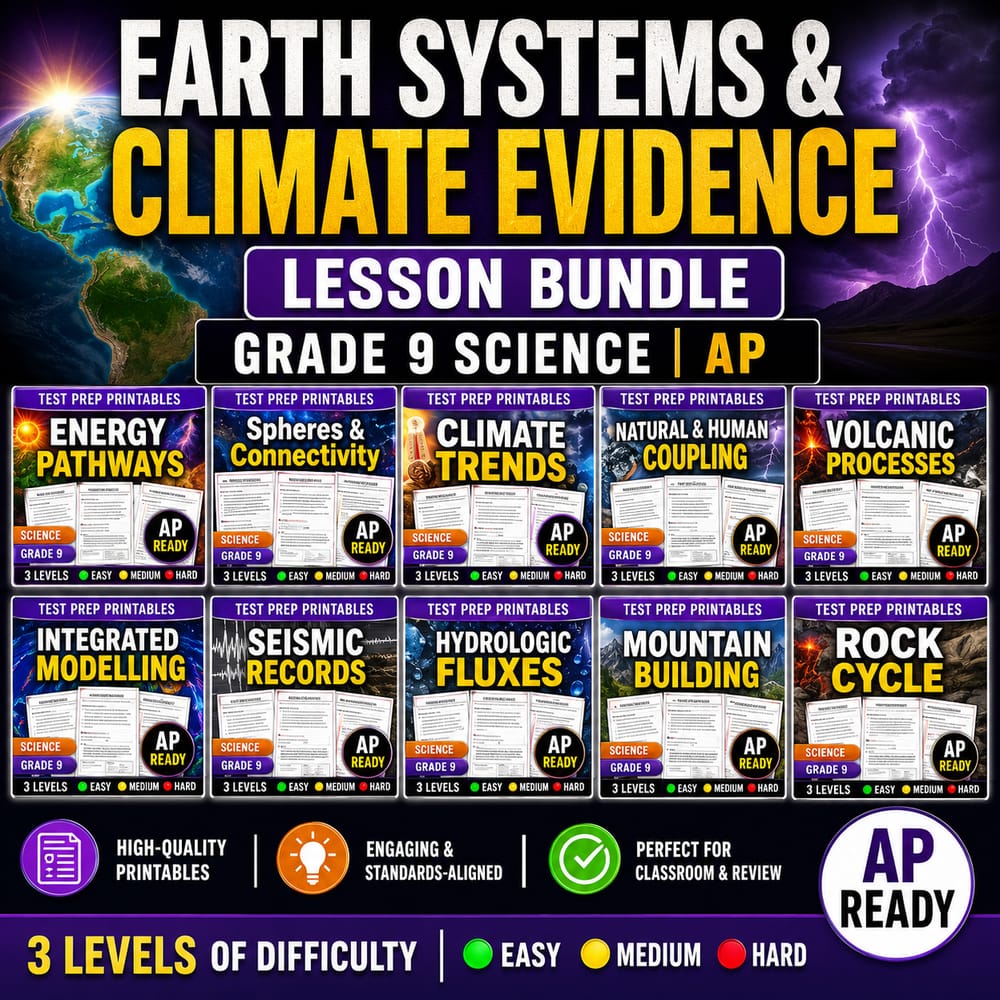


Earth Systems & Climate Evidence Lesson Bundle | Grade 9 Science | AP
$56.00$70.00Save $14.00
Prism Point Learning
·2 followers·13 sales
SubjectScienceGradeGrade 9
What’s included
14 worksheets · Save $14.00 (20%) · prices shown inside the bundle
 Energy Pathways Worksheet Grade 9 Science Activity | AP Climate Systems
- Explain how energy transfers such as radiation, conduction, and convection move heat through the atmosphere and oceans.
- Interpret global energy budget ideas to predict how differential heating drives circulation and weather variability.
- Connect energy partitioning to observable climate indicators like surface temperature patterns and sea surface temperature anomalies.
$4.00$5.00 Spheres Connectivity Worksheet for Grade 9 Science | AP Earth Systems
- Explain how the geosphere, hydrosphere, atmosphere, and biosphere interact through matter and energy exchanges.
- Use causal chains and mass-balance thinking to describe how nutrients, gases, and productivity move between Earth systems.
- Interpret coupled phenomena (such as river nutrient transport and ocean upwelling) using cross-domain models.
$4.00$5.00 Climate Trends Worksheet for Grade 9 AP Science Data Analysis Activities
- Analyze spatial and temporal climate data to identify trends and anomalies in temperature and precipitation
- Use evidence-based reasoning to separate long-term climate change from internal variability
- Interpret potential climate drivers by comparing observations with greenhouse gas and volcanic aerosol forcings
$4.00$5.00 Ocean-Atmosphere Coupling Worksheet for Grade 9 AP Science Practice
- Explain how changes in ocean sea surface temperature and ocean heat content can influence atmospheric convection and circulation.
- Describe how ENSO-related anomalies create teleconnections that affect regional climate patterns.
- Use time-lag and energy-budget reasoning to connect ocean variability to weather and longer-term climate signals.
$4.00$5.00 Volcanic Processes Worksheet for Grade 9 Science | AP Earth Science
- Explain how magma composition and tectonic setting influence volcanic eruption style and hazard potential.
- Compare effusive shield volcanism and explosive stratovolcano behavior using magma viscosity and volatile content.
- Use volcanic gas emissions and basic eruption timelines to describe how volcanoes modify landscapes and can affect climate.
$4.00$5.00 Integrated Modeling Worksheet for Grade 9 AP Science Systems Analysis
- Explain how integrated models couple geosphere, hydrosphere, atmosphere, and biosphere processes to simulate environmental change.
- Describe how parameter sensitivity and uncertainty propagation affect model projections.
- Use indicator metrics to compare hypotheses and interpret multi-variable model outputs across space and time.
$4.00$5.00 Seismic Records Worksheet for Grade 9 Science | AP Earth Science Activity
- Interpret P-wave and S-wave arrival times to determine relative event characteristics and estimate travel-time patterns.
- Use earthquake waveforms and frequency/amplitude features to infer differences between shallow and deep events.
- Connect epicenter maps and seismicity patterns to tectonic environments and surface hazard risks.
$4.00$5.00 Hydrologic Fluxes Worksheet Grade 9 Science Activity | AP Water Cycle
- Use a water-budget framework to describe how precipitation, evapotranspiration, runoff, infiltration, and storage control streamflow variability.
- Interpret discharge hydrographs and groundwater level records to infer how changes in recharge and withdrawals affect aquifer sustainability.
- Connect altered hydrologic fluxes to geomorphic responses such as channel adjustment and sediment yield.
$4.00$5.00 Mountain Building Worksheet for Grade 9 AP Science | Plate Tectonics
- Explain how plate convergence leads to crustal shortening, crustal thickening, and metamorphism during orogeny.
- Describe how isostatic adjustment and uplift change topography and influence erosion patterns.
- Use evidence from structural cross sections and thermochronology to link deep processes to surface landscape evolution.
$4.00$5.00 Rock Cycle Worksheet for Grade 9 Science | AP Earth Science Activity
- Explain how melting, crystallization, weathering, transport, deposition, and metamorphism transform rocks over geologic time.
- Identify physical and chemical mechanisms that drive rock changes and describe how these connect to tectonic settings.
- Use rock-cycle ideas and evidence from rock types to connect rock histories to landscape evolution and resource occurrence.
$4.00$5.00
Reviews & Feedback
Loading reviews...
Questions & Answers
Loading questions…
About this bundle
Related categories
Frequently asked questions
Who is Earth Systems & Climate Evidence Lesson Bundle | Grade 9 Science | AP designed for?
Earth Systems & Climate Evidence Lesson Bundle | Grade 9 Science | AP is designed for Grade 9 students and Science learners and can be used in classrooms, homeschool, or independent practice.
How do I download Earth Systems & Climate Evidence Lesson Bundle | Grade 9 Science | AP?
Add it to your cart and complete checkout. After payment, you can download immediately from your account, and you'll also receive a download link by email.
Similar Products

Earth Systems: Tectonics & Climate Lesson Bundle | Grade 9 Science NGSS
$22.40$28.00

Grade 10 Earth Science Worksheets Bundle | Climate & Earth Systems
$19.20$24.00

Grade 12 Science Lesson Bundle: Space, Earth Systems, and Climate (General)
$16.00$20.00

Earth Systems, Climate, and Sustainability Lesson Bundle | Grade 10 Science | Alberta
$36.00$45.00

Grade 6 Science Earth Systems & Climate Lesson Bundle | NGSS
$24.00$30.00