

New Year's Day Coloring Bookmarks Activity | Printable Reading Bookmarks
 Created byElena Brooks
Learning Objectives
- Identify New Year's Day as the theme of a seasonal activity
- Select colors to personalize a New Year's Day bookmark
- Complete a holiday-themed bookmark through coloring
Instant download
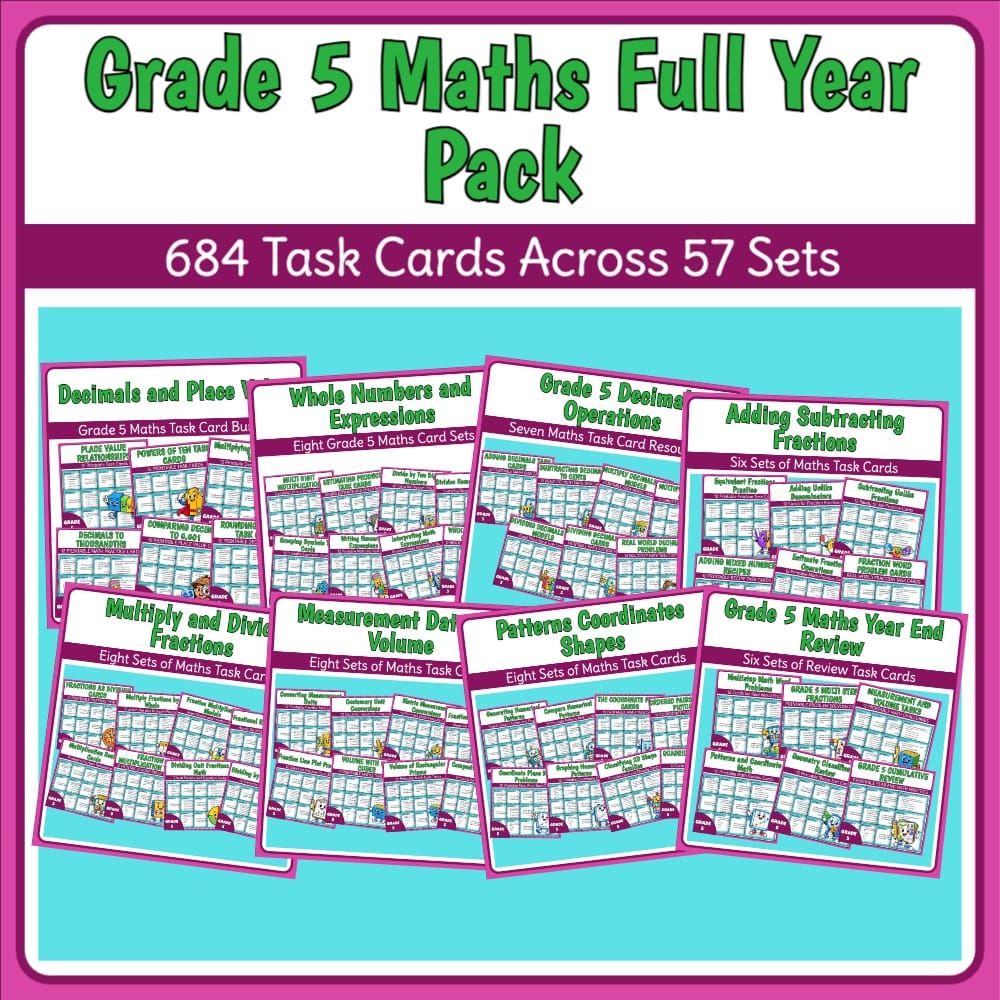
Grade 5 Maths Task Cards Full Year Bundle | 684 Cards, 57 Resources
Created byElena BrooksWith 684 Grade 5 Maths task cards across 57 resources, this full year bundle gives you 12 cards per set for practising key skills at different points in the school year. The eight lesson groups cover decimal place value, whole-number operations, fractions, measurement, data, patterns and geometry, with separate review sets for revisiting earlier work. Instea…
Instant download
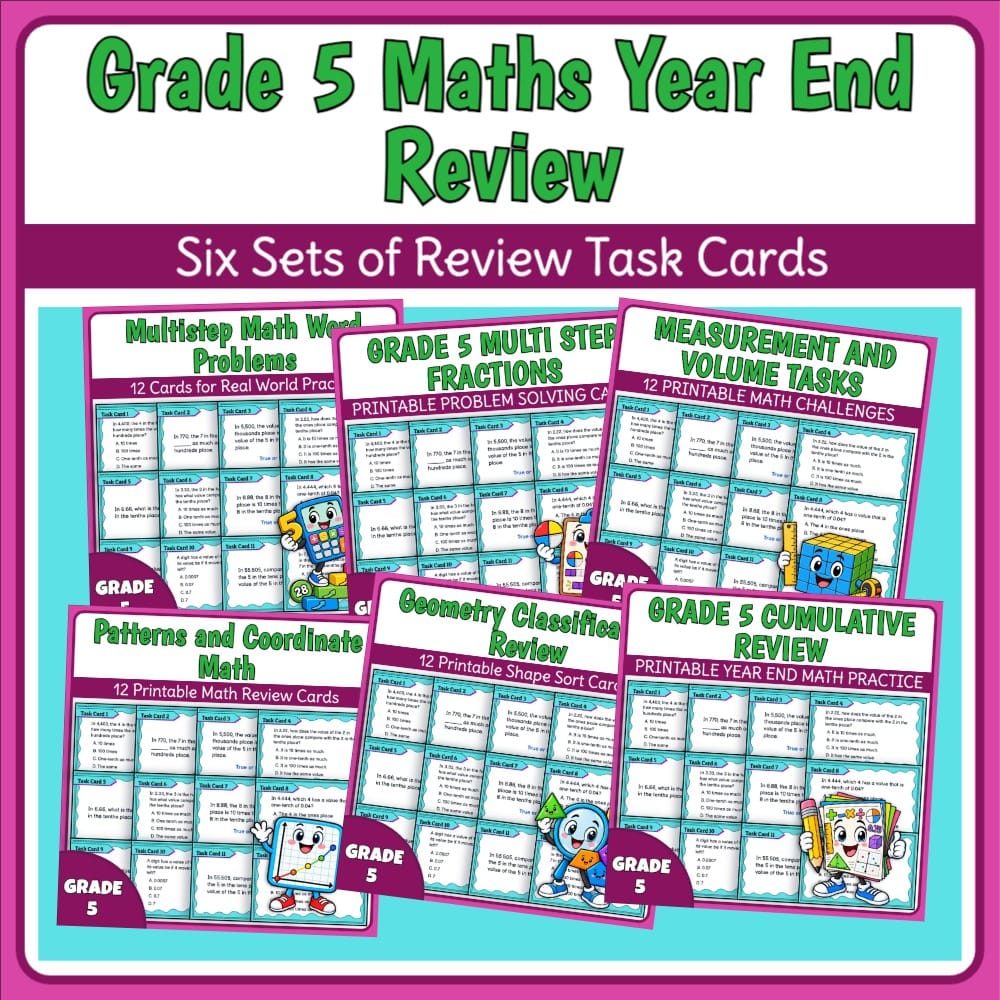
Grade 5 Maths End of Year Review and Problem Solving Task Cards Bundle
Created byElena BrooksWhen it's time to review Grade 5 Maths, students need practice that goes beyond repeating basic calculations. This Grade 5 Maths review task cards bundle includes six resources covering multi-step word problems, fractions, decimals, whole numbers, measurement, volume, geometry and numerical patterns. The sets let you revisit individual topics while also givi…
Instant download

Grade 5 Math Cumulative Review Task Cards | End of Year Skills Practice
Created byElena BrooksLearning Objectives
- Identify decimal place values and recognize equivalent decimal representations.
- Calculate products and quotients using whole numbers and decimals.
- Solve fraction addition and fraction division problems accurately.
Also included in: Grade 5 Maths End of Year Review and Problem Solving Task Cards Bundle +1 more
Instant download

Geometry Classification Task Cards | Grade 5 Shape Properties Review
Created byElena BrooksLearning Objectives
- Identify polygons using their numbers of sides and vertices.
- Classify quadrilaterals using angles, side lengths, and parallel sides.
- Compare the defining properties of squares, rectangles, and rhombuses.
Also included in: Grade 5 Maths End of Year Review and Problem Solving Task Cards Bundle +1 more
Instant download

Grade 5 Number Patterns and Coordinate Geometry Review Task Cards
Created byElena BrooksLearning Objectives
- Generate numerical sequences using addition and multiplication rules.
- Identify relationships between corresponding terms in two numerical patterns.
- Interpret ordered pairs using x-coordinates and y-coordinates.
Also included in: Grade 5 Maths End of Year Review and Problem Solving Task Cards Bundle +1 more
Instant download

Measurement and Volume Task Cards | Grade 5 Maths Problem Solving Review
Created byElena BrooksLearning Objectives
- Convert metric lengths, masses, and capacities between related units.
- Calculate rectangular prism volume using length, width, and height.
- Determine volume by reasoning about unit cubes.
Also included in: Grade 5 Maths End of Year Review and Problem Solving Task Cards Bundle +1 more
Instant download

Grade 5 Multi-Step Fraction Word Problems Review | Printable Task Cards
Created byElena BrooksLearning Objectives
- Calculate sums and differences of fractions with unlike denominators.
- Solve multiplication problems involving fractions and mixed-number quantities.
- Divide whole-number measurements into equal fractional-sized portions.
Also included in: Grade 5 Maths End of Year Review and Problem Solving Task Cards Bundle +1 more
Instant download

Multi-Step Whole Number and Decimal Word Problems Task Cards | Grade 5
Created byElena BrooksLearning Objectives
- Solve multi-step word problems involving whole numbers and decimals.
- Select appropriate arithmetic operations for real-world mathematical situations.
- Calculate decimal totals, differences, products, and quotients accurately.
Also included in: Grade 5 Maths End of Year Review and Problem Solving Task Cards Bundle +1 more
Instant download
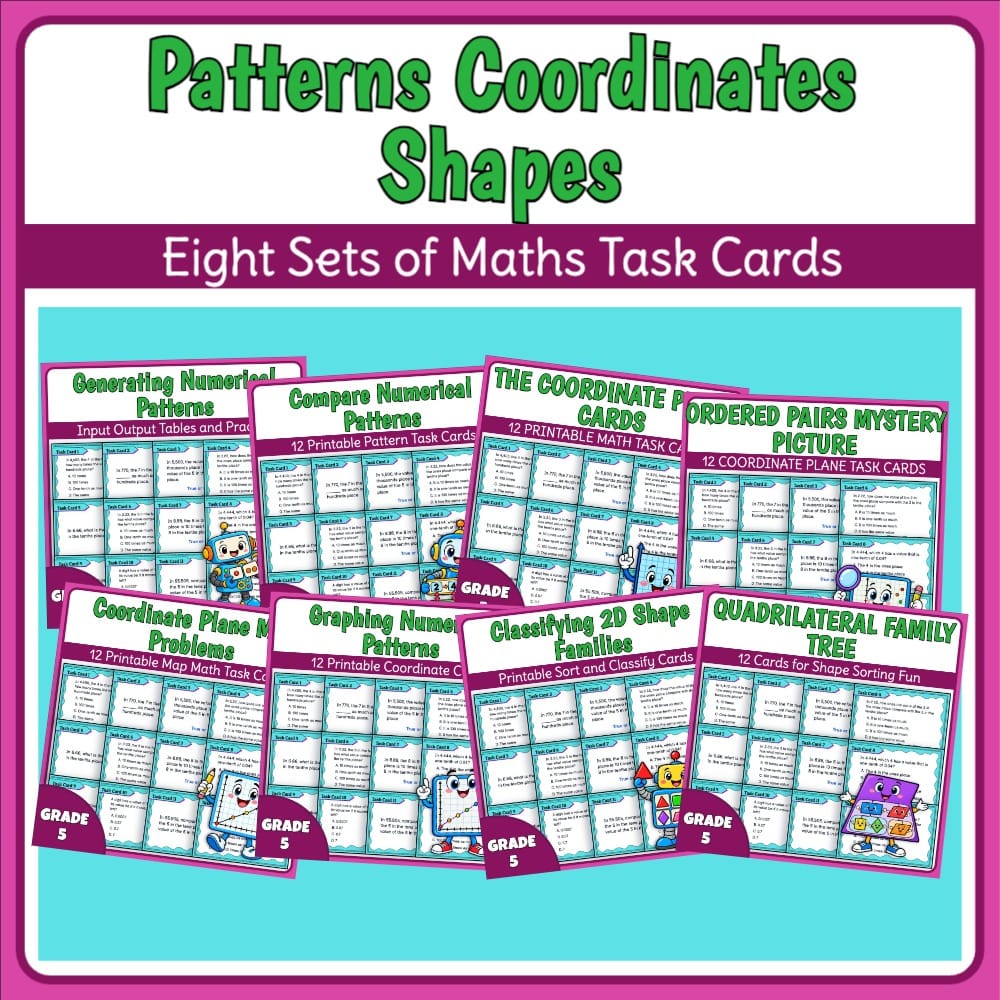
Grade 5 Maths Task Cards Bundle – Patterns, Coordinates and 2D Figures
Created byElena BrooksTeaching numerical patterns, coordinate planes and shape classification in Grade 5 Maths involves several different skills. This bundle contains eight sets of Grade 5 Maths task cards covering generating and comparing patterns, plotting ordered pairs, graphing coordinates and classifying two-dimensional figures. The separate sets help you choose practice tha…
Instant download

Hierarchy of Quadrilaterals Task Cards | Grade 5 Geometry Review
Created byElena BrooksLearning Objectives
- Identify quadrilaterals using sides, angles, and parallel lines.
- Classify rectangles, rhombuses, squares, and parallelograms by their properties.
- Organise quadrilaterals into a hierarchy from general to specific.
Also included in: Grade 5 Maths Task Cards Bundle – Patterns, Coordinates and 2D Figures +1 more
Instant download

Classifying 2D Figures Task Cards | Grade 5 Geometry Shape Classification
Created byElena BrooksLearning Objectives
- Identify polygons using their defining geometric attributes.
- Classify quadrilaterals by sides, angles and parallel relationships.
- Compare properties of squares, rectangles, rhombuses and parallelograms.
Also included in: Grade 5 Maths Task Cards Bundle – Patterns, Coordinates and 2D Figures +1 more
Instant download

Graphing Numerical Patterns Task Cards | Grade 5 Maths Coordinate Practice
Created byElena BrooksLearning Objectives
- Generate corresponding terms from two numerical patterns.
- Construct ordered pairs using matching terms from numerical sequences.
- Identify coordinate relationships on a first-quadrant graph.
Also included in: Grade 5 Maths Task Cards Bundle – Patterns, Coordinates and 2D Figures +1 more
Instant download

Coordinate Plane Task Cards – Grade 5 Maths Map Problems Practice
Created byElena BrooksLearning Objectives
- Identify x- and y-coordinates in first-quadrant ordered pairs.
- Determine ordered pairs from horizontal and vertical movements.
- Interpret coordinate values to describe locations on maps.
Also included in: Grade 5 Maths Task Cards Bundle – Patterns, Coordinates and 2D Figures +1 more
Instant download

Plotting Ordered Pairs Task Cards | Grade 5 Coordinate Plane Practice
Created byElena BrooksLearning Objectives
- Identify the x-coordinate and y-coordinate in an ordered pair.
- Interpret coordinates as horizontal and vertical distances from the origin.
- Describe first-quadrant point locations using coordinate movements.
Also included in: Grade 5 Maths Task Cards Bundle – Patterns, Coordinates and 2D Figures +1 more
Instant download

Coordinate Plane Task Cards Grade 5 Math | Ordered Pairs and Axes Practice
Created byElena BrooksLearning Objectives
- Identify the horizontal x-axis and vertical y-axis on coordinate planes.
- Locate the origin and recognise its coordinates as (0, 0).
- Distinguish x-coordinate values from y-coordinate values in ordered pairs.
Also included in: Grade 5 Maths Task Cards Bundle – Patterns, Coordinates and 2D Figures +1 more
Instant download

Comparing Numerical Patterns Task Cards | Grade 5 Maths Practice
Created byElena BrooksLearning Objectives
- Generate numerical patterns from given starting values and addition rules.
- Identify relationships between corresponding terms in two number patterns.
- Compare additive and multiplicative relationships between numerical sequences.
Also included in: Grade 5 Maths Task Cards Bundle – Patterns, Coordinates and 2D Figures +1 more
Instant download

Generating Numerical Patterns Task Cards | Grade 5 Maths Practice
Created byElena BrooksLearning Objectives
- Generate numerical patterns using given starting values and addition rules.
- Calculate corresponding terms in two related numerical sequences.
- Determine outputs using given input-output operation rules.
Also included in: Grade 5 Maths Task Cards Bundle – Patterns, Coordinates and 2D Figures +1 more
Instant download
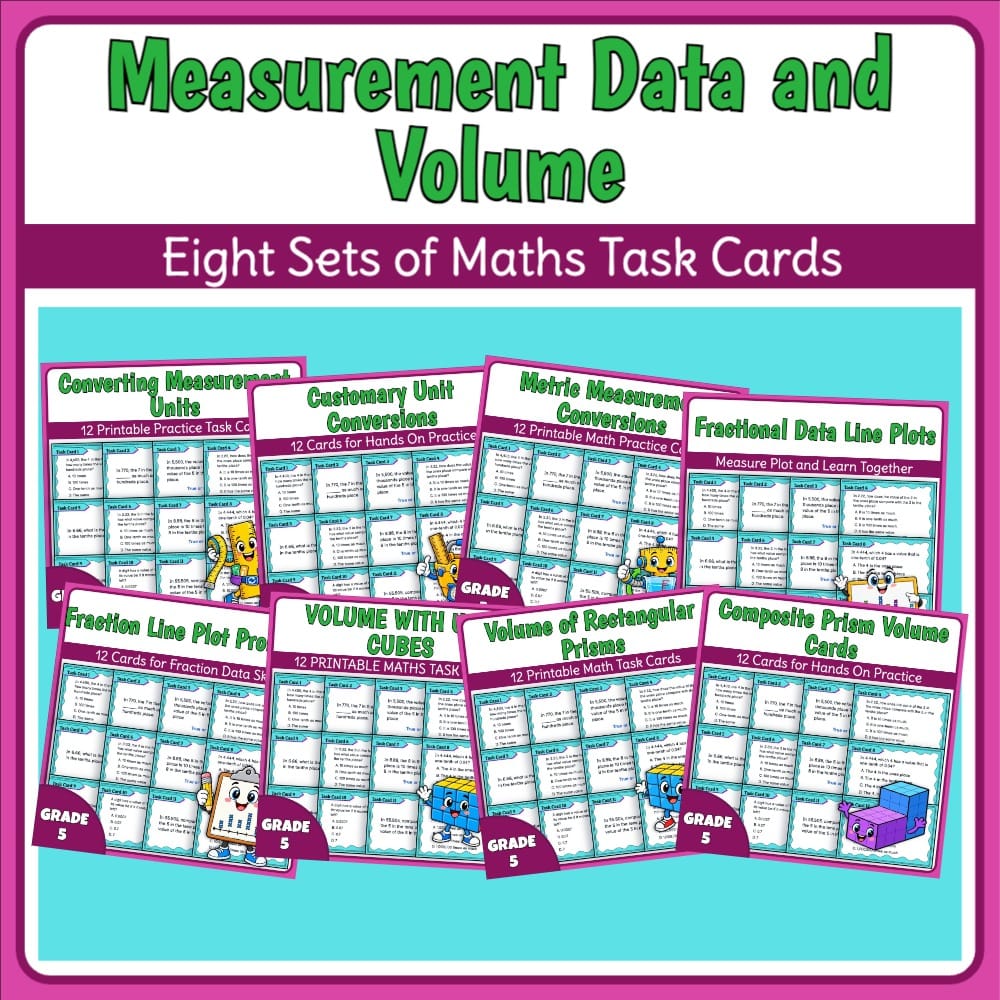
Grade 5 Maths Measurement, Data and Volume Task Cards Unit Bundle
Created byElena BrooksGrade 5 measurement, data and volume task cards bring together eight Maths resources covering unit conversions, fractional line plots and rectangular prism volume. Having separate sets for each skill makes it easier to plan practice around the topic you're teaching, especially when moving between measurement calculations, data questions and three-dimensional…
Instant download

Volume of Composite Rectangular Prisms Task Cards | Grade 5 Maths Practice
Created byElena BrooksLearning Objectives
- Calculate rectangular prism volumes using length × width × height.
- Identify the separate rectangular prisms forming a composite solid.
- Add individual prism volumes to calculate total composite volume.
Also included in: Grade 5 Maths Measurement, Data and Volume Task Cards Unit Bundle +1 more
Instant download

Volume of Rectangular Prisms Task Cards | Grade 5 Maths Practice
Created byElena BrooksLearning Objectives
- Explain how unit cubes and equal layers represent volume.
- Identify the length, width and height of rectangular prisms.
- Calculate rectangular prism volume using length × width × height.
Also included in: Grade 5 Maths Measurement, Data and Volume Task Cards Unit Bundle +1 more
Instant download

Volume with Unit Cubes Task Cards | Grade 5 Maths Counting Practice
Created byElena BrooksLearning Objectives
- Identify volume as the space occupied by a solid figure.
- Recognize cubic units as measurements of three-dimensional space.
- Count unit cubes arranged in equal layers.
Also included in: Grade 5 Maths Measurement, Data and Volume Task Cards Unit Bundle +1 more
Instant download

Line Plot Data Task Cards for Grade 5 | Fraction Word Problems Practice
Created byElena BrooksLearning Objectives
- Identify repeated measurements and frequencies in line plot data.
- Interpret fractional measurement data involving halves, fourths, and eighths.
- Calculate the range of a set of fractional measurements.
Also included in: Grade 5 Maths Measurement, Data and Volume Task Cards Unit Bundle +1 more
Instant download

Fractional Data Line Plots Task Cards | Grade 5 Maths Measurement Practice
Created byElena BrooksLearning Objectives
- Construct line plots using halves, fourths, and eighths.
- Identify appropriate fractional intervals for a number line.
- Organise repeated measurements into accurate frequency groups.
Also included in: Grade 5 Maths Measurement, Data and Volume Task Cards Unit Bundle +1 more
Instant download