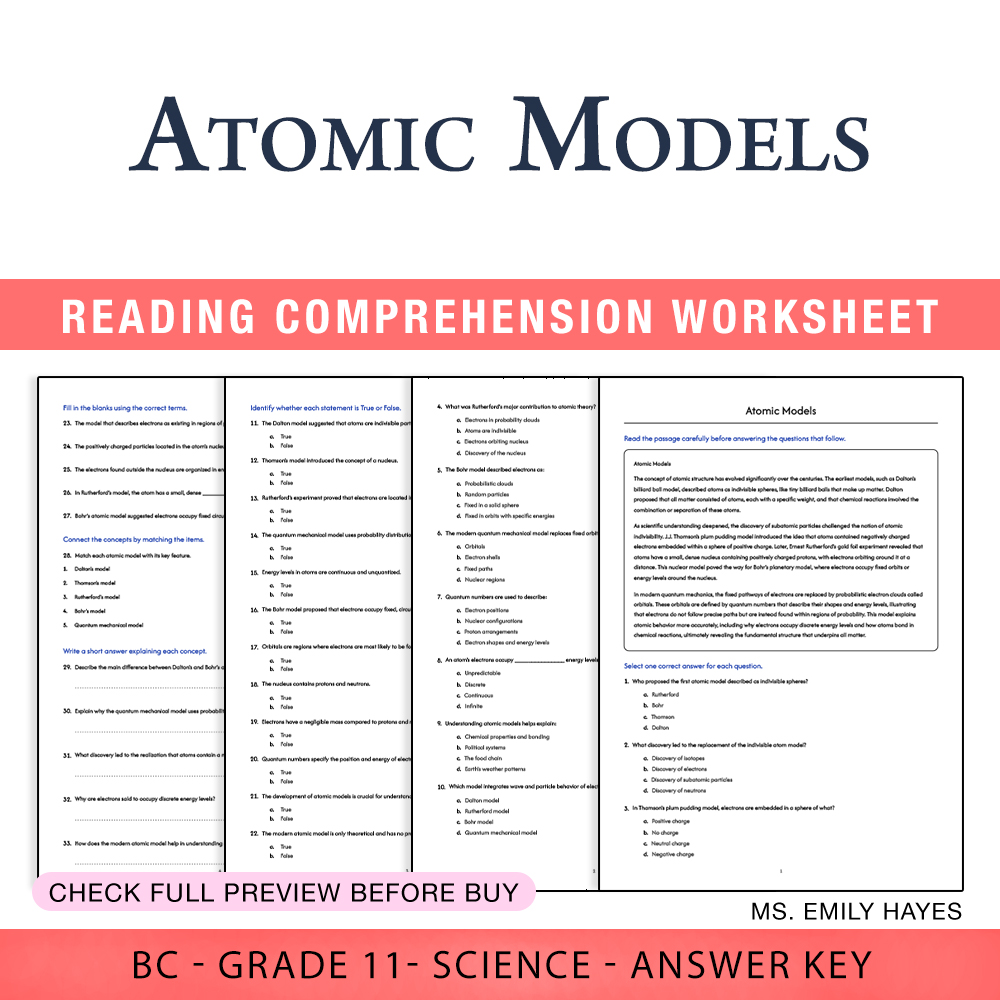
Are you looking for a practical and engaging way to enhance your Grade 11 science classroom? This comprehensive Atomic Models worksheet provides an excellent opportunity for students to master the evolution of atomic theory through a variety of question types designed to challenge and develop their understanding. Designed specifically for teachers seeking print-ready, classroom-ready materials aligned to BC science standards, this worksheet is perfect for reinforcing core concepts of atomic models while promoting critical thinking and deep comprehension. With expertly crafted questions covering historical models, current theories, and comparative analysis, your students will effectively grasp the development of atomic structure from early ideas to quantum mechanics.
Why Teachers Love This
✅ Saves preparation time with ready-to-use, high-quality content tailored to BC
✅ Fully printable PDF format with answer key and rubric, ready for immediate classroom use
✅ Helps address common student misconceptions about atomic models and encourages analytical thinking
✅ Engages students through diverse question formats like reading passages, multiple-choice, true/false, fill-in-the-blank, matching, and short answer questions
✅ Supports differentiated instruction and student assessment with clear, structured activities
✅ Builds essential skills in scientific explanation, comparison, and conceptual understanding, crucial for success in Grade 11 Science
Why Students Succeed With This
✅ Clear instructions and thoughtfully designed questions that guide learners step-by-step through complex ideas
✅ Progressive difficulty levels boost confidence as students move from recall to critical analysis and synthesis
✅ Connects scientific theories to real-world examples and historical context to enhance relevance
✅ Promotes active learning and deeper engagement with the development of atomic models and current scientific understanding
✅ Prepares students for assessments and future science coursework with solid foundational knowledge
✅ Encourages independent thinking and improved retention of complex concepts
What You Get
Complete, print-ready PDF worksheet and answer key, including:
• A detailed reading passage providing historical context on atomic models
• 10 multiple-choice questions assessing knowledge of key figures like Dalton, Thomson, and Bohr
• 12 true/false statements to reinforce misconceptions and factual understanding
• 5 fill-in-the-blank exercises focusing on terminology like electron probability and nuclear particles
• 1 matching activity linking atomic models to their features
• 5 short-answer questions designed for deeper critical thinking and comparisons
• 2 comprehensive essays encouraging synthesis of the evolution of atomic theories and their modern implications
Key Learning Objectives
Students will be able to:
➡️ Describe the progression of atomic models from Dalton to the quantum mechanical model
➡️ Identify key features of each atomic model and explain their significance
➡️ Compare and contrast different models, highlighting their limitations and strengths
➡️ Explain the role of electron probability and nuclear particles in modern atomic theory
➡️ Analyze the impact of discoveries such as the electron and nucleus on atomic structure understanding
Ideal Usage
This worksheet is perfect for classroom instruction, homework assignments, or review sessions. Its print-ready format makes it easy to incorporate into lesson plans or use as an individual or group activity. Suitable for in-person teaching, small groups, or independent learners, the activity supports various teaching strategies and assessment styles. Use it to reinforce foundational knowledge, foster critical thinking, or prepare students for lab activities and exams focused on atomic structure and models.
By integrating this Atomic Models worksheet into your curriculum, you’ll provide students with a meaningful, engaging, and challenging learning experience that builds a deep understanding of atomic theory—an essential cornerstone of modern science. Equip your classroom today with this ready-to-use resource and watch student comprehension and confidence soar! 🚀