Understand the Big Idea
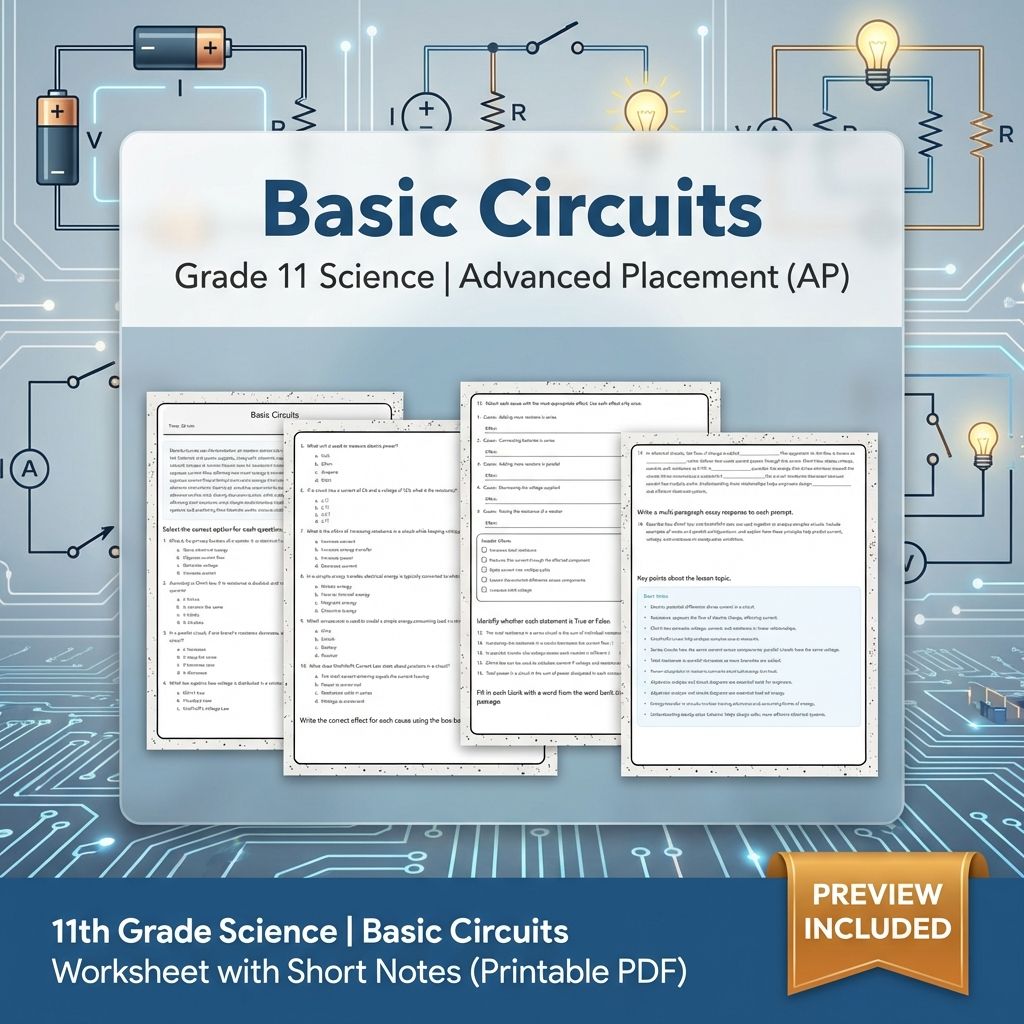
Explore the fundamentals of electrical circuits with this engaging Grade 11 Science worksheet. Designed for visual and hands-on learners, this printable PDF helps students grasp key concepts of basic circuits, resistors, and Ohm’s law. It’s perfect for AP level coursework and provides a clear, student-friendly way to build confidence in electrical principles. Teachers will love its structure, and students will enjoy the straightforward format that promotes understanding without overwhelming details.
This worksheet includes a variety of question formats that challenge students’ knowledge while reinforcing essential science skills. Whether reviewing for a test or practicing independently, it supports deep learning and quick assessment. The included short notes serve as handy reference points, summarizing crucial ideas to aid comprehension before tackling questions or after completing the activities. With its print-and-go design, it’s ideal for classwork, homework, or review sessions, making science concepts accessible and memorable.
Skills Students Practice
• Reading and interpreting informational passages
• Applying Ohm’s law to circuit scenarios
• Analyzing cause and effect relationships in electrical systems
• Identifying true/false statements about circuit properties
• Completing cloze passages to reinforce key terminology
• Formulating detailed explanations of complex circuit analysis
Resource Format
This is a well-organized PDF worksheet designed for easy printing and quick use. The layout is clean, with clear sections and ample space for student responses. The straightforward design helps students focus on learning without distraction. Teachers can easily distribute this worksheet during lessons or assign it as homework without needing any additional preparation. The answer key with a rubric offers quick grading and assessment support, saving valuable time.
Question Style & Structure
• One reading passage to introduce the topic and motivate students
• Multiple choice questions (10 items) to test knowledge of circuit components and laws
• A cause-effect question to evaluate understanding of circuit behavior
• Five true/false questions for quick checks of basic facts
• A fill-in-the-blank cloze passage to reinforce key terminology
• An in-depth essay question to assess comprehension and application skills
• One short note question that summarizes essential concepts
Designed to promote understanding, each question encourages critical thinking, not guessing. The included PDF answer key with rubric allows for efficient grading and feedback.
Perfect for the Classroom
This worksheet fits seamlessly into lessons on electrical circuits, physics review sessions, or AP prep. Use it for classwork, homework assignments, or independent review. It’s also a valuable resource for science clubs or extra practice before exams. The engaging question styles help maintain student interest while building a solid foundation in electrical engineering principles. Teachers will appreciate its versatility and focus on skill mastery.
Why This Worksheet Works
By combining clarity, simple explanations, and varied question formats, this worksheet supports student confidence and independence. Its time-saving design allows for quick grading and assessment, helping teachers provide meaningful feedback efficiently. Students gain a strong understanding of circuit concepts through structured practice, building skills that are essential for success in advanced physics topics. The included short notes reinforce learning and serve as handy references for review or revision.
Short Notes Included
This worksheet comes with concise short notes placed after each main section. These notes summarize crucial ideas like Ohm’s law, circuit components, and flow of charge. They are designed to support students’ understanding of key lesson ideas, making independent learning easier before or after completing the questions. The notes help clarify important concepts, foster retention, and make studying more efficient.