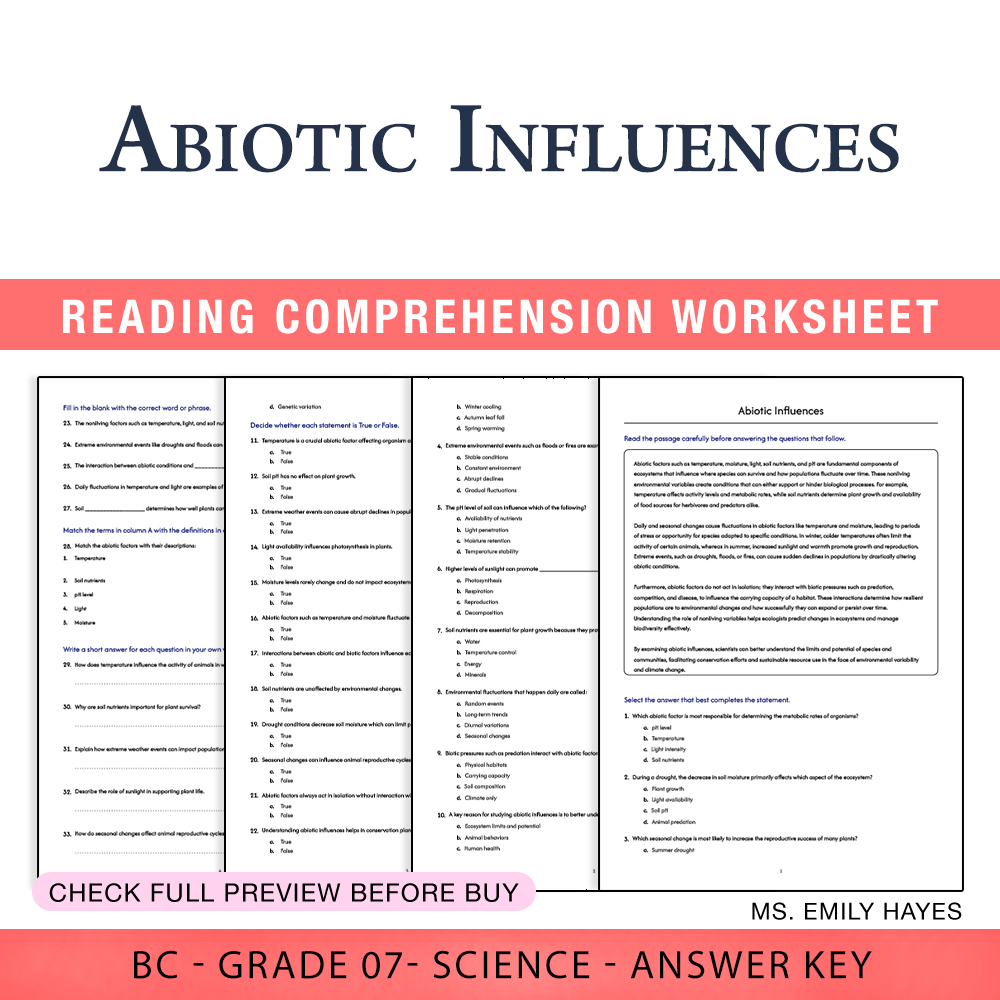
Are you looking for an effective way to help your Grade 7 students master the vital concepts of abiotic factors and their profound impact on ecosystems? This comprehensive Abiotic Influences Worksheet is tailored to address classroom challenges by providing engaging, print-ready activities that build essential scientific skills. Designed specifically to support BC curriculum standards, this worksheet helps students understand the crucial role abiotic factors such as temperature, soil nutrients, light, moisture, and pH play in ecological systems. With activities crafted to promote critical thinking, practical application, and deep understanding, this resource empowers teachers to foster an interactive learning environment that motivates students to explore the natural world confidently. Its carefully structured content allows young scientists to evaluate their knowledge, develop problem-solving skills, and enhance their comprehension of ecosystem dynamics, all while making learning enjoyable and accessible.
Why Teachers Love This ✅ Saves valuable preparation time with ready-to-use, high-quality PDF materials tailored to Grade 7 Science
✅ Simplifies lesson planning by providing a clear, print-ready worksheet and complete answer key with rubric
✅ Supports diverse classroom needs with a variety of question types including reading passages, multiple-choice, true/false, fill-in-the-blank, matching, and short answer questions
✅ Promotes student engagement through contextualized questions connecting abiotic factors to real-world ecosystems
✅ Reinforces important standard concepts in a structured, easy-to-follow format
✅ Encourages development of critical thinking, analytical skills, and scientific vocabulary
Why Students Succeed With This ✅ Clear, concise instructions guide students through each activity, reducing confusion and fostering independence
✅ Progressive question types—from basic recall to deep analytical writing—support mastery and confidence
✅ Real-life scenarios and thought-provoking essay prompts connect scientific concepts to students' understanding of environmental issues
✅ Strengthens foundational knowledge about how abiotic factors influence living organisms and ecosystems, building long-term scientific literacy
What You Get Immediately printable, PDF worksheet and answer key with rubric include:
• An engaging reading passage that introduces core concepts of abiotic factors
• Ten multiple-choice questions assessing understanding of ecological impacts
• Twelve true/false questions for quick assessments of key principles
• Five fill-in-the-blank exercises to reinforce terminology
• A matching activity pairing abiotic factors with descriptions to enhance conceptual clarity
• Five short answer questions encouraging explanatory responses about ecological interactions
• Two essay questions designed to develop higher-order thinking about ecosystem influences
Key Learning Objectives Students will master these core skills:
➡️ Identify and explain various abiotic factors impacting ecosystems
➡️ Analyze how abiotic factors influence organism behavior and distribution
➡️ Evaluate the effects of environmental changes on ecosystem stability
➡️ Connect abiotic factors to broader ecological concepts and environmental issues
Ideal Usage This worksheet is perfect for classroom practice, homework assignments, or review sessions. Its print-ready format means teachers can easily integrate it into lessons on ecology, ecosystems, and environmental science. Use it for in-class activities, formative assessments, or small-group discussions. Suitable for in-person learning environments, it supports both whole-class engagement and independent student work, helping students develop a deeper understanding of how nonliving factors shape the natural world.
Don't miss the opportunity to enhance your science instruction with this engaging, standards-aligned print resource. Help your students master the
essential concepts of abiotic influences and build critical ecological thinking skills to ensure their academic success now and in future science endeavors! 🚀