
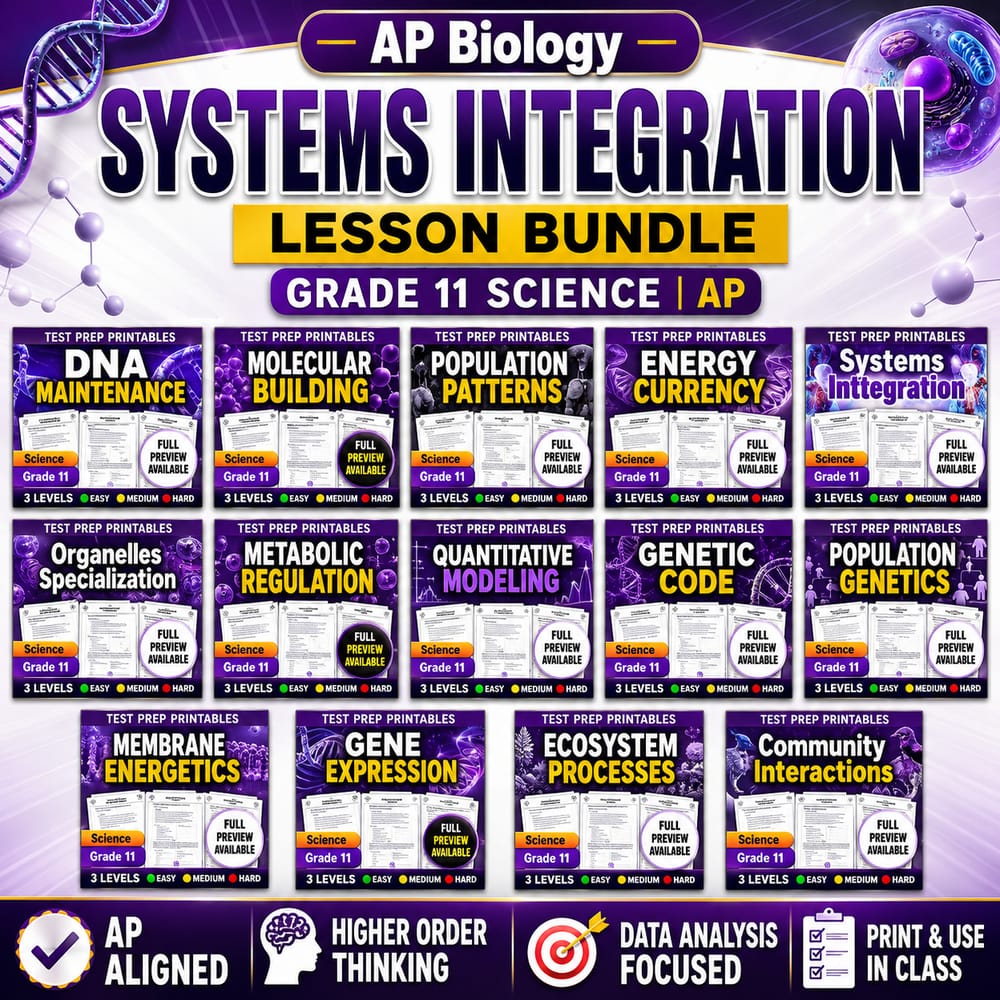


AP Biology Systems Integration Lesson Bundle: Grade 11 Science | AP
$56.00$70.00Save $14.00
Prism Point Learning
·2 followers·14 sales
SubjectScienceGradeGrade 11
What’s included
14 worksheets · Save $14.00 (20%) · prices shown inside the bundle
 DNA Maintenance Worksheet | Grade 11 AP Biology Practice Activities
- Explain how DNA replication fidelity and proofreading reduce mutation rates
- Describe major DNA repair pathways, including excision repair and double-strand break repair
- Analyze how different mutation types and repair failures can affect genome stability over time
$4.00$5.00 AP Science Molecular Building Worksheet Pack | Grade 11 Activities
- Explain how molecular building blocks scale up to cellular structures, from macromolecules to organelles.
- Compare prokaryotic and eukaryotic cellular organization, focusing on membranes, cytoskeleton, and compartmentalization.
- Use ultrastructure evidence to justify how localization supports specific biochemical pathways.
$4.00$5.00 AP Biology Population Patterns Worksheet | Grade 11 Science Practice
- Explain exponential and logistic growth models and how carrying capacity affects population trajectories.
- Differentiate density-dependent and density-independent factors and predict their effects on population size.
- Interpret population graphs and life-history ideas to evaluate population persistence and long-term viability.
$4.00$5.00 Energy Currency Worksheet | ATP & Cellular Energy Practice Grade 11 AP Science
- Explain how ATP couples exergonic and endergonic reactions through energy transfer and free-energy changes.
- Interpret reaction coordinate diagrams to describe activation energy, intermediates, and how catalysts/enzymes affect rates.
- Relate enzyme kinetics and environmental conditions to metabolic flux in glycolysis, oxidative phosphorylation, and phosphorylation-driven transport.
$4.00$5.00 AP Science Systems Integration Worksheet | Grade 11 Integrated Practice
- Explain how biological systems integrate across molecular, cellular, organismal, and ecosystem scales using feedback and regulatory networks.
- Model system behavior by identifying inputs, outputs, regulators, and feedback loops, and predict responses to perturbations.
- Evaluate the limits of reductionist models and describe how multi-scale representations improve predictions.
$4.00$5.00 Organelle Specialization Worksheet | Grade 11 AP Biology Practice
- Explain how organelles’ structures relate to their specific functions in metabolism, protein trafficking, and signaling.
- Compare mitochondria, chloroplasts, endoplasmic reticulum, and lysosomes using membrane features and biochemical roles.
- Describe how compartmentalization and selective permeability affect reaction rates and metabolic integration.
$4.00$5.00 Metabolic Regulation Worksheet | Grade 11 AP Biology Practice Pack
- Explain how cells regulate metabolic pathway flux using allosteric control, covalent modification, compartmentalization, and hormonal signaling
- Use feedback inhibition and branch-point regulation to predict how metabolite levels affect pathway rates
- Connect thermodynamic constraints and enzyme kinetics to how cells balance anabolic and catabolic demands during fasting or high activity
$4.00$5.00 AP Science Quantitative Modeling Worksheet Pack | Grade 11 Practice
- Explain how quantitative models represent biological systems using differential equations, network representations, and statistical inference.
- Identify how parameters are estimated and how sensitivity analysis reveals which assumptions most affect model outputs.
- Evaluate model validity by comparing predictions to empirical datasets such as population time series, gene expression profiles, and metabolic flux data.
$4.00$5.00 Genetic Code Worksheet | Grade 11 AP Biology Practice Activities
- Explain how DNA base-pairing and nucleic acid structure support faithful information storage and inheritance.
- Describe how transcription and translation transfer genetic information using codons, reading frames, and genetic code rules.
- Analyze how mutations and recombination can change gene expression and phenotype.
$4.00$5.00 AP Biology Population Genetics Worksheet | Grade 11 Science Practice
- Explain how Hardy-Weinberg equilibrium provides a null model for allele frequency change in populations.
- Calculate genotype frequencies from allele frequencies and interpret how microevolutionary forces alter them over time.
- Compare the effects of selection, genetic drift, mutation, and migration on evolutionary trajectories and adaptive potential.
$4.00$5.00
Reviews & Feedback
Loading reviews...
Questions & Answers
Loading questions…
About this bundle
Related categories
Frequently asked questions
Who is AP Biology Systems Integration Lesson Bundle: Grade 11 Science | AP designed for?
AP Biology Systems Integration Lesson Bundle: Grade 11 Science | AP is designed for Grade 11 students and Science learners and can be used in classrooms, homeschool, or independent practice.
How do I download AP Biology Systems Integration Lesson Bundle: Grade 11 Science | AP?
Add it to your cart and complete checkout. After payment, you can download immediately from your account, and you'll also receive a download link by email.
Similar Products

Grade 10 Energy in Biological Systems Science Daily Reading Lesson Bundle | TEKS
$32.00$40.00

Grade 11 Life Science Biology Lesson Bundle (NGSS) | SCIENCE NGSS
$16.80$21.00

Grade 10 Science Cells and Systems Lesson Bundle | Alberta Curriculum
$36.00$45.00

Grade 9 Homeostasis and Body Systems Biology Worksheets Bundle | TEKS
$40.00$50.00