
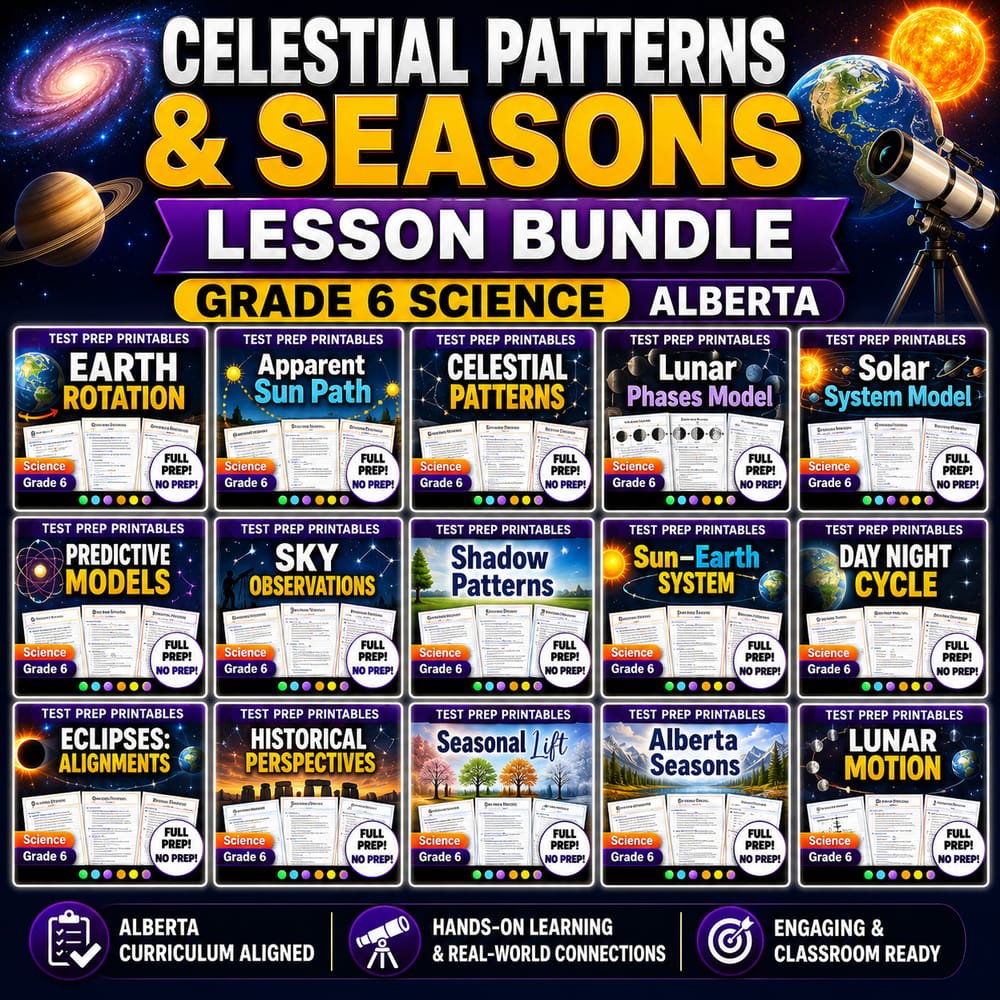


Celestial Patterns & Seasons Lesson Bundle | Grade 6 Science | Alberta
$60.00$75.00Save $15.00
Prism Point Learning
·2 followers·13 sales
SubjectScienceGradeGrade 6
What’s included
15 worksheets · Save $15.00 (20%) · prices shown inside the bundle
 Earth Rotation Worksheet | Grade 6 Science Activities
- Explain how Earth’s rotation about its axis produces alternating daylight and darkness.
- Describe how Earth’s axial rotation creates the apparent daily motion of the Sun and stars.
- Connect the timing of sunrise, solar noon, and sunset to different time zones across Alberta.
$4.00$5.00 Apparent Sun Path Worksheet | Grade 6 Science Activities
- Explain how Earth’s tilt and latitude affect the Sun’s apparent path across the sky
- Describe how solar elevation at noon changes between summer and winter and how that affects day length
- Compare how sunrise and sunset locations shift in different seasons and at different latitudes
$4.00$5.00 Celestial Patterns Worksheet Grade 6 Science | Assessment and Practice
- Describe how the Sun, Moon, planets, and constellations appear to move in predictable patterns from a fixed location
- Explain how seasonal star patterns can be used to recognize characteristic times of year
- Compare how planets change position more slowly than constellations against the background stars
$4.00$5.00 Lunar Phases Model Worksheet | Grade 6 Science Activities
- Explain how a geometric model using the relative positions of the Sun, Earth, and Moon predicts lunar phases.
- Use the model to describe how the Moon’s apparent illumination changes over a week.
- Connect the order of crescent, quarter, gibbous, and full phases to the Moon’s position in its path.
$4.00$5.00 Solar Timekeeping Worksheet | Grade 6 Science Activities
- Explain how apparent solar motion relates to solar noon and local solar time.
- Describe why solar time and clock time differ (longitude, time zones, and the equation of time).
- Connect Alberta examples of solar timekeeping to adjustments for civil schedules.
$4.00$5.00 Predictive Models Worksheet | Grade 6 Science Alberta Standards
- Explain how Earth–Sun geometry and motion can be represented with simplified models to predict observable sky events.
- Use predictive-model reasoning to connect seasonal changes with daylight duration and solar angles at a fixed latitude (Alberta).
- Interpret model inputs, relationships, and outputs to make qualitative predictions and justify them with evidence.
$4.00$5.00 Sky Observations Worksheet Grade 6 Science | Alberta Standards Practice
- Describe how systematic sky observations help identify repeating patterns over time.
- Explain how Earth’s rotation and the Moon’s movement affect what we see in the sky.
- Use simple records (sunrise/sunset times, Moon phases, and star positions) to make observational conclusions.
$4.00$5.00 Shadow Patterns Worksheet | Grade 6 Science Activities
- Explain how the Sun’s apparent motion changes shadow direction during the day
- Describe how seasonal changes in Sun angle affect shadow length
- Use observations of shadows to connect day/night and seasons to Earth’s motion and axial tilt
$4.00$5.00 Sun–Earth–Moon Worksheet | Grade 6 Science Practice
- Explain how the Sun, Earth, and Moon relative positions create Moon phases
- Describe how eclipses happen when the Sun, Earth, and Moon align
- Connect the Moon’s gravity to tides on Earth
$4.00$5.00 Day Night Cycle Worksheet | Grade 6 Science Practice
- Explain how Earth’s rotation and the direction of sunlight create day and night
- Describe how Earth’s axial tilt and orbit cause seasonal changes in day length
- Connect patterns of daylight in Alberta to Earth’s orientation and yearly position
$4.00$5.00
Reviews & Feedback
Loading reviews...
Questions & Answers
Loading questions…
About this bundle
Related categories
Frequently asked questions
Who is Celestial Patterns & Seasons Lesson Bundle | Grade 6 Science | Alberta designed for?
Celestial Patterns & Seasons Lesson Bundle | Grade 6 Science | Alberta is designed for Grade 6 students and Science learners and can be used in classrooms, homeschool, or independent practice.
How do I download Celestial Patterns & Seasons Lesson Bundle | Grade 6 Science | Alberta?
Add it to your cart and complete checkout. After payment, you can download immediately from your account, and you'll also receive a download link by email.
Similar Products

Grade 6 Celestial Motion & Seasons Science Lesson Bundle | Alberta
$60.00$75.00

Grade 6 Science Lesson Group: Earth & Space Reading Worksheets Bundle
$36.00$45.00

Grade 6 Science Sky Science Unit Bundle – Celestial Motion & Earth-Sun Relations
$36.00$45.00

Grade 6 Science Sky Science Unit Bundle | Alberta Curriculum Worksheets
$36.00$45.00

Grade 1 Science Unit Bundle | Earth's Place in the Universe NGSS Alignment
$4.80$6.00