
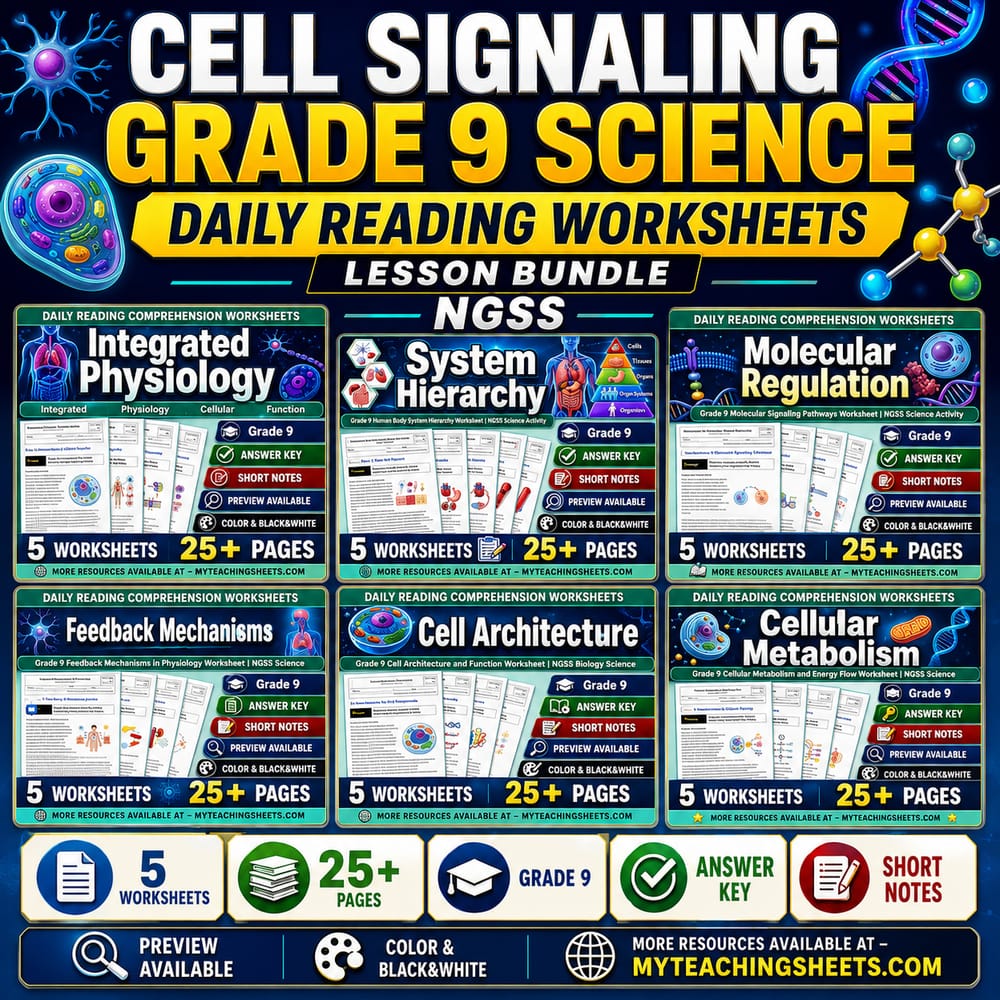
Cell Signaling Grade 9 Science Daily Reading Worksheets Lesson Bundle | NGSS
$24.00$30.00Save $6.00
BRIGHT PATH RESOURCES
·3 followers·23 sales
SubjectScienceGradeGrade 9
What’s included
6 worksheets · Save $6.00 (20%) · prices shown inside the bundle
 Grade 9 Integrated Physiology Cellular Function Worksheet | NGSS Science
- Understand the basic functions of cells in the human body.
- Identify how molecular and cellular interactions contribute to organ system functions.
- Analyze clinical examples to connect molecular defects with physiological dysfunction.
$4.00$5.00 Grade 9 Science Worksheet | NGSS Aligned Printable Activity + Answer Key
- Identify the basic structures of cells and tissues.
- Differentiate between various tissue types and their functions.
- Describe how tissues combine to form organs and organ systems.
$4.00$5.00 Grade 9 Molecular Signaling Pathways Worksheet | NGSS Science Activity
- Identify basic mechanisms of molecular signaling
- Understand the role of receptor-ligand interactions
- Describe signal transduction cascades
$4.00$5.00 Grade 9 Feedback Mechanisms in Physiology Worksheet | NGSS Science Activity
- Understand the concept of negative and positive feedback in physiological processes.
- Identify examples of feedback mechanisms involved in thermoregulation, blood glucose control, and osmoregulation.
- Explain the roles of sensors, effectors, and set points in maintaining internal stability.
$4.00$5.00 Grade 9 Cell Architecture and Function Worksheet | NGSS Biology Science
- Identify basic cell organelles such as nucleus, mitochondria, endoplasmic reticulum, and ribosomes.
- Understand the functions of different cell components and how they work together.
- Recognize how nucleic acid sequences influence protein structures and cellular functions.
$4.00$5.00 Grade 9 Cellular Metabolism and Energy Flow Worksheet | NGSS Science
- Understand the basic processes of cellular respiration, including glycolysis, the citric acid cycle, and electron transport chain.
- Identify the organelles involved in energy production, such as mitochondria and chloroplasts.
- Explain how ATP is generated and used as energy currency in cells.
$4.00$5.00
Reviews & Feedback
Loading reviews...
Questions & Answers
Loading questions…
About this bundle
Related categories
Frequently asked questions
Who is Cell Signaling Grade 9 Science Daily Reading Worksheets Lesson Bundle | NGSS designed for?
Cell Signaling Grade 9 Science Daily Reading Worksheets Lesson Bundle | NGSS is designed for Grade 9 students and Science learners and can be used in classrooms, homeschool, or independent practice.
How do I download Cell Signaling Grade 9 Science Daily Reading Worksheets Lesson Bundle | NGSS?
Add it to your cart and complete checkout. After payment, you can download immediately from your account, and you'll also receive a download link by email.
Similar Products

Grade 8 Body Systems & Cell Structure Science Daily Reading Lesson Bundle | BC
$48.00$60.00

Cells & Circulatory System Grade 8 Science Lesson Bundle | NGSS Daily Reading
$12.00$15.00

Grade 10 Science Daily Reading: Cells & Systems Lesson Bundle | Alberta
$48.00$60.00

Grade 10 AP Science Daily Reading Lesson Bundle: Ecology, Genetics & Cells
$35.20$44.00

Grade 8 Circulatory & Cell Function Science Daily Reading Lesson Bundle | NGSS
$6.40$8.00