
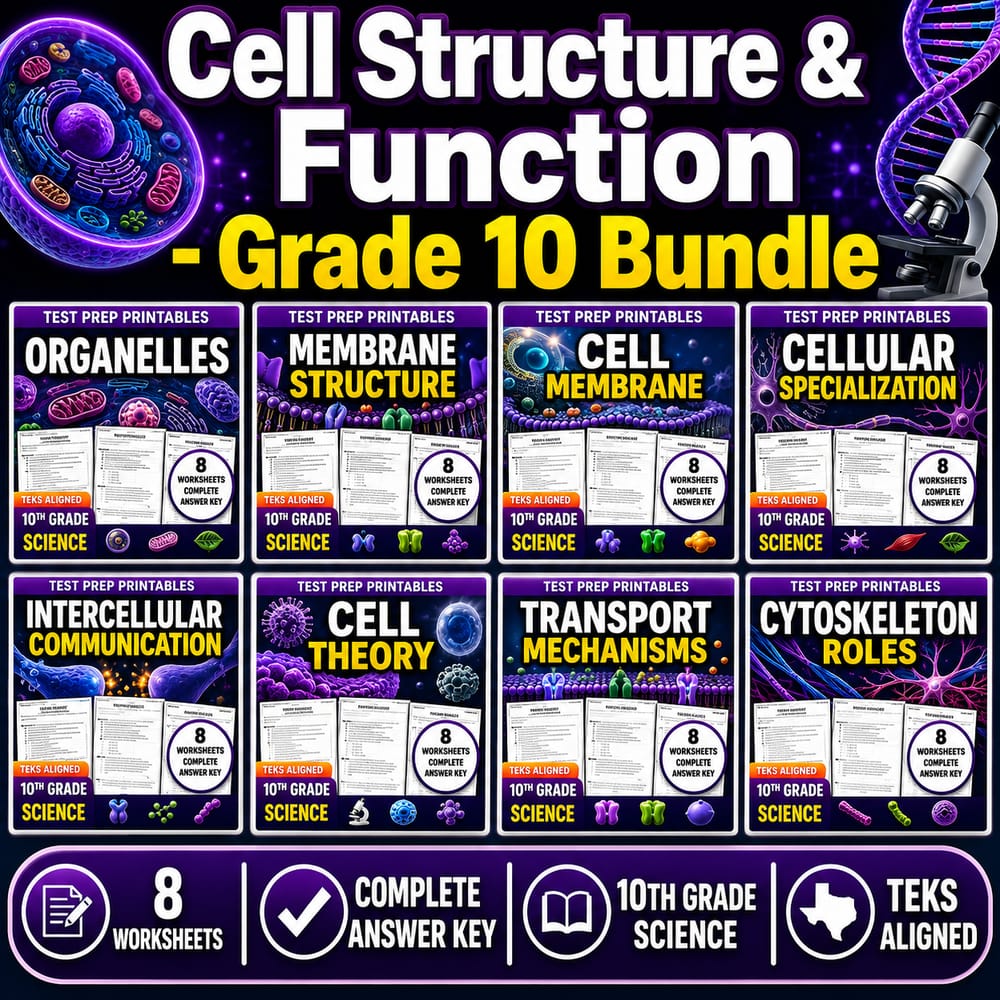
Cell Structure & Function Lesson Bundle – Grade 10 Science Texas Essential Knowledge and Skills
$32.00$40.00Save $8.00
Prism Point Learning
·2 followers·13 sales
SubjectScienceGradeGrade 10
What’s included
8 worksheets · Save $8.00 (20%) · prices shown inside the bundle
 Organelles Worksheet Pack | Grade 10 Science Activities
- Explain how membrane-bound and non-membrane-bound organelles carry out specialized cell functions.
- Describe how compartmentalization improves efficiency in cellular processes.
- Match specific organelles to their roles in energy conversion, protein production, and genetic control.
$4.00$5.00 Membrane Structure Worksheet | Grade 10 Science Activities
- Explain how the fluid mosaic model describes the plasma membrane as a dynamic structure of lipids and proteins.
- Describe how phospholipid bilayer asymmetry and cholesterol influence membrane function and fluidity.
- Compare membrane protein roles, including receptors and transporters, and relate them to signaling and transport.
$4.00$5.00 Cell Membrane Worksheet | Grade 10 Science Practice with TEKS Standards
- Explain how the phospholipid bilayer and embedded molecules create selective permeability in the cell membrane.
- Describe the roles of membrane proteins, cholesterol, and carbohydrate markers in transport and cell recognition.
- Connect membrane structure to specific transport processes such as diffusion and osmosis.
$4.00$5.00 Cellular Specialization Worksheet | Grade 10 Science Activities
- Explain how cell specialization leads to specific functions within multicellular organisms.
- Relate organelle abundance to the tasks performed by different cell types.
- Connect cellular structure and subcellular organization to tissue and organ system roles.
$4.00$5.00 Intercellular Communication Worksheet | Grade 10 Science Practice
- Describe how cells communicate using autocrine, paracrine, endocrine, and synaptic signaling
- Explain how receptor–ligand specificity and signal transduction help information spread inside cells
- Compare direct cytoplasmic connections (gap junctions and plasmodesmata) with chemical signaling modes
$4.00$5.00 Cell Theory Worksheet | Grade 10 Science Activities
- Explain the three main ideas of cell theory and connect them to real biological examples
- Describe how microscopy helped scientists discover and compare cell types across bacteria, plants, and animals
- Compare unicellular and multicellular organization and relate structure to function
$4.00$5.00 Transport Mechanisms Worksheet | Grade 10 Science Practice
- Differentiate passive transport (diffusion and osmosis) from active transport and bulk transport
- Explain how concentration gradients and electrochemical gradients affect movement of ions and molecules across membranes
- Describe how ATP-powered pumps and carrier proteins help substances cross cellular boundaries
$4.00$5.00 Cytoskeleton Roles Worksheet | Grade 10 Science TEKS Practice
- Explain how microtubules, actin filaments, and intermediate filaments each contribute to cell structure and function.
- Describe how motor proteins and filament systems move materials or support processes like mitosis.
- Connect cytoskeleton organization to real examples such as axonal transport, muscle contraction, and cilia-driven fluid movement.
$4.00$5.00
Reviews & Feedback
Loading reviews...
Questions & Answers
Loading questions…
About this bundle
Related categories
Frequently asked questions
Who is Cell Structure & Function Lesson Bundle – Grade 10 Science Texas Essential Knowledge and Skills designed for?
Cell Structure & Function Lesson Bundle – Grade 10 Science Texas Essential Knowledge and Skills is designed for Grade 10 students and Science learners and can be used in classrooms, homeschool, or independent practice.
How do I download Cell Structure & Function Lesson Bundle – Grade 10 Science Texas Essential Knowledge and Skills?
Add it to your cart and complete checkout. After payment, you can download immediately from your account, and you'll also receive a download link by email.
Similar Products

Grade 10 Cell Structure & Function Science Worksheets Bundle | TEKS Biology
$32.00$40.00

Grade 9 Ecology, Inheritance, and Cell Functions Science Lesson Bundle (General)
$25.60$32.00

AP Biology Cell Structure and Function Activities | Grade 11 Advanced Placement
$28.80$36.00

Grade 7 Science Lesson Bundle | Cell Structures & Functions Worksheets
$36.00$45.00

Grade 9 Cell Structure and Function Biology Worksheets Bundle | TEKS
$40.00$50.00