
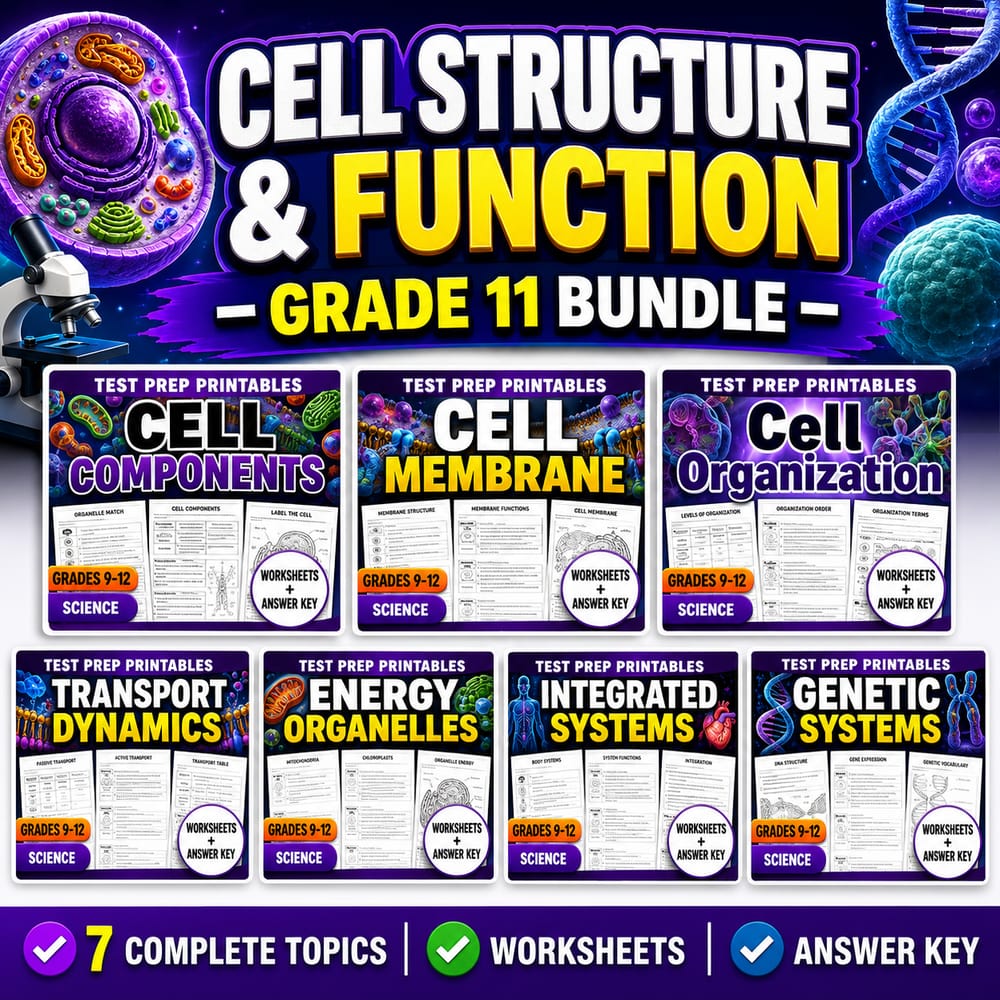
Cell Structure & Function Lesson Bundle | Grade 11 Science | teks
$32.00$40.00Save $8.00
Prism Point Learning
·2 followers·13 sales
SubjectScienceGradeGrade 11Pages251 Pages
What’s included
8 worksheets · 251 pages · Save $8.00 (20%) · prices shown inside the bundle
 Cell Components Worksheet | Grade 11 Science Practice
- Identify major eukaryotic cell components and describe their specific functions.
- Compare membrane-bound and non-membrane-bound structures in terms of what they do.
- Explain how organelles coordinate to support metabolism, genetic control, and transport.
$4.00$5.00 Cell Membrane Worksheet | Grade 11 Science Activities
- Explain how the cell membrane’s selective permeability controls movement of substances between cells and the environment.
- Compare passive transport, active transport, and vesicular transport using examples and energy requirements.
- Describe the roles of membrane proteins (channels, carriers, receptors, enzymes) and cholesterol in maintaining homeostasis.
$4.00$5.00 Cell Organization Worksheet for Grade 11 Science | TEKS Practice
- Explain hierarchical organization in multicellular organisms from cells to organ systems
- Describe how cell differentiation leads to specialized structures and functions
- Connect regulated gene expression, intercellular signaling, and the extracellular matrix to cell specialization
$4.00$5.00 Transport Dynamics Worksheet | Grade 11 Science Practice
- Explain how electrochemical gradients and membrane properties control ion movement across cell membranes
- Compare active transport, secondary active transport, and coupled transporters in terms of energy use
- Describe how tonicity and selective permeability influence cell volume and signaling
$4.00$5.00 Energy Organelles Worksheet | Grade 11 Science Activities
- Explain how mitochondria and chloroplasts convert energy into usable chemical forms.
- Describe the roles of the inner mitochondrial membrane and thylakoid membranes in ATP production.
- Compare the steps of oxidative phosphorylation and the Calvin cycle in energy conversion.
$4.00$5.00 Integrated Systems Worksheet Pack | Grade 11 Science Practice
- Explain how cellular specialization and communication create emergent functions at tissue, organ, and organism levels
- Describe how chemical signaling, gap junctions, and the extracellular matrix coordinate cell behavior
- Relate disruptions in signaling or organization to changes in whole-system health
$4.00$5.00 Cell Types Worksheet | Grade 11 Science Practice TEKS
- Compare prokaryotic and eukaryotic cells using their structures and how those structures support cell functions
- Explain how genome organization and cell division differ between prokaryotes and eukaryotes
- Use cell-type vocabulary (nucleoid, nucleus, organelles, ribosomes) to justify scientific claims
$4.00$5.00 Genetic Systems Worksheet | Grade 11 Science Activities and Practice
- Compare how prokaryotic and eukaryotic genomes are organized and expressed
- Explain how operons, plasmids, chromatin, and introns affect transcription and gene regulation
- Describe how differences in genetic systems influence DNA replication and environmental responses
$4.00$5.00
Reviews & Feedback
Loading reviews...
Questions & Answers
Loading questions…
About this bundle
Related categories
Frequently asked questions
Who is Cell Structure & Function Lesson Bundle | Grade 11 Science | teks designed for?
Cell Structure & Function Lesson Bundle | Grade 11 Science | teks is designed for Grade 11 students and Science learners and can be used in classrooms, homeschool, or independent practice.
How do I download Cell Structure & Function Lesson Bundle | Grade 11 Science | teks?
Add it to your cart and complete checkout. After payment, you can download immediately from your account, and you'll also receive a download link by email.
Similar Products

Grade 10 Cell Structure & Function Science Worksheets Bundle | TEKS Biology
$32.00$40.00

Grade 10 Science Lesson Group Bundle | Cell Structure & Function TEKS
$19.20$24.00

Grade 10 Science | Cell Structure & Function Unit Worksheet Bundle(TEKS-Aligned)
$19.20$24.00

Grade 9 Ecology, Inheritance, and Cell Functions Science Lesson Bundle (General)
$25.60$32.00

Grade 9 Cell Structure and Function Biology Worksheets Bundle | TEKS
$40.00$50.00