
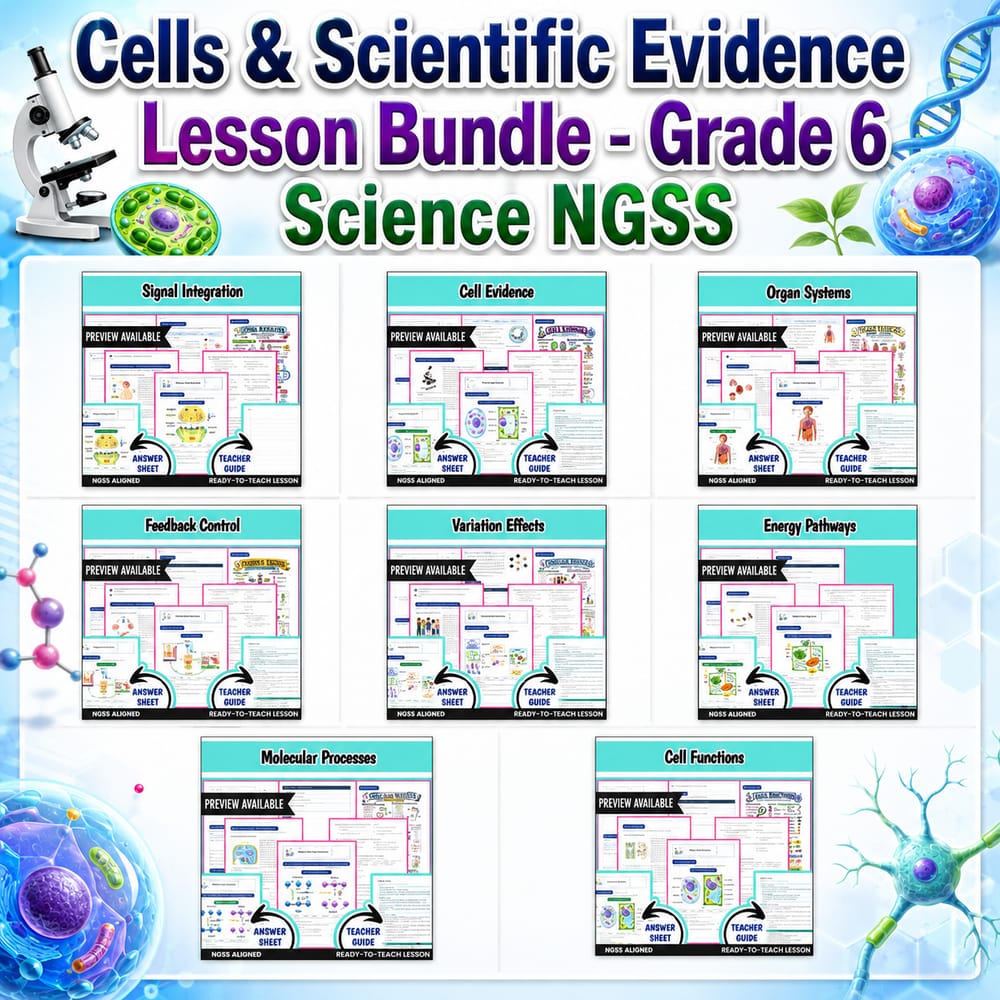
Cells & Scientific Evidence Lesson Bundle – Grade 6 Science NGSS
$32.00$40.00Save $8.00
Amber Owl Education
New·0 followers·1 sales
SubjectScienceGradeGrade 6
What’s included
8 worksheets · Save $8.00 (20%) · prices shown inside the bundle
 Signal Integration Worksheet & Doodle Notes | NGSS Grade 6 Science
- Explain how cells communicate using chemical and electrical signals.
- Describe how receptors translate signals into cellular responses, including signal transduction cascades.
- Differentiate rapid nervous impulses from longer-term endocrine effects.
$4.00$5.00 Cell Evidence Worksheet | NGSS Grade 6 Cells & Scientific Evidence
- Describe how microscopy and preserved specimens provide evidence that cells are the basic unit of life.
- Distinguish single-celled organisms from multicellular organisms using observable cell features.
- Explain how the organization from cells to tissues, organs, and whole organisms is supported by empirical observations.
$4.00$5.00 Grade 6 Organ Systems Worksheet | NGSS Human Body Science Activity
- Describe how organ systems (circulatory, respiratory, digestive, and nervous) work together to support body functions.
- Explain how tissues and organs contribute to system-level outcomes by connecting cellular processes to organ function.
- Use vocabulary from organ systems to identify roles of key organs (heart, lungs, liver, and brain).
$4.00$5.00 Feedback Control Worksheet & Doodle Notes | NGSS Grade 6 Science
- Explain how negative feedback helps maintain internal stability (homeostasis) in the body.
- Identify the roles of sensors, control centers, and effectors in feedback control systems.
- Compare negative and positive feedback by describing how each changes the direction of change.
$4.00$5.00 Grade 6 Variation Effects Worksheet | NGSS Science Activity & Notes
- Explain how genetic differences and environmental influences can produce phenotypic variation within a species.
- Describe how temperature and nutrition can change gene expression or growth during development.
- Connect DNA sequence variation and epigenetic/environmental modifiers to observed differences in structure and function.
$4.00$5.00 Energy Pathways Worksheet | NGSS Grade 6 Science Activity & Notes
- Explain how photosynthesis and cellular respiration transform energy in chloroplasts and mitochondria.
- Describe how matter cycles between organisms and the atmosphere through gas exchange and respiration.
- Use the idea of mass conservation to connect reactants and products in energy pathway processes.
$4.00$5.00 Grade 6 Molecular Processes Worksheet | NGSS Science Activity & Notes
- Explain how monomers assemble into polymers through condensation reactions.
- Describe how hydrolysis breaks polymers into smaller building blocks.
- Connect the structure of macromolecules (proteins, nucleic acids, lipids, carbohydrates) to their functions in cells.
$4.00$5.00 Cell Functions Worksheet | NGSS Grade 6 Life Science Activity
- Explain how major cell organelles contribute to essential cell functions.
- Connect the structure of organelles to their specific roles in the cell.
- Compare plant and animal cell features using organelle function.
$4.00$5.00
Reviews & Feedback
Loading reviews...
Questions & Answers
Loading questions…
About this bundle
Related categories
Frequently asked questions
Who is Cells & Scientific Evidence Lesson Bundle – Grade 6 Science NGSS designed for?
Cells & Scientific Evidence Lesson Bundle – Grade 6 Science NGSS is designed for Grade 6 students and Science learners and can be used in classrooms, homeschool, or independent practice.
How do I download Cells & Scientific Evidence Lesson Bundle – Grade 6 Science NGSS?
Add it to your cart and complete checkout. After payment, you can download immediately from your account, and you'll also receive a download link by email.
Similar Products

Grade 10 Life Science Evolution, Genetics & Cells Lesson Bundle – Florida NGSSS
$64.00$80.00

Grade 7 Cell Evidence & Matter Cycling Science Lesson Bundle NGSS
$20.00$25.00

Grade 11 Photosynthesis & Cellular Processes Science Lesson Bundle NGSS
$28.00$35.00

Grade 8 Science Worksheets | NGSS Cells & Body Systems Bundle
$7.20$9.00

Grade 9 Ecology, Genetics & Cells Science Lesson Bundle | General Framework
$19.20$24.00