
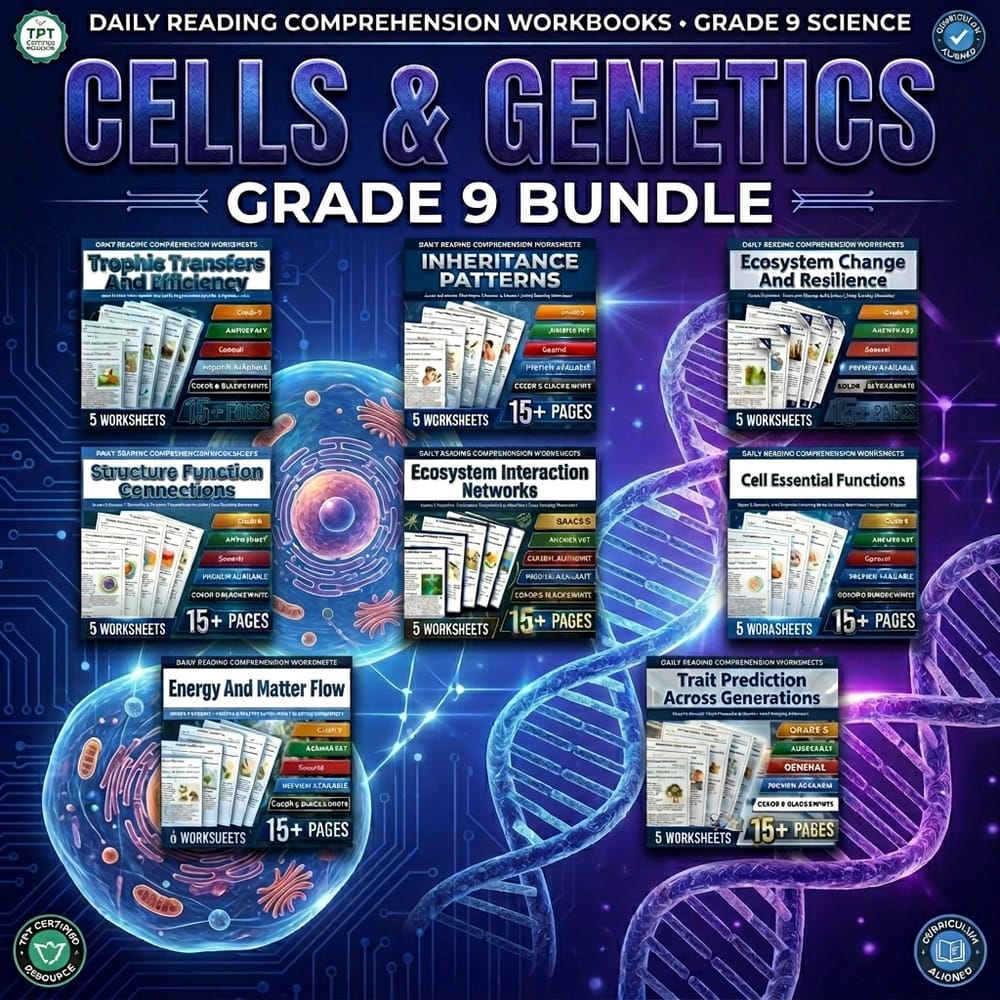
Cells Genetics & Ecosystems Grade 9 Science Reading Lesson Bundle | General
$25.60$32.00Save $6.40
Bright Mind Resources
New·1 followers·12 sales
SubjectScienceGradeGrade 9
What’s included
8 worksheets · Save $6.40 (20%) · prices shown inside the bundle
 Grade 9 Science – Trophic Levels & Energy Transfer Daily Reading Worksheet
- Explain the roles of producers, consumers, and decomposers in an ecosystem.
- Describe how energy moves through trophic levels.
- Interpret biomass and resource data to understand ecosystem dynamics.
$3.20$4.00 Grade 9 Science – Inheritance Patterns & Genetics | Daily Reading Worksheet
- Define key genetic terms: genes, alleles, genotypes, phenotypes
- Explain how dominant and recessive traits are inherited
- Identify inherited traits based on genetic diagrams
$3.20$4.00 Grade 9 Science – Ecosystem Change & Resilience | Daily Reading Worksheet
- Understand the components that make up an ecosystem.
- Recognize how disturbances can alter ecosystem stability.
- Learn about factors that influence ecosystems' ability to recover.
$3.20$4.00 Grade 9 Science – Structure & Function Connections in Cells | Reading Worksheet
- Identify major cellular organelles and describe their functions
- Explain how cell structures relate to their roles within an organism
- Use models to connect physical features of cells to their biological tasks
$3.20$4.00 Grade 9 Science – Ecosystem Interactions & Networks | Daily Reading Worksheet
- Identify key components of ecosystems including organisms and environmental factors.
- Understand how predation, competition, and mutualism influence species populations.
- Explain the impact of environmental variables like water, temperature, and nutrients on ecosystems.
$3.20$4.00 Grade 9 Science – Cell Essential Functions Reading Worksheet | Standards-Aligned
- Understand the role of cell membranes in regulating transport.
- Identify different functions of cellular components involved in maintaining internal balance.
- Explain how cells respond to environmental changes through structure and function.
$3.20$4.00 Grade 9 Science – Energy & Matter Flow | Daily Reading Worksheet
- Understand how energy flows through food chains in ecosystems.
- Identify the different roles of producers, consumers, and decomposers.
- Describe how matter cycles through living organisms and the environment.
$3.20$4.00 Grade 9 Science – Trait Prediction & Genetics Daily Reading Worksheet
- Understand the basic principles of genetic inheritance.
- Learn how parental alleles influence offspring traits.
- Interpret probability patterns in trait prediction.
$3.20$4.00
Reviews & Feedback
Loading reviews...
Questions & Answers
Loading questions…
About this bundle
Related categories
Frequently asked questions
Who is Cells Genetics & Ecosystems Grade 9 Science Reading Lesson Bundle | General designed for?
Cells Genetics & Ecosystems Grade 9 Science Reading Lesson Bundle | General is designed for Grade 9 students and Science learners and can be used in classrooms, homeschool, or independent practice.
How do I download Cells Genetics & Ecosystems Grade 9 Science Reading Lesson Bundle | General?
Add it to your cart and complete checkout. After payment, you can download immediately from your account, and you'll also receive a download link by email.
Similar Products

Grade 10 AP Science Daily Reading Lesson Bundle: Ecology, Genetics & Cells
$35.20$44.00

Grade 10 Biology Cells, Genetics, Evolution & Ecosystems Lesson Bundle | Florida NGSSS
$64.00$80.00

Grade 10 Life Science Evolution, Genetics & Cells Lesson Bundle – Florida NGSSS
$64.00$80.00

Grade 9 Ecology, Genetics & Cells Science Lesson Bundle | General Framework
$19.20$24.00

Grade 12 Cell, Genetics, and Ecosystems Science AP Lesson Bundle Worksheet B
$56.00$70.00