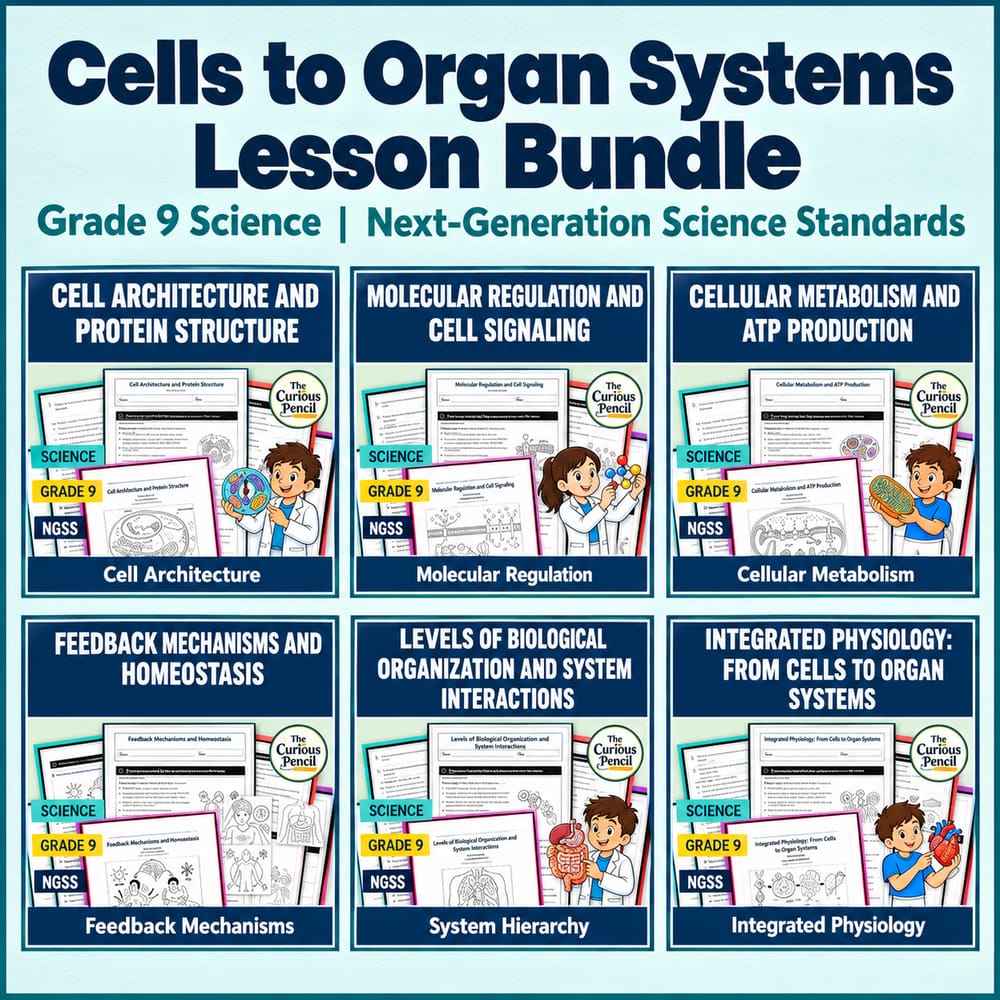
Cells to Organ Systems Lesson Bundle | Grade 9 Science | Next-Generation Science Standards — bundle cover
Cells to Organ Systems Lesson Bundle | Grade 9 Science | Next-Generation Science Standards — included worksheet 1
Cells to Organ Systems Lesson Bundle | Grade 9 Science | Next-Generation Science Standards — included worksheet 2
Cells to Organ Systems Lesson Bundle | Grade 9 Science | Next-Generation Science Standards — included worksheet 3
Cells to Organ Systems Lesson Bundle | Grade 9 Science | Next-Generation Science Standards — included worksheet 4
Cells to Organ Systems Lesson Bundle | Grade 9 Science | Next-Generation Science Standards — included worksheet 5
Cells to Organ Systems Lesson Bundle | Grade 9 Science | Next-Generation Science Standards — included worksheet 6
Grade 9 Science worksheet — Cells to Organ Systems Lesson Bundle | Grade 9 Science | Next-Generation Science Standards

Description

Overview


Cells to Organ Systems in Grade 9 Science is the focus of this NGSS science lesson bundle, with 6 ready-to-teach worksheets aligned to Next Generation Science Standards. Students investigate how cell structure supports function, how molecules move information through signaling pathways, and how organisms maintain stability through feedback systems. Across the set, learners connect biological organization from cells to organ systems with evidence-based reasoning about regulation, metabolism, and homeostasis.

This unit bundle supports classroom routines where students read, model, interpret diagrams, and explain cause-and-effect relationships in living systems. The worksheets emphasize making sense of phenomena, using scientific vocabulary accurately, and grounding explanations in patterns found in data, models, and text.

Because these materials are bundled by theme, you can plan a coherent 1–3 week sequence for instruction, practice, and review centered on Cells to Organ Systems.

What’s Included


  • ✅ Biological Organization Worksheets: Cells to Organ Systems | Grade 9 – Build understanding of how cells organize into tissues and organ systems within larger biological structures.
  • ✅ Molecular Regulation and Cell Signaling Worksheets | Grade 9 Science – Examine how signals travel and how cells respond to regulate activities using molecules and mechanisms.
  • ✅ Integrated Physiology: Cells to Organ Systems Worksheets Grade 9 – Connect cell-level processes to how organ systems work together to support overall organism function.
  • ✅ Homeostasis and Feedback Mechanisms Worksheets | Grade 9 Science – Practice interpreting feedback loops and explaining how changes trigger responses to maintain stable internal conditions.
  • ✅ Cellular Metabolism and ATP Production: Grade 9 Worksheets – Analyze how cells convert energy, produce ATP, and use matter and energy transformations to sustain life functions.
  • ✅ Cell Architecture and Protein Structure: Grade 9 Science Worksheets – Describe how cell structures and protein shape/function relate, supporting regulation and cellular performance.

Skills & Standards


Aligned to NGSS, this unit supports science and engineering practices such as constructing explanations, analyzing and interpreting data and models, and using evidence to justify claims. Students learn to connect disciplinary core ideas including structure and function, organization for matter and energy flow, and information processing in living systems. Crosscutting concepts like systems and system models and cause and effect are embedded through prompts that require students to track how molecular events scale up to physiological outcomes.

Within this Cells to Organ Systems unit, students build specific abilities to: (1) relate observable cellular components to their functions in biological organization; (2) interpret signaling and regulation as mechanisms that control cell behavior; (3) use feedback mechanisms to predict how internal changes can be corrected; (4) explain cellular metabolism by linking ATP production to energy needs; and (5) connect protein structure to how cells execute biological roles.

Worksheets emphasize evidence-based explanations by asking learners to cite patterns from diagrams, walkthroughs, and scenario data, then translate those observations into clear causal reasoning about living systems.

Perfect For


  • Teachers seeking structured instruction
  • Sub plans
  • Homework or review
  • Intervention or centers
  • Assessment preparation

How to Use


Plan this NGSS science lesson bundle for a focused 1–3 week unit: introduce foundational organization, move into signaling and homeostasis, then culminate with metabolism and protein/cell architecture connections. Use short daily warm-ups to review key terms (cell structure, signaling molecules, feedback, ATP) and to connect the day’s questions back to Cells to Organ Systems.

For guided practice, pair one worksheet with a class model or diagram walk-through, then have students complete a “claim–evidence–reasoning” style explanation using the prompts. Close each day with targeted exit tickets that ask students to predict outcomes from a simple change (for example, what happens if signaling is blocked, or if a feedback loop responds too slowly). Finish with an end-of-unit review that blends multiple mechanisms—organization, regulation, and energy—to check transfer of understanding.

Closing


These worksheets help students describe and support explanations for how cells coordinate to maintain stable, functioning organ systems.

Cells to Organ Systems Lesson Bundle | Grade 9 Science | Next-Generation Science Standards

$19.20$24.00Save $4.80
the curious pencil
New·0 followers·2 sales
SubjectScienceGradeGrade 9Pages103 Pages

What’s included

6 worksheets · 103 pages · Save $4.80 (20%) · prices shown inside the bundle

  1. Cell Architecture and Protein Structure: Grade 9 Science Worksheets
    Cell Architecture and Protein Structure: Grade 9 Science Worksheets

    Grade 9 · Science · 18 Pages

    • Explain how nucleic acid sequences influence amino acid sequences
    • Describe how protein folding connects molecular structure to function
    • Connect protein structure to cellular architecture and function
    $3.20$4.00
  2. Molecular Regulation and Cell Signaling Worksheets | Grade 9 Science
    Molecular Regulation and Cell Signaling Worksheets | Grade 9 Science

    Grade 9 · Science · 16 Pages

    • Explain how transcription factors regulate gene expression and protein production
    • Describe how ligand-receptor binding initiates signal transduction pathways
    • Analyze how insulin signaling promotes cellular glucose uptake
    $3.20$4.00
  3. Cellular Metabolism and ATP Production: Grade 9 Worksheets
    Cellular Metabolism and ATP Production: Grade 9 Worksheets

    Grade 9 · Science · 18 Pages

    • Explain how glycolysis contributes to ATP production during cellular respiration.
    • Describe how the citric acid cycle transfers energy to electron carriers.
    • Explain how electron transport and proton gradients drive ATP production.
    $3.20$4.00
  4. Homeostasis and Feedback Mechanisms Worksheets | Grade 9 Science
    Homeostasis and Feedback Mechanisms Worksheets | Grade 9 Science

    Grade 9 · Science · 18 Pages

    • Explain how negative feedback maintains stable internal conditions
    • Describe the roles of sensors, control centers, and effectors
    • Analyze thermoregulation, blood glucose, and water balance
    $3.20$4.00
  5. Biological Organization Worksheets: Cells to Organ Systems | Grade 9
    Biological Organization Worksheets: Cells to Organ Systems | Grade 9

    Grade 9 · Science · 17 Pages

    • Identify levels of biological organization from cells to organ systems.
    • Explain how specialized cells contribute to tissue structure and function.
    • Describe how tissues combine to form functional organs.
    $3.20$4.00
  6. Integrated Physiology: Cells to Organ Systems Worksheets Grade 9
    Integrated Physiology: Cells to Organ Systems Worksheets Grade 9

    Grade 9 · Science · 16 Pages

    • Explain how molecular changes can influence cellular and organ function
    • Describe how genetic variation can affect organ system performance
    • Analyze how CFTR dysfunction contributes to respiratory difficulties
    $3.20$4.00

Reviews & Feedback

Loading reviews...

Questions & Answers

Loading questions…

About this bundle

Related categories

Frequently asked questions

Who is Cells to Organ Systems Lesson Bundle | Grade 9 Science | Next-Generation Science Standards designed for?
Cells to Organ Systems Lesson Bundle | Grade 9 Science | Next-Generation Science Standards is designed for Grade 9 students and Science learners and can be used in classrooms, homeschool, or independent practice.
How do I download Cells to Organ Systems Lesson Bundle | Grade 9 Science | Next-Generation Science Standards?
Add it to your cart and complete checkout. After payment, you can download immediately from your account, and you'll also receive a download link by email.