
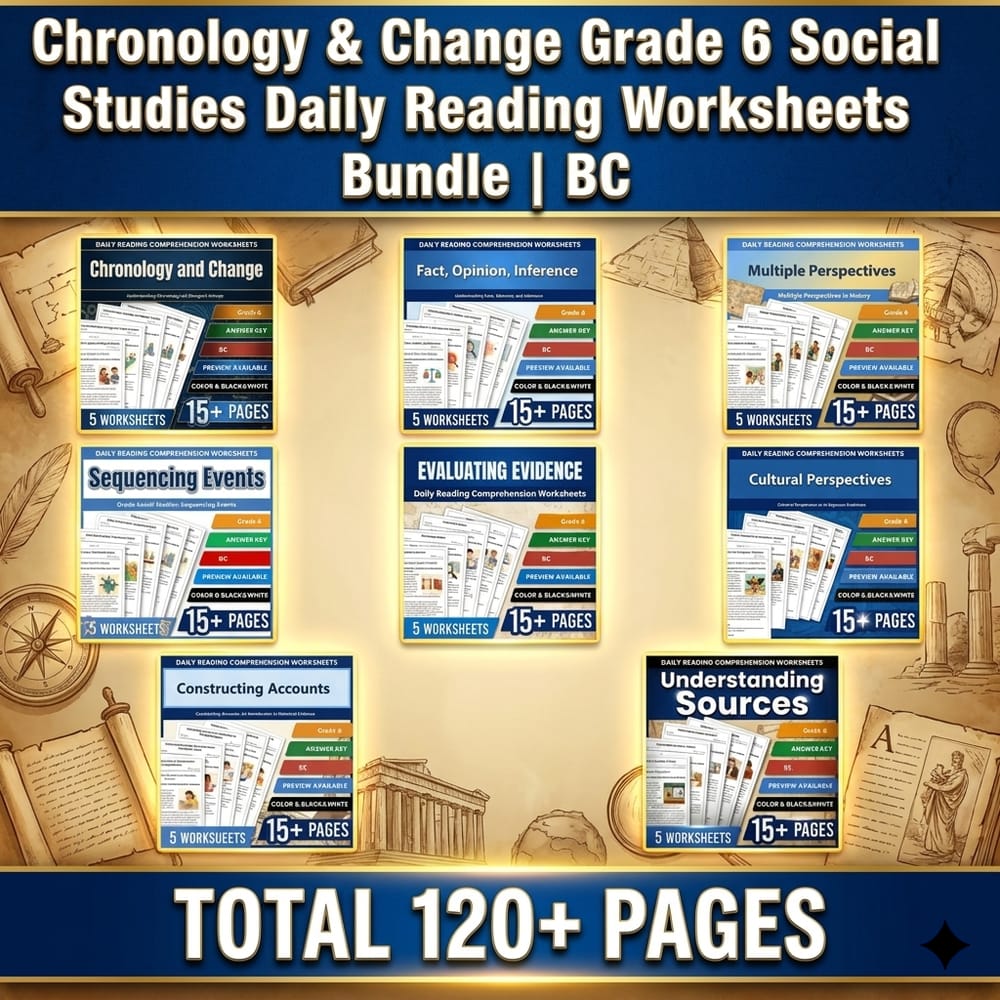
Chronology & Change Grade 6 Social Studies Daily Reading Worksheets Bundle | BC
$25.60$32.00Save $6.40
Quiet Forest Education
·3 followers·20 sales
SubjectSocial StudiesGradeGrade 6Pages259 Pages
What’s included
8 worksheets · 259 pages · Save $6.40 (20%) · prices shown inside the bundle
 Grade 6 Social Studies Chronology & Historical Change Worksheet | BC
- Learn the importance of chronological order in historical understanding.
- Construct basic timelines to illustrate technological advancements.
- Analyze how sequencing of events influences perceptions of progress and causality.
$3.20$4.00 Understanding Facts, Opinions & Inference Worksheet | Grade 6 BC
- Differentiate between facts and opinions in sources.
- Make inferences based on textual evidence.
- Analyze quotes from historical figures and articles critically.
$3.20$4.00 Multiple Perspectives in History Worksheet Grade 6 Social Studies BC
- Understand the concept of multiple viewpoints in historical narratives.
- Identify different perspectives such as Indigenous, settler, and immigrant viewpoints.
- Analyze how diverse perspectives influence historical interpretation.
$3.20$4.00 Grade 6 Social Studies Sequencing Events Worksheet | BC Curriculum
- Identify and understand the chronological order of events in Indigenous migration patterns.
- Develop skills to sequence historical events accurately.
- Recognize how early migration shaped the land and influenced subsequent history.
$3.20$4.00 Evaluating Evidence Worksheet Grade 6 Social Studies BC + Answer Key
- Understand what makes a source trustworthy
- Identify credible versus biased sources
- Analyze the authenticity of historical evidence
$3.20$4.00 Cultural Perspectives in Indigenous Traditions Worksheet | Grade 6 BC
- Understand the cultural significance of the Eagle Dance in Indigenous communities.
- Analyze how cultural backgrounds influence historical narratives.
- Identify differences between Indigenous worldviews and Western interpretations.
$3.20$4.00 Constructing Accounts Historical Evidence Worksheet | Grade 6 BC
- Identify and distinguish between primary and secondary sources.
- Understand how historians use different sources to construct historical narratives.
- Analyze the reliability and bias of various historical evidence.
$3.20$4.00 Understanding Sources in History Worksheet | Grade 6 Social Studies BC
- Define primary and secondary sources.
- Identify examples of primary and secondary sources.
- Distinguish between firsthand documents and later retellings.
$3.20$4.00
Reviews & Feedback
Loading reviews...
Questions & Answers
Loading questions…
About this bundle
Related categories
Frequently asked questions
Who is Chronology & Change Grade 6 Social Studies Daily Reading Worksheets Bundle | BC designed for?
Chronology & Change Grade 6 Social Studies Daily Reading Worksheets Bundle | BC is designed for Grade 6 students and Social Studies learners and can be used in classrooms, homeschool, or independent practice.
How do I download Chronology & Change Grade 6 Social Studies Daily Reading Worksheets Bundle | BC?
Add it to your cart and complete checkout. After payment, you can download immediately from your account, and you'll also receive a download link by email.
Similar Products

High School Social Studies 9-12 Full-Year Bundle | California
$262.50$525.00

Grade 11 Social Studies Full-Year Worksheets Bundle | California
$105.00$150.00

Grade 10 Social Studies Full-Year Worksheets Bundle | California
$84.00$120.00

Grade 9 Social Studies Full-Year Worksheets Bundle | California
$77.00$110.00

Middle School Social Studies 6-8 Full-Year Bundle | California
$447.50$895.00