
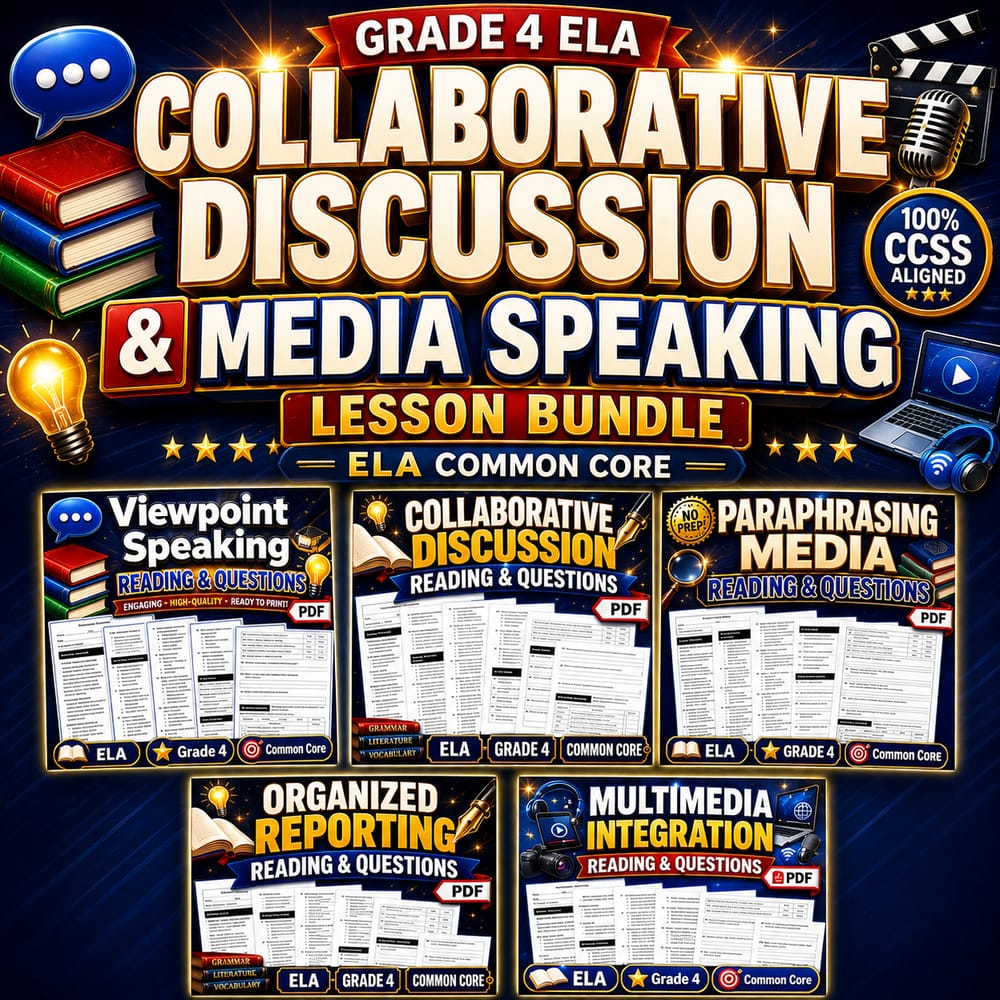
Collaborative Discussion & Media Speaking Lesson Bundle Grade 4 ELA Common Core
$16.00$20.00Save $4.00
Golden Apple Studio
New·2 followers·3 sales
SubjectELAGradeGrade 4Pages78 Pages
What’s included
5 worksheets · 78 pages · Save $4.00 (20%) · prices shown inside the bundle
 Grade 4 ELA Viewpoint Speaking Worksheet (PDF) | CCSS Standards
- Present a clear viewpoint by stating a claim and using reasons that connect directly to the claim.
- Support opinions with relevant evidence (facts, examples, or observations) and explain how it supports the viewpoint.
- Address opposing or alternative perspectives respectfully and explain why the speaker’s viewpoint still matters.
$3.20$4.00 Grade 4 ELA Collaborative Discussion Worksheet (PDF) | CCSS Standards
- Participate in collaborative discussions by sharing ideas clearly and staying on the topic.
- Ask and answer questions to build understanding and to connect to others’ comments.
- Use respectful turn-taking and clarifying statements to strengthen mutual understanding.
$3.20$4.00 Grade 4 ELA Paraphrasing Media Worksheet (CCSS) | Reading & Writing Practice (PDF)
- Explain what paraphrasing means and how it differs from copying word-for-word.
- Paraphrase the main idea and supporting details from spoken or media information.
- Maintain meaning by using new wording while keeping the original message structure.
$3.20$4.00 Grade 4 ELA – Organized Reporting Worksheet (PDF) Aligned with CCSS
- Describe how organized reporting uses a logical sequence to present information clearly.
- Identify and use transitions to show changes in focus from one idea to the next.
- Select relevant facts and details that match the purpose of the report.
$3.20$4.00 Grade 4 ELA Worksheet | Multimedia Integration and Presentation Skills (PDF)
- Explain how multimedia integration improves a presentation by connecting visuals and audio to the spoken message.
- Identify when to use visuals and audio so they support comprehension rather than distract listeners.
- Apply planning steps to create a simple multimedia plan that matches a presentation script.
$3.20$4.00
Reviews & Feedback
Loading reviews...
Questions & Answers
Loading questions…
About this bundle
Related categories
Frequently asked questions
Who is Collaborative Discussion & Media Speaking Lesson Bundle Grade 4 ELA Common Core designed for?
Collaborative Discussion & Media Speaking Lesson Bundle Grade 4 ELA Common Core is designed for Grade 4 students and ELA learners and can be used in classrooms, homeschool, or independent practice.
How do I download Collaborative Discussion & Media Speaking Lesson Bundle Grade 4 ELA Common Core?
Add it to your cart and complete checkout. After payment, you can download immediately from your account, and you'll also receive a download link by email.
Similar Products

Grade 3 Collaborative Discussion Media Skills ELA Lesson Bundle – TEKS
$12.00$15.00

Grade 7 Speaking & Listening: Presenting, Claims & Collaboration Lesson Bundle | CCSS ELA
$9.60$12.00

Grade 3 Collaborative Discussion ELA Lesson Bundle: Alberta Framework
$24.00$30.00

Grade 10 ELA Audience-Aware Collaborative Communication Lesson Bundle | Alberta
$14.40$18.00

Grade 5 Collaborative Turns and Audience-Responsive Speech ELA Lessons TEKS
$14.40$18.00