
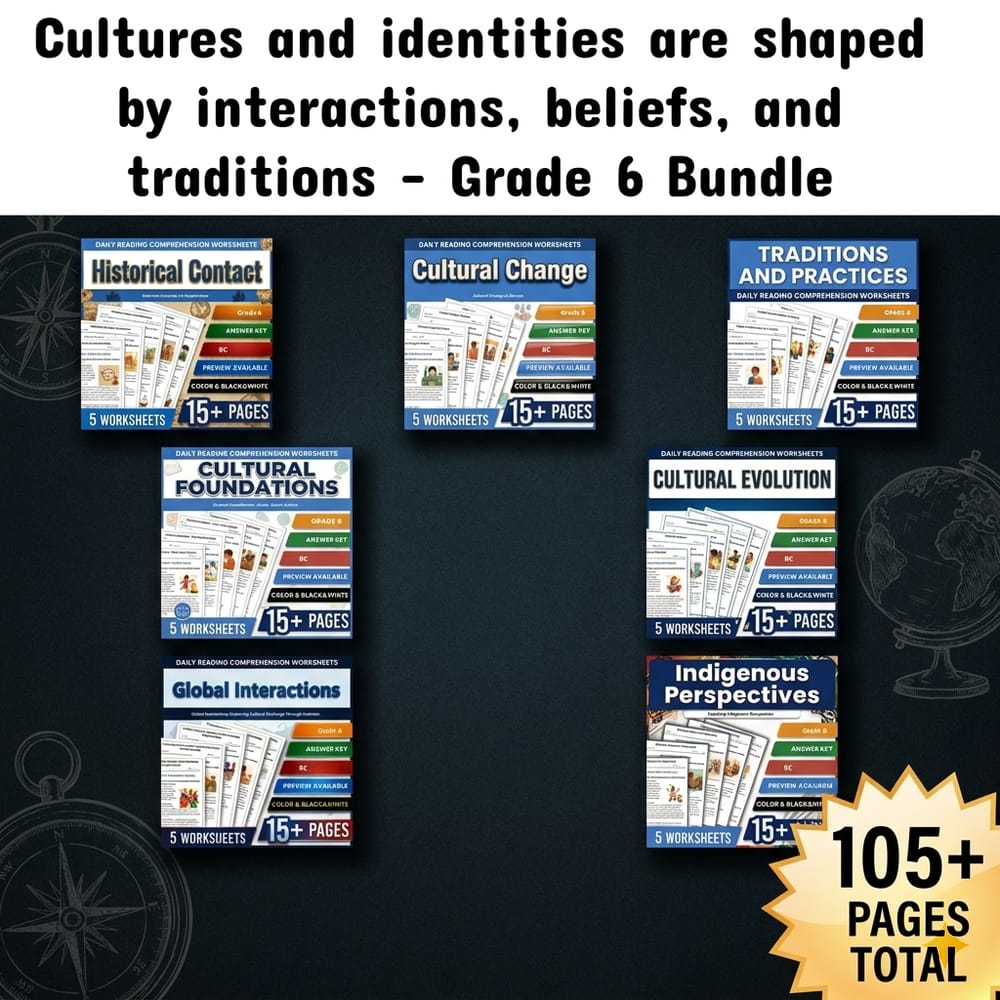
Cultures: Traditions, Contact & Change Lesson Bundle | Grade 6 Social Studies BC
$22.40$28.00Save $5.60
Quiet Forest Education
·3 followers·20 sales
SubjectSocial StudiesGradeGrade 6Pages233 Pages
What’s included
7 worksheets · 233 pages · Save $5.60 (20%) · prices shown inside the bundle
 Grade 6 Historical Contact and Exploration Worksheet | BC Social Studies
- Understand the key motives and routes of early exploration
- Identify the cultural exchanges that resulted from exploration
- Analyze the impacts of contact between different societies during the Age of Exploration
$3.20$4.00 Cultural Change in Society Worksheet | Grade 6 Social Studies BC
- Understand factors influencing cultural identity
- Analyze the impact of globalization, technology, and migration on cultures
- Recognize how cultures adapt and evolve over time
$3.20$4.00 Grade 6 Traditions and Practices in Cultures Worksheet | BC Social Studies
- Understand the role of traditions in different societies.
- Analyze how rituals and customs reinforce community identity.
- Compare cultural practices from diverse communities.
$3.20$4.00 Grade 6 Cultural Foundations Social Studies Worksheet | BC Curriculum
- Understand the core beliefs and values that influence cultural identities.
- Identify traditional practices, social roles, and rituals as expressions of cultural values.
- Examine how indigenous and contemporary communities preserve cultural identity through traditions.
$3.20$4.00 Cultural Evolution Worksheet | Grade 6 Social Studies BC Curriculum
- Understand traditional cultural practices in different communities
- Recognize how external influences affect cultural identities
- Reflect on the importance of preserving cultural diversity amidst change
$3.20$4.00 Grade 6 Cultural Exchange Festivals Worksheet | Global Interactions BC
- Understand the significance of multicultural festivals in promoting cultural exchange
- Analyze how festivals influence identities and bring communities together
- Recognize different types of intercultural contact and their impacts
$3.20$4.00 Grade 6 Indigenous Perspectives Worksheet | BC Social Studies Activity
- Understand the cultural practices and traditions of Indigenous communities.
- Recognize how Indigenous groups maintain their identity through traditions.
- Analyze the ways in which external influences are adapted by Indigenous peoples.
$3.20$4.00
Reviews & Feedback
Loading reviews...
Questions & Answers
Loading questions…
About this bundle
Related categories
Frequently asked questions
Who is Cultures: Traditions, Contact & Change Lesson Bundle | Grade 6 Social Studies BC designed for?
Cultures: Traditions, Contact & Change Lesson Bundle | Grade 6 Social Studies BC is designed for Grade 6 students and Social Studies learners and can be used in classrooms, homeschool, or independent practice.
How do I download Cultures: Traditions, Contact & Change Lesson Bundle | Grade 6 Social Studies BC?
Add it to your cart and complete checkout. After payment, you can download immediately from your account, and you'll also receive a download link by email.

