
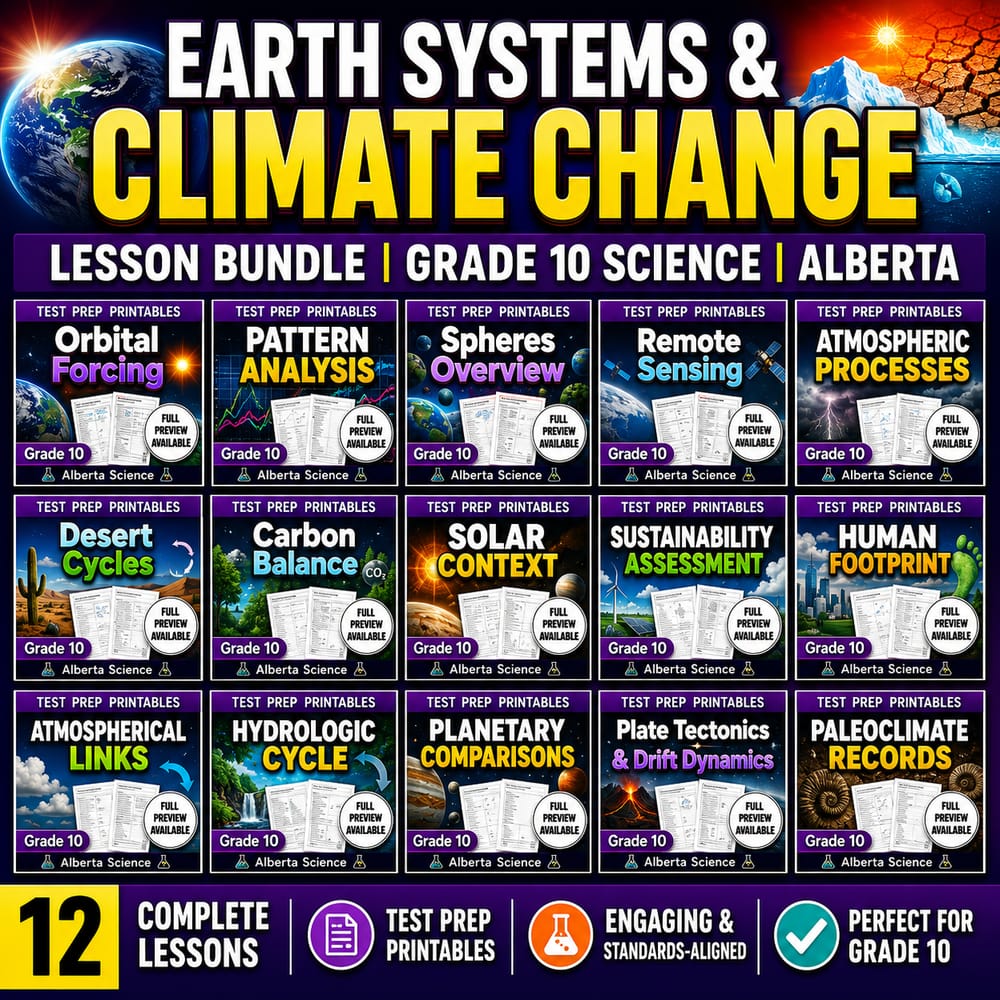


Earth Systems & Climate Change Lesson Bundle | Grade 10 Science | Alberta
$60.00$75.00Save $15.00
Prism Point Learning
·2 followers·13 sales
SubjectScienceGradeGrade 10
What’s included
15 worksheets · Save $15.00 (20%) · prices shown inside the bundle
 Orbital Forcing Worksheet | Grade 10 Science Practice
- Explain how variations in Earth’s orbital shape, axial tilt, and precession change where and when solar energy reaches the planet.
- Describe how orbital forcing can contribute to slow climate cycles and glacial–interglacial rhythms over tens to hundreds of thousands of years.
- Distinguish long-term orbital drivers from shorter-term atmospheric and human influences on regional climate.
$4.00$5.00 Pattern Analysis Worksheet Pack | Grade 10 Science Activities
- Identify temporal and spatial patterns in Earth and space data using observations and simple statistical summaries
- Differentiate trends, cycles, and random variation, and explain how correlation supports (or does not prove) relationships
- Evaluate how sampling frequency and data quality affect confidence in inferred patterns
$4.00$5.00 Spheres Overview Worksheet | Grade 10 Science Activities
- Identify the geosphere, hydrosphere, atmosphere, and biosphere and describe their basic properties.
- Explain how matter and energy move between Earth’s spheres using examples from Alberta.
- Use evidence from landscapes and climate patterns to make cause-and-effect connections among the spheres.
$4.00$5.00 Remote Sensing Worksheet | Grade 10 Science Activities
- Explain how satellite and aerial remote sensing collect information using different sensor types and spectral ranges.
- Describe how multi-spectral data and indices help detect environmental change over time in Alberta contexts.
- Interpret common derived products (e.g., vegetation indices, water extent, surface temperature) and relate them to field measurements.
$4.00$5.00 Atmospheric Processes Worksheet | Grade 10 Science Practice
- Explain how pressure, temperature, and moisture differences drive regional weather patterns
- Describe how fronts, Chinook winds, and convection affect precipitation distribution
- Relate atmospheric composition and surface albedo to the Earth’s energy balance
$4.00$5.00 Resource Cycles Worksheet | Grade 10 Science Assessment
- Explain how Earth systems move and transform resources through cycle pathways and reservoirs
- Interpret residence time and flux as factors that influence ecosystem function and resource availability
- Connect examples from Alberta (snowpack runoff, peat carbon storage, prairie nitrogen flux, and mineral sources) to resource cycles
$4.00$5.00 Carbon Balance Worksheet | Grade 10 Science Activities
- Explain how carbon moves among the atmosphere, vegetation, soil, and ocean through major flux pathways
- Describe how natural disturbances and succession can change carbon uptake, release, and long-term storage
- Use carbon-balance ideas to predict how changes in fluxes may affect greenhouse gas concentrations and climate feedbacks
$4.00$5.00 Solar Context Worksheet | Grade 10 Science Activities
- Explain how Earth’s rotation and revolution determine seasonal daylight and solar angle changes.
- Relate solar irradiance and orbital geometry to energy input patterns that affect climate and ecosystems.
- Describe the roles of gravity and orbital motion in the Earth–Moon–Sun system.
$4.00$5.00 Sustainability Assessment Worksheet Grade 10 Science Activities
- Explain how environmental, economic, and social indicators work together in sustainability assessment
- Identify metrics used to evaluate long-term viability of resource use (e.g., renewal rates and pollutant loads)
- Apply assessment ideas to decisions about extraction, conservation, and restoration in a regional context
$4.00$5.00 Human Footprint Worksheet Grade 10 Science | Alberta Standards Practice
- Explain how land use, resource extraction, and greenhouse gas emissions change Earth systems.
- Describe how these changes can affect soil, water, and atmospheric processes over time.
- Use measurable indicators (like habitat area, water quality, and emissions) to evaluate environmental impacts.
$4.00$5.00
Reviews & Feedback
Loading reviews...
Questions & Answers
Loading questions…
About this bundle
Related categories
Frequently asked questions
Who is Earth Systems & Climate Change Lesson Bundle | Grade 10 Science | Alberta designed for?
Earth Systems & Climate Change Lesson Bundle | Grade 10 Science | Alberta is designed for Grade 10 students and Science learners and can be used in classrooms, homeschool, or independent practice.
How do I download Earth Systems & Climate Change Lesson Bundle | Grade 10 Science | Alberta?
Add it to your cart and complete checkout. After payment, you can download immediately from your account, and you'll also receive a download link by email.
Similar Products

Earth Systems: Tectonics & Climate Lesson Bundle | Grade 9 Science NGSS
$22.40$28.00

Grade 10 Earth Science Worksheets Bundle | Climate & Earth Systems
$19.20$24.00

Earth Systems, Climate, and Sustainability Lesson Bundle | Grade 10 Science | Alberta
$36.00$45.00

Grade 12 Science Lesson Bundle: Space, Earth Systems, and Climate (General)
$16.00$20.00

Grade 10 Earth Systems & Climate Science Lesson Bundle – Alberta Framework
$60.00$75.00