
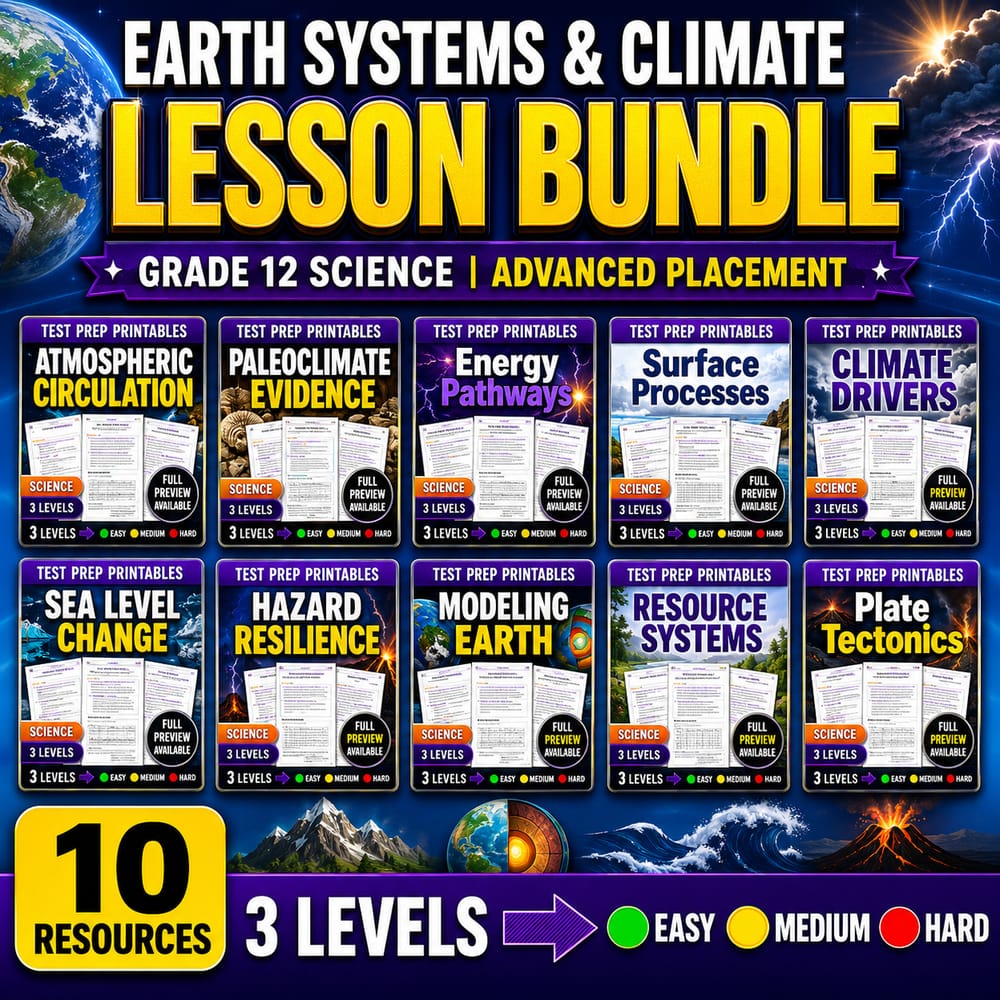


Earth Systems & Climate Lesson Bundle | Grade 12 Science | Advanced Placement
$48.00$60.00Save $12.00
Prism Point Learning
·2 followers·14 sales
SubjectScienceGradeGrade 12
What’s included
12 worksheets · Save $12.00 (20%) · prices shown inside the bundle
 Atmospheric Circulation Worksheet | Grade 12 AP Science Climate Systems Activity
- Describe how large-scale circulation cells (Hadley, Ferrel, and polar) redistribute heat and influence pressure patterns
- Explain how the Coriolis effect and thermal gradients shape jet streams and midlatitude storm tracks
- Use circulation and pressure-map reasoning to connect atmospheric dynamics with precipitation and seasonal/regional climate shifts
$4.00$5.00 Paleoclimate Evidence Worksheet | Grade 12 AP Science Climate History Activity
- Interpret how different climate proxy records (ice cores, marine sediments, tree rings, speleothems) preserve past climate information.
- Explain how isotopic, chemical, and biological indicators are used to infer temperature and precipitation changes.
- Describe how age models and calibration connect proxy signals to known forcings and quantify uncertainty and resolution limits.
$4.00$5.00 Energy Pathways Worksheet | Grade 12 AP Science Energy Systems Activity
- Explain how energy transfers through radiation, conduction, convection, and phase change within Earth systems.
- Apply conservation of energy to simple energy budgets that connect microscopic processes to large-scale weather and ocean patterns.
- Interpret relationships between sea-surface temperature gradients, ocean currents, and geothermal heat flow.
$4.00$5.00 Surface Processes Worksheet | Grade 12 AP Science Earth Systems Activity
- Explain how weathering, erosion, transport, and deposition interact to shape landscapes and create sedimentary records.
- Use sediment budgets and process-response ideas to relate climate, vegetation, and tectonic uplift to rates of surface change.
- Interpret how changes in sediment flux and channel form can alter depositional environments and stratigraphic architecture.
$4.00$5.00 Climate Drivers Worksheet | Grade 12 AP Science Climate Change Activity
- Explain how greenhouse gas, volcanic, solar, and land-surface changes affect climate through radiative forcing.
- Use basic energy-balance ideas to compare the relative magnitude and timing of different climate drivers.
- Describe key feedbacks (ice-albedo and water vapor) and how uncertainty is quantified in climate projections.
$4.00$5.00 Sea Level Change Worksheet | Grade 12 AP Science Climate Systems Activity
- Explain major drivers of sea level variability, including thermal expansion and land-ice mass loss.
- Describe how tide-gauge records, satellite altimetry, and coastal stratigraphy are used to infer sea level change.
- Use the idea of “fingerprinting” to connect observed patterns to likely causes and interpret uncertainties in projections.
$4.00$5.00 Hazard Resilience Worksheet | Grade 12 AP Science Natural Hazards Activity
- Explain how hazard frequency, magnitude, and landscape vulnerability combine to influence risk and resilience.
- Use probabilistic thinking to characterize hazards and interpret uncertainty in hazard modeling.
- Evaluate strategies for reducing long-term impacts through land-use planning, early warning, and engineered interventions.
$4.00$5.00 Modeling Earth Worksheet | Grade 12 AP Science Earth Systems Activity
- Explain how energy-balance, circulation, and landscape-evolution models represent coupled Earth processes over different timescales.
- Use model validation and sensitivity ideas to interpret model outputs and compare scenarios.
- Describe how parameter choices and limited resolution can create uncertainty when models use heterogeneous observations.
$4.00$5.00 Resource Systems Worksheet | Grade 12 AP Science Environmental Systems Activity
- Explain how geological resources, extraction processes, and societal demand interact in mineral, groundwater, and hydrocarbon systems.
- Use ore deposit models, aquifer properties, and basin maturation ideas to predict supply limits and long-term change.
- Evaluate trade-offs among resource availability, environmental impacts, and technological or regulatory adaptations.
$4.00$5.00 Plate Tectonics Worksheet | Grade 12 AP Science Earth Systems Activity
- Explain how plate motion creates different boundary types (convergent, divergent, and transform) and associated landforms.
- Connect seismicity, volcanic activity, and earthquake focal mechanisms to tectonic processes.
- Interpret plate reconstructions and bathymetry to infer crustal evolution over geologic time.
$4.00$5.00
Reviews & Feedback
Loading reviews...
Questions & Answers
Loading questions…
About this bundle
Related categories
Frequently asked questions
Who is Earth Systems & Climate Lesson Bundle | Grade 12 Science | Advanced Placement designed for?
Earth Systems & Climate Lesson Bundle | Grade 12 Science | Advanced Placement is designed for Grade 12 students and Science learners and can be used in classrooms, homeschool, or independent practice.
How do I download Earth Systems & Climate Lesson Bundle | Grade 12 Science | Advanced Placement?
Add it to your cart and complete checkout. After payment, you can download immediately from your account, and you'll also receive a download link by email.
Similar Products

Earth Systems: Tectonics & Climate Lesson Bundle | Grade 9 Science NGSS
$22.40$28.00

Grade 10 Earth Science Worksheets Bundle | Climate & Earth Systems
$19.20$24.00

Grade 10 Earth and Climate Systems Science Lesson Bundle Worksheets (AP)
$32.00$40.00

Grade 12 Earth Systems and Climate Science Bundle – Advanced Placement (AP)
$48.00$60.00

Grade 10 Earth Systems Science lesson bundle | Advanced Placement (AP) Practice
$36.00$45.00