
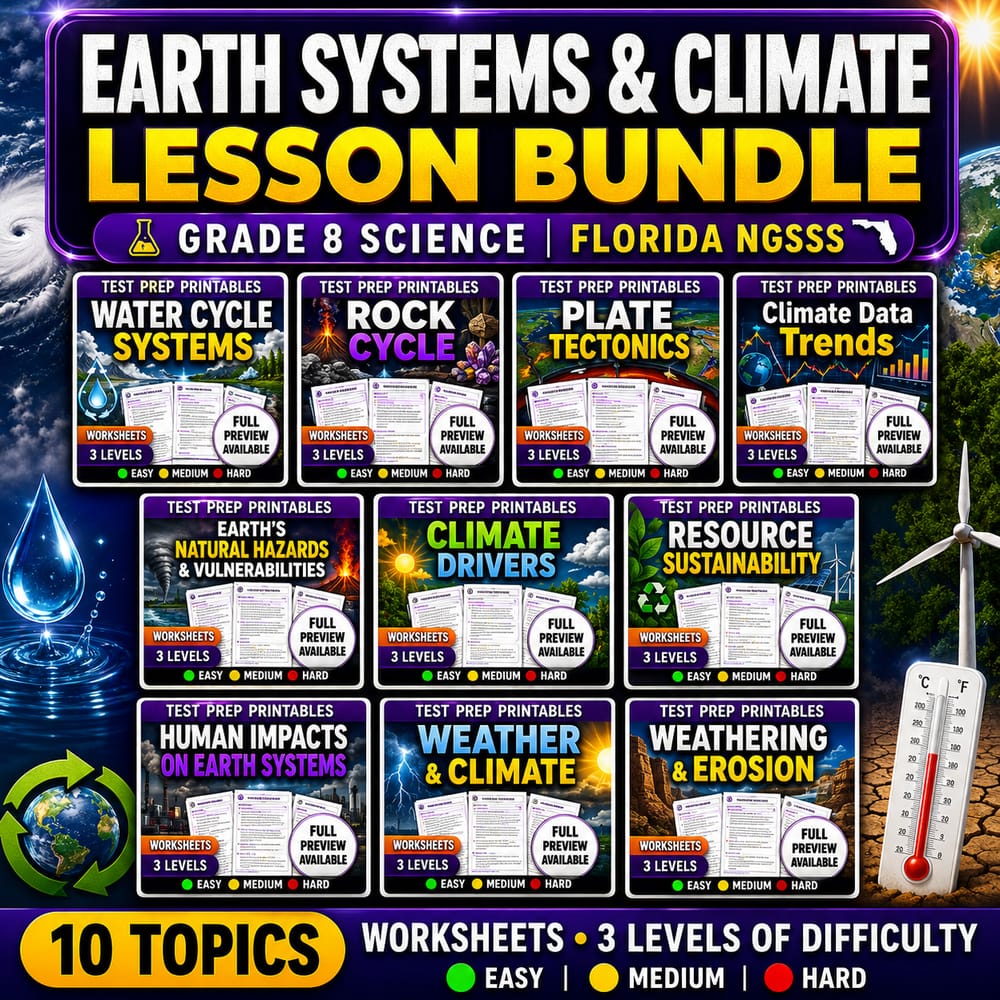
Earth Systems & Climate Lesson Bundle | Grade 8 Science | Florida NGSSS
$40.00$50.00Save $10.00
Prism Point Learning
·2 followers·13 sales
SubjectScienceGradeGrade 8
What’s included
10 worksheets · Save $10.00 (20%) · prices shown inside the bundle
 Water Cycle Systems Worksheet Grade 8 Science | Hydrology Activities
- Explain how water moves through Earth’s systems during evaporation, condensation, precipitation, runoff, and infiltration.
- Describe how temperature and energy affect evaporation and precipitation patterns.
- Connect human water use to changes in local water availability and environmental impacts.
$4.00$5.00 Rock Cycle Worksheet Grade 8 Science Activities | Earth Science NGSSS
- Explain how the rock cycle connects igneous, sedimentary, and metamorphic rocks
- Describe how weathering, erosion, deposition, heat, and pressure transform rocks over time
- Relate lithospheric recycling to tectonic plate motion and Earth’s energy transfer
$4.00$5.00 Plate Tectonics Worksheet Grade 8 Science Activities & Earth Science Practice
- Explain how plate motions reshape Earth’s landforms over geologic time.
- Describe how evidence (matching coastlines, seafloor features, earthquakes) supports plate tectonics.
- Differentiate divergent, convergent, and transform boundaries by typical landforms and activity.
$4.00$5.00 Climate Data Trends Worksheet Grade 8 Science Practice & Climate Analysis
- Interpret long-term climate trends by comparing average values and extreme events over time.
- Use data from temperature, precipitation, and storm-frequency records to make evidence-based claims.
- Explain how climate indicators and ocean-atmosphere phenomena (El Niño and La Niña) can change rainfall and temperatures.
$4.00$5.00 Earthquakes and Volcanoes Worksheet Grade 8 Science Practice Activity
- Explain how plate movement can cause earthquakes and volcanic eruptions by describing energy release in Earth’s interior.
- Identify patterns in where earthquakes and volcanoes occur and relate them to tectonic hazards.
- Compare primary and secondary effects of seismic and volcanic events, such as landslides and tsunamis.
$4.00$5.00 Climate Drivers Worksheet Grade 8 Science Climate Systems & Energy Balance
- Explain how latitude affects the angle of incoming solar energy and influences climate patterns.
- Describe how greenhouse gases, cloud cover, and surface reflectivity affect energy balance in Earth’s system.
- Analyze how atmospheric circulation and ocean currents redistribute heat to create regional climate differences.
$4.00$5.00 Resource Sustainability Worksheet Grade 8 Science Activities & Practice
- Explain the difference between renewable and nonrenewable resources and why renewability matters for sustainability
- Describe how human extraction and use of resources can affect ecosystems and environmental health
- Evaluate whether resource use is sustainable by considering demand, regeneration capacity, and environmental indicators
$4.00$5.00 Human Impacts on Earth Systems Worksheet | Grade 8 Science Activities
- Explain how human activities can change Earth systems by altering energy and matter in the atmosphere, hydrosphere, and geosphere
- Describe how greenhouse-gas emissions can influence temperature patterns and then affect precipitation and storms
- Evaluate environmental solutions using evidence, while considering tradeoffs
$4.00$5.00 Weather vs Climate Worksheet Grade 8 Science Practice | NGSSS
- Explain the difference between weather and climate using examples from temperature, precipitation, and wind.
- Describe how long-term data (many years) helps reveal climate trends.
- Identify factors that influence typical weather and climate patterns, such as energy from the Sun, air-mass movement, and oceans/landmasses.
$4.00$5.00 Weathering and Erosion Worksheet Grade 8 Science Practice Activity
- Explain how physical weathering and chemical weathering break down rocks and change Earth materials
- Describe how erosion transports weathered material by wind, water, ice, and gravity
- Connect deposition to sediment layers and lithification to form new rock
$4.00$5.00
Reviews & Feedback
Loading reviews...
Questions & Answers
Loading questions…
About this bundle
Related categories
Frequently asked questions
Who is Earth Systems & Climate Lesson Bundle | Grade 8 Science | Florida NGSSS designed for?
Earth Systems & Climate Lesson Bundle | Grade 8 Science | Florida NGSSS is designed for Grade 8 students and Science learners and can be used in classrooms, homeschool, or independent practice.
How do I download Earth Systems & Climate Lesson Bundle | Grade 8 Science | Florida NGSSS?
Add it to your cart and complete checkout. After payment, you can download immediately from your account, and you'll also receive a download link by email.
Similar Products

Earth Systems: Tectonics & Climate Lesson Bundle | Grade 9 Science NGSS
$22.40$28.00

Grade 10 Earth Science Worksheets Bundle | Climate & Earth Systems
$19.20$24.00

Space & Earth Systems Lesson Bundle | Grade 10 Science | Florida NGSSS
$36.00$45.00

Grade 8 Earth Systems and Climate Science Lesson Bundle – Florida NGSSS
$40.00$50.00

Grade 12 Science Lesson Bundle: Space, Earth Systems, and Climate (General)
$16.00$20.00