
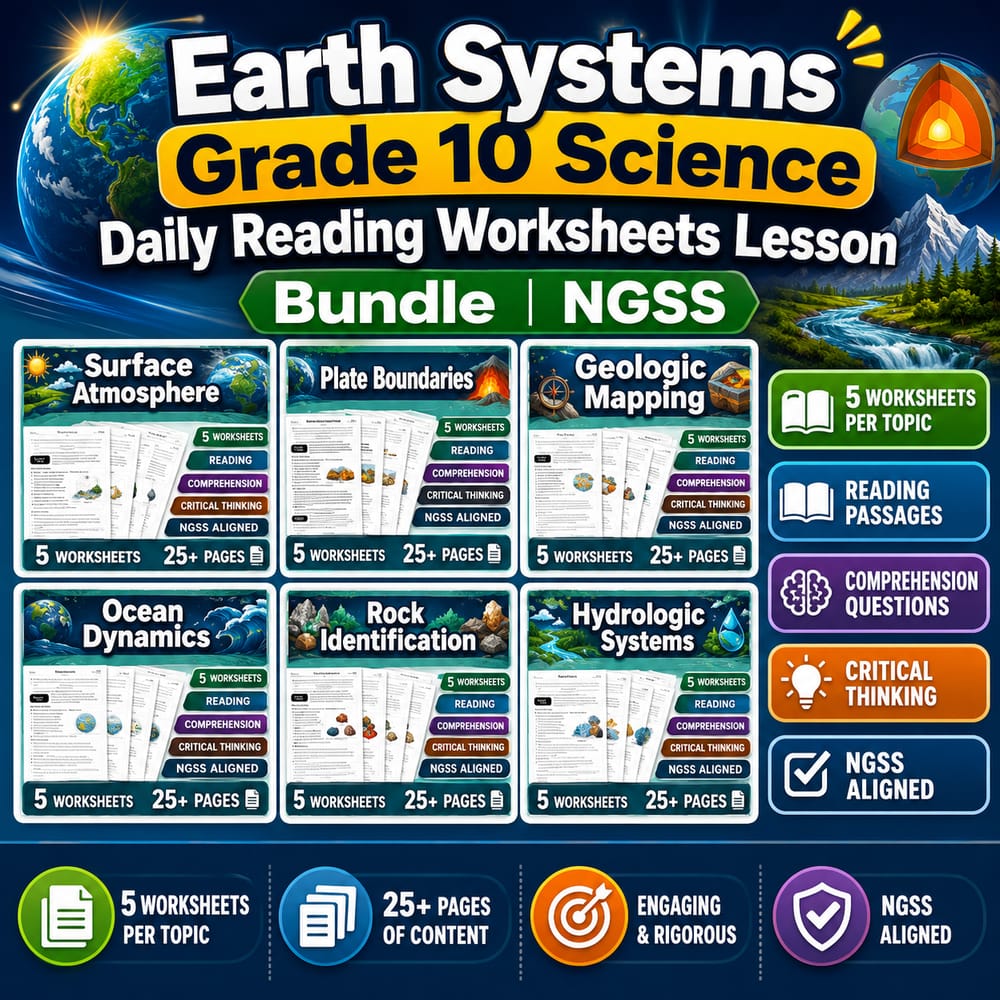
Earth Systems Grade 10 Science Daily Reading Worksheets Lesson Bundle | NGSS
$28.00$35.00Save $7.00
BRIGHT PATH RESOURCES
·3 followers·23 sales
SubjectScienceGradeGrade 10
What’s included
7 worksheets · Save $7.00 (20%) · prices shown inside the bundle
 Grade 10 Surface Atmosphere Worksheet | NGSS Earth Science Activity
- Understand the interactions between Earth's surface and atmosphere.
- Identify how surface properties influence atmospheric conditions.
- Describe concepts such as albedo, radiative forcing, and water cycle processes.
$4.00$5.00 Grade 10 Plate Boundaries & Divergent Boundaries Worksheet | NGSS Science
- Understand the features of divergent plate boundaries
- Identify geological phenomena associated with divergent boundaries
- Analyze the processes occurring at mid-ocean ridges
$4.00$5.00 Grade 10 Introduction to Geologic Mapping Worksheet | NGSS Earth Science
- Understand the basic concepts of geologic mapping
- Identify types of geoscience data involved in mapping
- Describe methods used to interpret Earth's structural features
$4.00$5.00 Grade 10 Ocean Dynamics Science Worksheet | NGSS Earth Science Activity
- Identify main ocean circulation patterns such as thermohaline circulation, gyres, and coastal upwelling.
- Understand how observational tools like ARGO floats and satellites are used to study ocean heat and mass transport.
- Recognize the influence of ocean circulation on climate, sea level, and coastal ecosystems.
$4.00$5.00 Grade 10 Hydrologic Systems Science Worksheet | NGSS Water Cycle Activity
- Understand key concepts related to Science
- Apply knowledge through practice questions
- Demonstrate comprehension of the material
$4.00$5.00 Grade 10 Rock Cycle & Rock Transformations Worksheet | NGSS Earth Science
- Understand the basic types of rocks: igneous, sedimentary, and metamorphic.
- Explain the processes involved in the rock cycle: crystallization, lithification, metamorphism, and weathering.
- Identify petrologic indicators such as mineral assemblages, textures, and geochemical signatures.
$4.00$5.00 Grade 10 Introduction to Paleoclimate Evidence Worksheet | NGSS Science
- Understand different sources of paleoclimate data such as ice cores, tree rings, marine sediments, and speleothems.
- Learn how isotopic ratios, microfossil assemblages, and sedimentary facies help reconstruct past climate conditions.
- Compare paleorecords with instrumental data to interpret Earth's climate history and variability.
$4.00$5.00
Reviews & Feedback
Loading reviews...
Questions & Answers
Loading questions…
About this bundle
Related categories
Frequently asked questions
Who is Earth Systems Grade 10 Science Daily Reading Worksheets Lesson Bundle | NGSS designed for?
Earth Systems Grade 10 Science Daily Reading Worksheets Lesson Bundle | NGSS is designed for Grade 10 students and Science learners and can be used in classrooms, homeschool, or independent practice.
How do I download Earth Systems Grade 10 Science Daily Reading Worksheets Lesson Bundle | NGSS?
Add it to your cart and complete checkout. After payment, you can download immediately from your account, and you'll also receive a download link by email.
Similar Products

Grade 10 Earth Science Worksheets | NGSS Earth’s Systems Bundle
$16.80$21.00

Earth and Human Activity Grade 11 Science Daily Reading Worksheets Bundle | NGSS
$24.00$30.00

Grade 4 Earth Science Worksheets | NGSS Earth's Systems Bundle
$4.80$6.00

Earth's Place in the Universe Grade 11 Science Daily Reading Bundle | NGSS
$8.00$10.00

Grade 9 Earth Systems Science Daily Reading Worksheets Lesson Bundle | BC
$48.00$60.00