
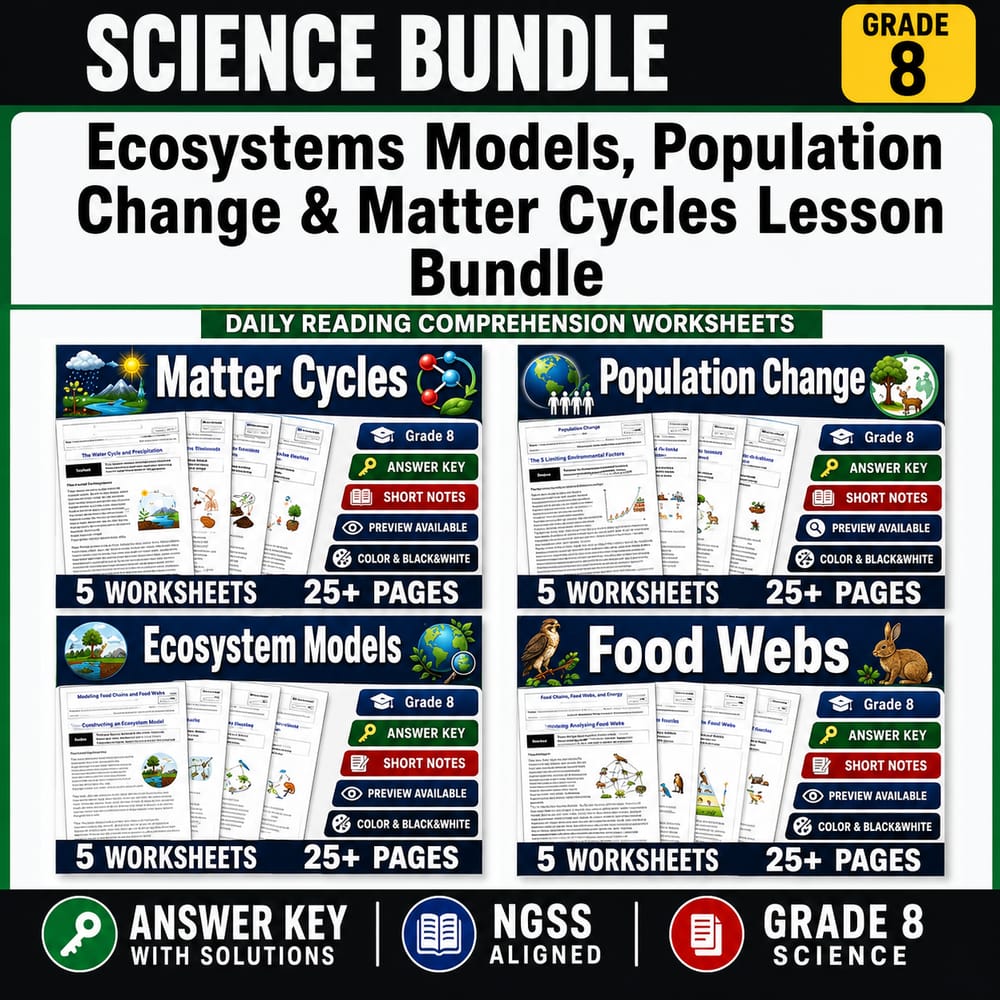
Ecosystems Models, Population Change & Matter Cycles Bundle | Grade 8 Science
$16.00$20.00Save $4.00
BRIGHT PATH RESOURCES
·3 followers·23 sales
SubjectScienceGradeGrade 8
What’s included
4 worksheets · Save $4.00 (20%) · prices shown inside the bundle
 Grade 8 Matter Cycles Worksheet | NGSS Earth Science Activity PDF
- Understand key concepts related to Science
- Apply knowledge through practice questions
- Demonstrate comprehension of the material
$4.00$5.00 Grade 8 Population Change Worksheet | NGSS Ecosystems Science Activity
- Identify factors that influence population growth and decline.
- Understand the concepts of carrying capacity, density-dependent, and density-independent factors.
- Analyze case studies related to invasive species, resource depletion, and environmental changes.
$4.00$5.00 Grade 8 Understanding Ecosystem Models Worksheet | NGSS Science Activity
- Identify biotic components of ecosystems
- Recognize abiotic components in environmental systems
- Understand how different parts of an ecosystem interact
$4.00$5.00 Grade 8 Food Webs Worksheet | NGSS Ecosystems Science Activity PDF
- Identify components of a food web: producers, consumers, decomposers
- Describe energy transfer between trophic levels
- Explain the concept of ecological efficiency and energy loss in food chains
$4.00$5.00
Reviews & Feedback
Loading reviews...
Questions & Answers
Loading questions…
About this bundle
Related categories
Frequently asked questions
Who is Ecosystems Models, Population Change & Matter Cycles Bundle | Grade 8 Science designed for?
Ecosystems Models, Population Change & Matter Cycles Bundle | Grade 8 Science is designed for Grade 8 students and Science learners and can be used in classrooms, homeschool, or independent practice.
How do I download Ecosystems Models, Population Change & Matter Cycles Bundle | Grade 8 Science ?
Add it to your cart and complete checkout. After payment, you can download immediately from your account, and you'll also receive a download link by email.

