
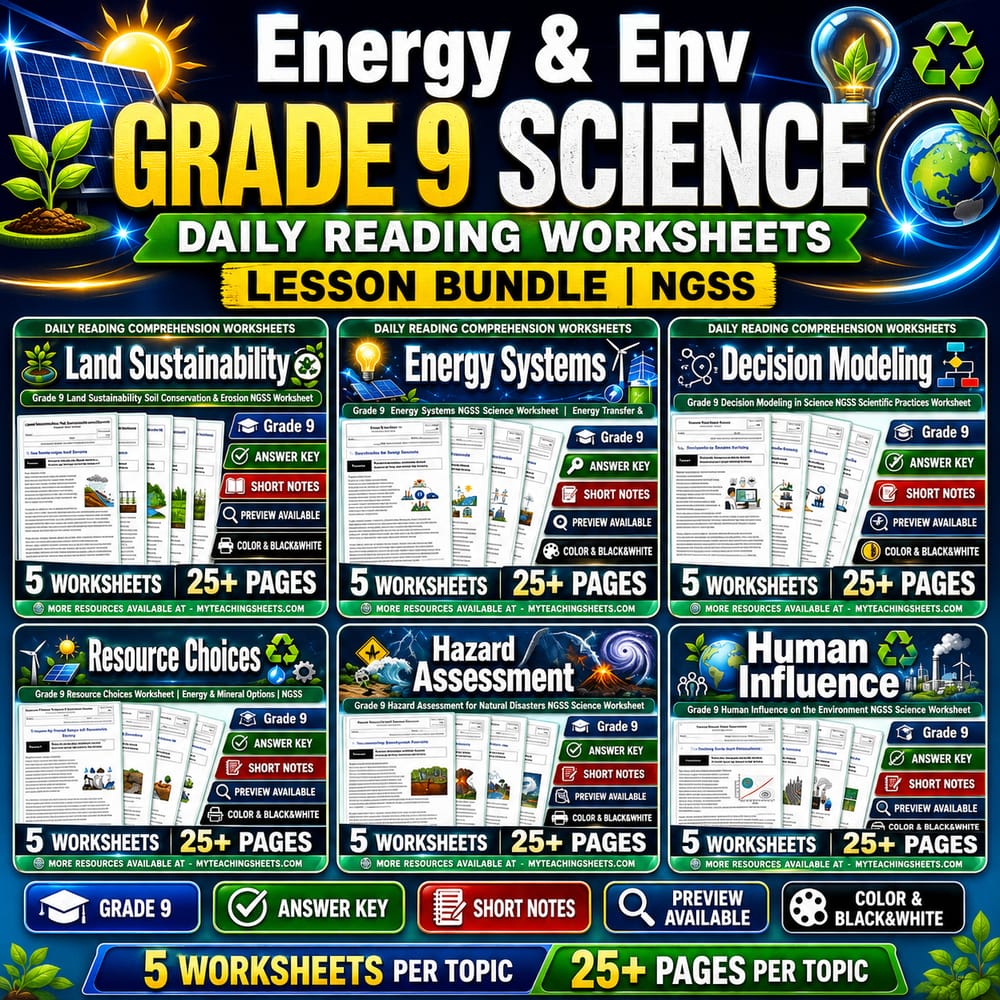
Energy & Env Grade 9 Science Daily Reading Worksheets Lesson Bundle | NGSS
$24.00$30.00Save $6.00
BRIGHT PATH RESOURCES
·3 followers·23 sales
SubjectScienceGradeGrade 9
What’s included
6 worksheets · Save $6.00 (20%) · prices shown inside the bundle
 Grade 9 Land Sustainability Soil Conservation & Erosion NGSS Worksheet
- Understand the causes and effects of soil erosion
- Identify methods of soil conservation
- Recognize human impacts on land degradation
$4.00$5.00 Grade 9 Energy Systems NGSS Science Worksheet | Energy Transfer & Forms
- Identify different types of energy sources.
- Understand the transition from fossil fuels to renewable energy.
- Explain concepts of decarbonization and greenhouse gas accounting.
$4.00$5.00 Grade 9 Decision Modeling in Science NGSS Scientific Practices Worksheet
- Understand the role of systems and decision models in environmental science.
- Explore how scenario analysis, cost-benefit, and lifecycle assessments inform mitigation strategies.
- Analyze trade-offs among greenhouse gas reduction, health, and economic development.
$4.00$5.00 Grade 9 Resource Choices Worksheet | Energy & Mineral Options | NGSS Science
- Understand different energy sources and their environmental impacts
- Compare fossil fuels and renewable energy options
- Analyze trade-offs in resource extraction and sustainability
$4.00$5.00 Grade 9 Hazard Assessment for Natural Disasters NGSS Science Worksheet
- Understand how earthquake risks are evaluated using historical and probabilistic methods.
- Identify key factors influencing earthquake hazard assessments, including occurrence, frequency, and impact.
- Analyze how hazard data and mapping inform community preparedness and mitigation strategies.
$4.00$5.00 Grade 9 Human Influence on the Environment NGSS Science Worksheet
- Understand the significance of the Keeling Curve in tracking atmospheric CO2 levels.
- Analyze how human activities impact carbon dioxide concentrations.
- Evaluate evidence linking atmospheric CO2 changes to climate variability.
$4.00$5.00
Reviews & Feedback
Loading reviews...
Questions & Answers
Loading questions…
About this bundle
Related categories
Frequently asked questions
Who is Energy & Env Grade 9 Science Daily Reading Worksheets Lesson Bundle | NGSS designed for?
Energy & Env Grade 9 Science Daily Reading Worksheets Lesson Bundle | NGSS is designed for Grade 9 students and Science learners and can be used in classrooms, homeschool, or independent practice.
How do I download Energy & Env Grade 9 Science Daily Reading Worksheets Lesson Bundle | NGSS?
Add it to your cart and complete checkout. After payment, you can download immediately from your account, and you'll also receive a download link by email.
Similar Products

Matter-Energy Grade 7 Science Daily Reading Worksheets Lesson Bundle | TEKS
$40.00$50.00

Forces & Energy Grade 7 Science Daily Reading Worksheets Lesson Bundle | TEKS
$32.00$40.00

Energy Grade 11 Science Daily Reading Worksheets Lesson Bundle | NGSS
$20.00$25.00

Energy Work Power Grade 10 Science Daily Reading Worksheets Lesson Bundle | ngss
$20.00$25.00

Grade 8 Motion Forces Energy Science Daily Reading Lesson Bundle | BC
$48.00$60.00