
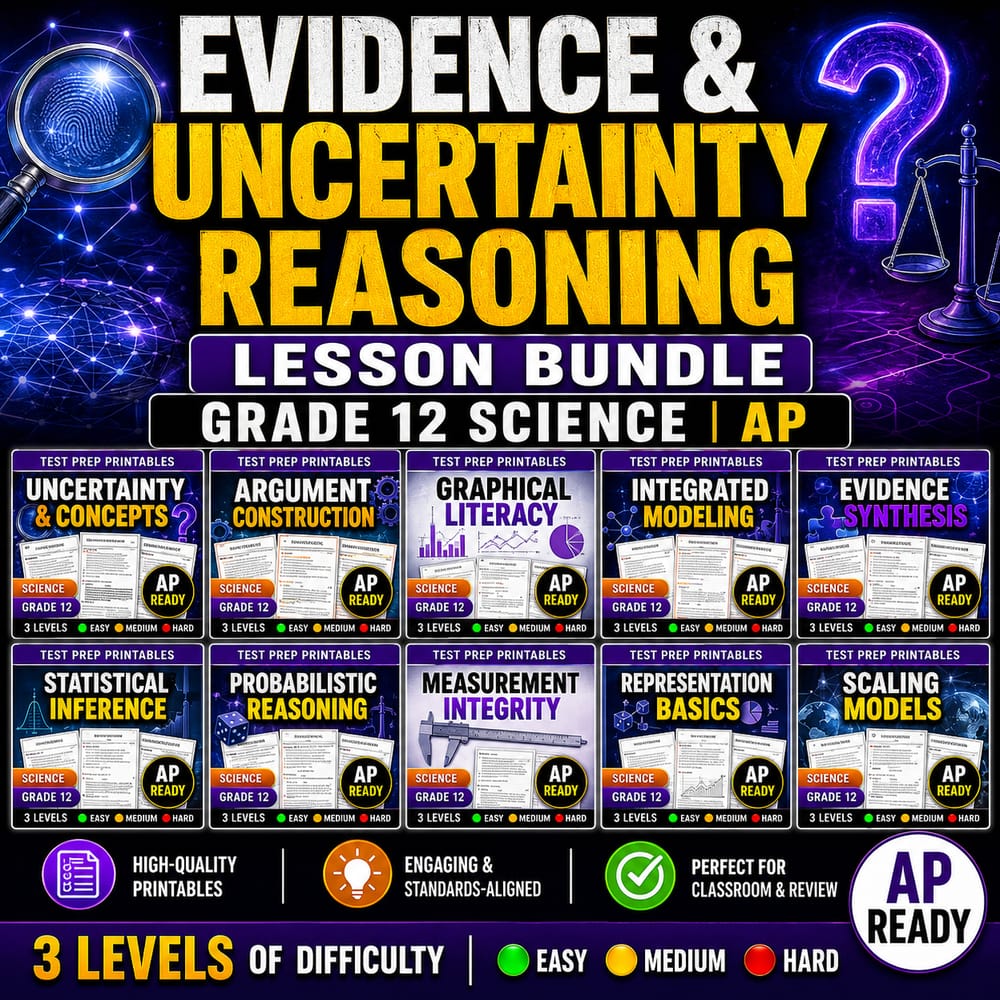
Evidence & Uncertainty Reasoning Lesson Bundle | Grade 12 Science | AP
$40.00$50.00Save $10.00
Prism Point Learning
·2 followers·13 sales
SubjectScienceGradeGrade 12
What’s included
10 worksheets · Save $10.00 (20%) · prices shown inside the bundle
 Uncertainty Concepts Worksheet | Grade 12 AP Science Data Analysis Activity
- Differentiate systematic bias, random error, and conceptual model uncertainty in real scientific measurements and studies.
- Use statistical and visual tools (confidence intervals and error bars) to express uncertainty in quantitative results.
- Explain how uncertainty affects the strength of conclusions when comparing measurements or evaluating model predictions.
$4.00$5.00 Argument Construction Worksheet Pack | Grade 12 AP Science Practice
- Construct evidence-based scientific arguments by clearly stating claims and supporting them with warrants and backing from data and observations.
- Evaluate the relevance and sufficiency of evidence, including how well alternatives are addressed.
- Use models and empirical results together to justify conclusions while recognizing limits of inference and uncertainty.
$4.00$5.00 Graphical Literacy Worksheet | Grade 12 AP Science Data Analysis Activity
- Interpret scatter plots, histograms, residual plots, and log–log axes to identify patterns and trends.
- Choose appropriate scales and transformations to linearize relationships and support model selection.
- Evaluate the quality of a fit qualitatively and quantitatively, including the role of residuals and uncertainty.
$4.00$5.00 Integrated Modeling Worksheet | Grade 12 AP Science Systems Thinking Activity
- Explain how model validation and scenario forecasting use quantitative evidence from data and residual analysis.
- Use uncertainty quantification (e.g., confidence bounds) to communicate how trustworthy model predictions are.
- Construct evidence-based scientific arguments about model adequacy, limitations, and possible sources of discrepancy.
$4.00$5.00 Evidence Synthesis Worksheet | AP Environmental Science Grade 12 Activity
- Explain how evidence synthesis combines multiple lines of data to evaluate competing scientific hypotheses.
- Compare meta-analytic reasoning and model-comparison metrics as tools for weighing evidence.
- Apply causal criteria and corroboration checks to resolve conflicts between paleoclimate proxies and instrumental records.
$4.00$5.00 Statistical Inference Worksheet | Grade 12 AP Science Data Analysis Activity
- Interpret confidence intervals, p-values, and effect sizes as evidence for quantitative claims while considering assumptions.
- Apply hypothesis testing and regression diagnostics to evaluate model adequacy and decide between alternative models.
- Explain practical significance using effect size and residual patterns, not only statistical significance thresholds.
$4.00$5.00 Probabilistic Reasoning Worksheet | Grade 12 AP Science Critical Thinking
- Explain how priors, likelihoods, and posteriors combine to quantify uncertainty in a Bayesian framework.
- Contrast frequentist and Bayesian interpretations of probability using real scientific examples.
- Use probability statements to make decision-relevant conclusions and communicate uncertainty.
$4.00$5.00 Measurement Integrity Worksheet | Grade 12 AP Science Data Quality Activity
- Explain how calibration, accuracy, precision, and traceability support trustworthy measurements in lab and industry settings.
- Describe how repeatability and systematic bias can be quantified and corrected using calibration models.
- Interpret how measurement uncertainty affects derived parameters and the limits of data analysis and reporting.
$4.00$5.00 Representation Basics Worksheet | Grade 12 AP Science Data Interpretation
- Define what a scientific model/representation is and explain its purpose in relating ideas to real-world phenomena
- Describe common limits of representations, including assumptions and cases where a model may not generalize
- Compare types of models (schematic diagrams, mathematical equations, and computational simulations) and justify representation choice
$4.00$5.00 Scaling Models Worksheet | Grade 12 AP Science Systems Modeling Activity
- Explain how scaling laws connect measurements across different spatial and temporal scales.
- Use dimensional analysis to check whether a model equation can be dimensionally consistent.
- Apply nondimensional parameters to compare phenomena with different sizes, speeds, or times.
$4.00$5.00
Reviews & Feedback
Loading reviews...
Questions & Answers
Loading questions…
About this bundle
Related categories
Frequently asked questions
Who is Evidence & Uncertainty Reasoning Lesson Bundle | Grade 12 Science | AP designed for?
Evidence & Uncertainty Reasoning Lesson Bundle | Grade 12 Science | AP is designed for Grade 12 students and Science learners and can be used in classrooms, homeschool, or independent practice.
How do I download Evidence & Uncertainty Reasoning Lesson Bundle | Grade 12 Science | AP?
Add it to your cart and complete checkout. After payment, you can download immediately from your account, and you'll also receive a download link by email.
Similar Products

Grade 9 Uncertainty & Evidence Science Lesson Bundle (General)
$22.40$28.00

Grade 11 Uncertainty, Models & Evidence Science Lesson Bundle | General
$14.40$18.00

Uncertainty in Graphs & Evidence Lesson Bundle | Grade 9 Science General
$22.40$28.00

Grade 10 Scientific Reasoning, Models & Evidence Science Lesson Bundle
$24.00$30.00

Grade 10 Evidence & Uncertainty Science Assessment Lesson Bundle: General
$32.00$40.00