
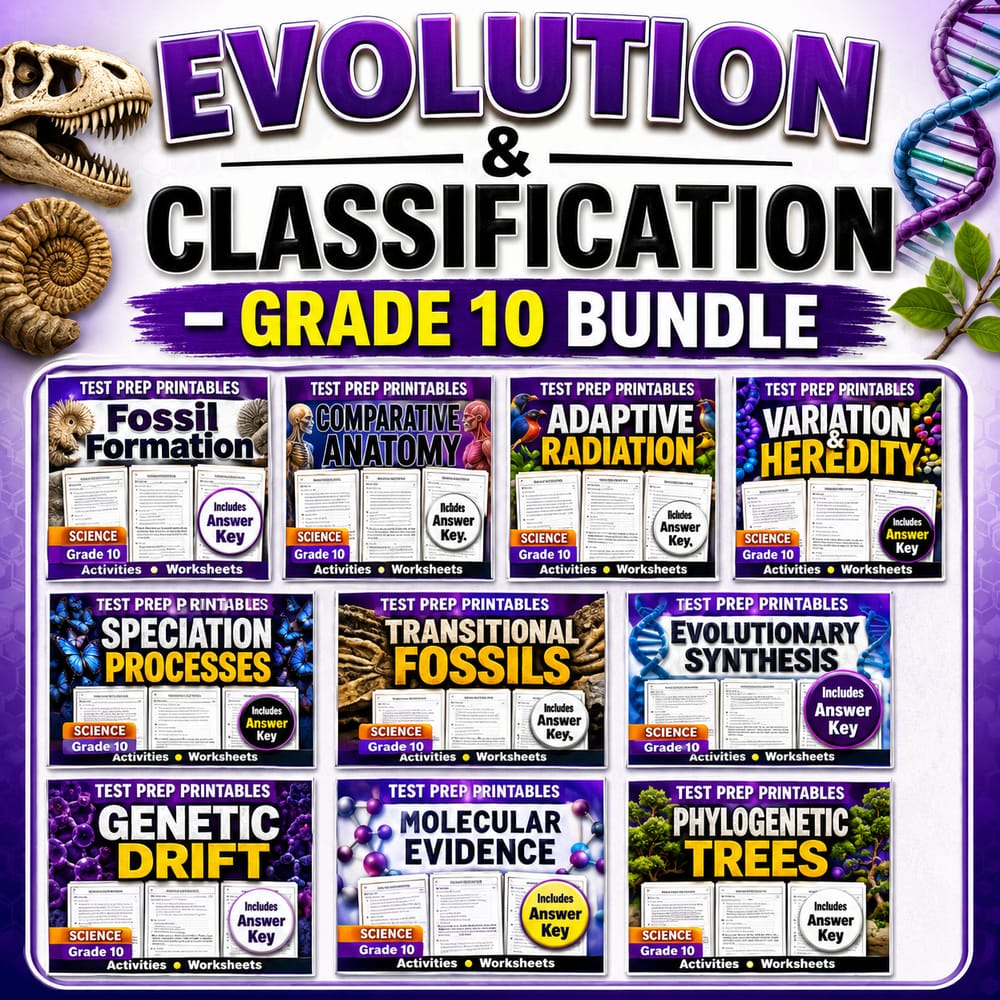
Evolution & Classification Lesson Bundle|Grade 10 Science|Texas Essential Knowledge & Skills
$40.00$50.00Save $10.00
Prism Point Learning
·2 followers·13 sales
SubjectScienceGradeGrade 10
What’s included
10 worksheets · Save $10.00 (20%) · prices shown inside the bundle
 Fossil Formation Worksheet | Grade 10 Science Activities
- Explain how fossils form through burial in sediment and processes like mineralization and compression
- Describe how fossil distributions and stratigraphic succession provide relative dating
- Differentiate relative dating from absolute dating using radiometric methods
$4.00$5.00 Comparative Anatomy Worksheet | Grade 10 Science Activities
- Explain how homologous, analogous, and vestigial structures provide evidence for evolution.
- Use comparative anatomy with embryology and molecular data to infer common ancestry and adaptations.
- Distinguish between evolutionary explanations for similarities that arise from common descent versus convergent evolution.
$4.00$5.00 Adaptive Radiation Worksheet | Grade 10 Science Activities
- Explain how adaptive radiation leads to multiple closely related species occupying different ecological niches.
- Describe common triggers for adaptive radiation, such as colonization of new habitats and the removal of competitors.
- Interpret how morphology, behavior, and physiology changes can reflect different resource use and environmental pressures.
$4.00$5.00 Variation And Heredity Worksheet | Grade 10 Science Practice
- Explain how genetic variation arises through mutation, recombination, and gene flow.
- Describe how heritable traits can change survival and reproduction in different environments.
- Connect natural selection to changes in allele frequencies across generations.
$4.00$5.00 Speciation Processes Worksheet | Grade 10 Science Activities
- Explain how reproductive isolation can form through geographic, ecological, behavioral, or chromosomal barriers.
- Compare allopatric, sympatric, and parapatric speciation in terms of spatial and gene-flow conditions.
- Describe how selection, genetic drift, and mutation contribute to divergence over time.
$4.00$5.00 Transitional Fossils Worksheet | Grade 10 Science Activities
- Explain what transitional fossils are and why they matter for understanding evolutionary change.
- Describe how anatomical features and intermediate traits can connect major groups.
- Evaluate how fossil-record gaps and taphonomic bias can affect what we observe.
$4.00$5.00 Evolutionary Synthesis Worksheet | Grade 10 Science Practice
- Explain how the evolutionary synthesis connects natural selection, mutation, genetic drift, and gene flow to species change over time
- Describe how fossils, phylogenies, and ecological/genetic evidence can converge to support evolutionary hypotheses
- Use examples to distinguish adaptation, speciation, and extinction within a synthesis framework
$4.00$5.00 Genetic Drift Worksheet | Grade 10 Science Activities
- Explain how genetic drift changes allele frequencies in small populations through chance events.
- Distinguish genetic drift from natural selection and predict likely outcomes in isolated populations.
- Describe founder effects and population bottlenecks and how they affect genetic diversity.
$4.00$5.00 Molecular Evidence Worksheet | Grade 10 Science Activities
- Explain how DNA, RNA, and protein sequences can provide evidence for evolutionary relationships.
- Describe how sequence similarity, conserved genes, and molecular clocks are used in phylogeny and divergence-time estimates.
- Identify challenges like horizontal gene transfer and convergent molecular evolution and why using multiple genes improves conclusions.
$4.00$5.00 Phylogenetic Trees Worksheet | Grade 10 Science Activities
- Explain how branching diagrams represent hypotheses of evolutionary relationships
- Use shared derived characteristics and molecular or fossil evidence to interpret phylogenetic trees
- Describe how classification reflects nested evolutionary groupings
$4.00$5.00
Reviews & Feedback
Loading reviews...
Questions & Answers
Loading questions…
About this bundle
Related categories
Frequently asked questions
Who is Evolution & Classification Lesson Bundle|Grade 10 Science|Texas Essential Knowledge & Skills designed for?
Evolution & Classification Lesson Bundle|Grade 10 Science|Texas Essential Knowledge & Skills is designed for Grade 10 students and Science learners and can be used in classrooms, homeschool, or independent practice.
How do I download Evolution & Classification Lesson Bundle|Grade 10 Science|Texas Essential Knowledge & Skills?
Add it to your cart and complete checkout. After payment, you can download immediately from your account, and you'll also receive a download link by email.
Similar Products

Grade 11 Science Lesson Group Bundle TEKS | Evolution & Classification
$24.00$30.00

Grade 9 Science Evolution & Classification Unit Worksheet Pack
$16.00$20.00

Grade 9 Biological Evolution Lesson Bundle for NGSS Science
$16.00$20.00

Grade 12 Molecular Genetics & Evolution Lesson Bundle Daily Reading | Alberta
$48.00$60.00

Grade 10 Evolution & Classification Science Worksheets Bundle | TEKS Biology
$40.00$50.00