
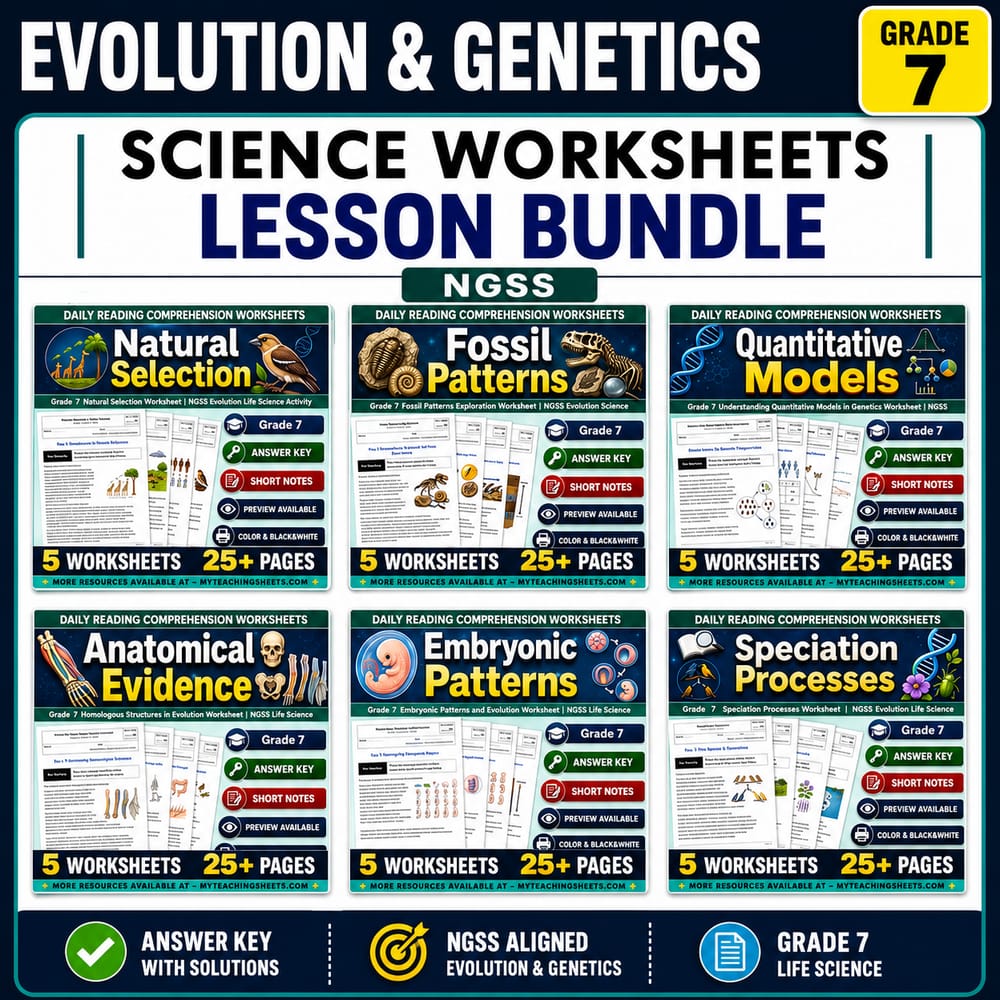
Evolution & Genetics Grade 7 Science Worksheets Lesson Bundle | NGSS
$24.00$30.00Save $6.00
BRIGHT PATH RESOURCES
·3 followers·23 sales
SubjectScienceGradeGrade 7
What’s included
6 worksheets · Save $6.00 (20%) · prices shown inside the bundle
 Grade 7 Natural Selection Worksheet | NGSS Evolution Life Science Activity
- Understand the basic concepts of natural selection
- Recognize how traits influence survival and reproduction
- Identify examples of adaptation in different species
$4.00$5.00 Grade 7 Fossil Patterns Exploration Worksheet | NGSS Evolution Science
- Understand what fossils are and their significance in Earth's history
- Identify different types of fossils and their features
- Analyze patterns of extinction and morphological change in the fossil record
$4.00$5.00 Grade 7 Understanding Quantitative Models in Genetics Worksheet | NGSS
- Understand key concepts related to Science
- Apply knowledge through practice questions
- Demonstrate comprehension of the material
$4.00$5.00 Grade 7 Homologous Structures in Evolution Worksheet | NGSS Life Science
- Understand key concepts related to Science
- Apply knowledge through practice questions
- Demonstrate comprehension of the material
$4.00$5.00 Grade 7 Embryonic Patterns and Evolution Worksheet | NGSS Life Science
- Identify key stages of embryonic development across different animal groups
- Compare and contrast embryonic features among taxa to understand evolutionary relationships
- Recognize conserved structures such as pharyngeal pouches and limb buds
$4.00$5.00 Grade 7 Speciation Processes Worksheet | NGSS Evolution Life Science
- Understand the key mechanisms that lead to the formation of new species.
- Identify examples of reproductive isolation and geographic separation.
- Explain how polyploidy and adaptive radiation contribute to biodiversity.
$4.00$5.00
Reviews & Feedback
Loading reviews...
Questions & Answers
Loading questions…
About this bundle
Related categories
Frequently asked questions
Who is Evolution & Genetics Grade 7 Science Worksheets Lesson Bundle | NGSS designed for?
Evolution & Genetics Grade 7 Science Worksheets Lesson Bundle | NGSS is designed for Grade 7 students and Science learners and can be used in classrooms, homeschool, or independent practice.
How do I download Evolution & Genetics Grade 7 Science Worksheets Lesson Bundle | NGSS?
Add it to your cart and complete checkout. After payment, you can download immediately from your account, and you'll also receive a download link by email.
Similar Products

Grade 10 Biology Cells, Genetics, Evolution & Ecosystems Lesson Bundle | Florida NGSSS
$64.00$80.00

Grade 10 Life Science Evolution, Genetics & Cells Lesson Bundle – Florida NGSSS
$64.00$80.00

Grade 12 Molecular Genetics & Evolution Lesson Bundle Daily Reading | Alberta
$48.00$60.00

Grade 12 Science Genetics & Evolution Worksheets Lesson Bundle
$19.20$24.00

Ecology, Evolution & Genetics Lesson Bundle | Grade 11 Science NGSSS
$44.00$55.00