
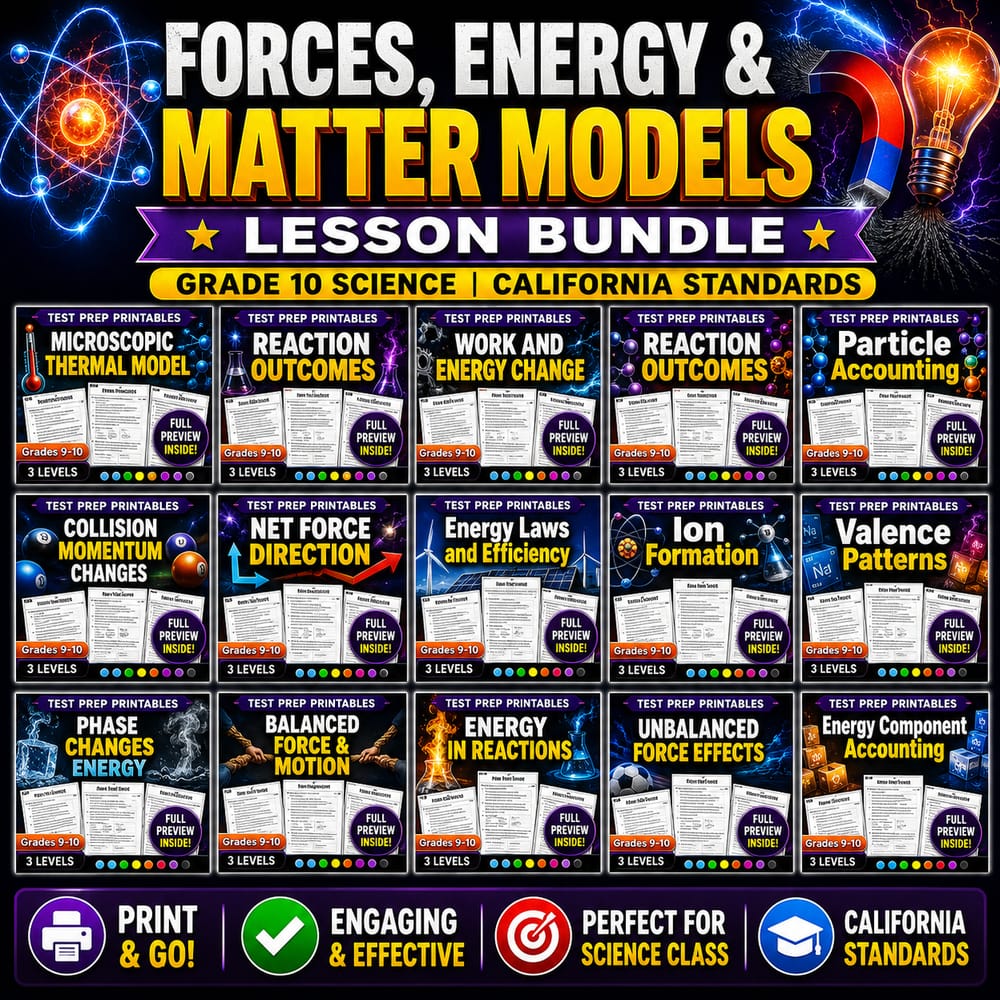


Forces, Energy & Matter Models Lesson Bundle | Grade 10 Science | California Standards
$60.00$75.00Save $15.00
Prism Point Learning
·2 followers·13 sales
SubjectScienceGradeGrade 10
What’s included
15 worksheets · Save $15.00 (20%) · prices shown inside the bundle
 Microscopic Thermal Model Worksheet | Grade 10 Science Practice
- Explain temperature using a microscopic model of particle motion and average kinetic energy.
- Use the microscopic thermal model to describe how heat transfers between objects.
- Predict how energy moving into or out of a system changes particle motion and observable temperature.
$4.00$5.00 Reaction Outcomes Worksheet | Grade 10 Chemistry Reactions Practice
- Explain reaction outcomes by connecting atomic rearrangements to observed changes
- Use conservation of atoms as evidence that reactions rearrange atoms rather than create or destroy them
- Describe how electron structures and bonding changes help predict products
$4.00$5.00 Work and Energy Change Worksheet | Grade 10 Physics Practice
- Explain how work done by a force through displacement changes a system’s energy components
- Interpret energy graphs by relating slope or trend to the direction and rate of energy transfer
- Distinguish kinetic energy, elastic potential energy, and gravitational potential energy in work-energy scenarios
$4.00$5.00 Radiation Energy Transfer Worksheet | Grade 10 Heat Transfer Practice
- Explain how electromagnetic radiation transfers energy without direct contact
- Describe how absorption of radiation can change the temperature or state of matter
- Connect properties of radiation (e.g., wavelength/energy) to the effects observed in materials
$4.00$5.00 Particle Accounting Worksheet | Grade 10 Matter Counting Practice
- Explain particle accounting using atomic-level models to show what is conserved in chemical reactions.
- Use diagrams or particle representations to identify which bonds break and which bonds form during a reaction.
- Connect conservation of atoms to reaction completion and product identity.
$4.00$5.00 Collision Momentum Changes Worksheet | Grade 10 Physics Science Activity
- Explain how net force acting over a collision time interval changes an object's momentum
- Connect impulse to the change in velocity before and after contact
- Use Newton's third law to reason about forces between two interacting objects during a collision
$4.00$5.00 Net Force Direction Worksheet | Grade 10 Physics Force Practice
- Explain how the direction of net force determines the direction of acceleration.
- Use vector addition ideas to predict how multiple forces change an object’s motion.
- Interpret everyday motion (turning, speeding up, slowing down) using force diagrams and net force.
$4.00$5.00 Energy Loss & Efficiency Worksheet | Grade 10 Science Practice
- Explain how energy transfers and losses occur in real systems using the idea of useful energy vs. wasted energy.
- Calculate and interpret efficiency as the fraction of total energy transfer that produces intended outcomes.
- Identify common loss mechanisms (friction, sound, heat) and describe how reducing them can increase output.
$4.00$5.00 Ion Formation Worksheet Grade 10 Chemistry Activities & Practice
- Explain how incomplete outer energy levels lead to predictable ion charges
- Use electron models to determine whether an atom forms a cation or an anion
- Connect electron transfer to properties of ionic substances such as conductivity and reactivity
$4.00$5.00 Valence Patterns Worksheet | Grade 10 Chemistry Practice Activities
- Explain how valence electrons and electron configurations help predict an element’s typical bonding and ion formation.
- Describe recurring patterns on the periodic table and connect them to changes in reactivity across groups and periods.
- Use metallic vs. nonmetallic tendencies to make evidence-based predictions from electron behavior.
$4.00$5.00
Reviews & Feedback
Loading reviews...
Questions & Answers
Loading questions…
About this bundle
Related categories
Frequently asked questions
Who is Forces, Energy & Matter Models Lesson Bundle | Grade 10 Science | California Standards designed for?
Forces, Energy & Matter Models Lesson Bundle | Grade 10 Science | California Standards is designed for Grade 10 students and Science learners and can be used in classrooms, homeschool, or independent practice.
How do I download Forces, Energy & Matter Models Lesson Bundle | Grade 10 Science | California Standards?
Add it to your cart and complete checkout. After payment, you can download immediately from your account, and you'll also receive a download link by email.
Similar Products

Grade 11 Science Cross-Discipline Models of Energy, Matter & Force Lesson
$48.00$60.00

Grade 8 Science Matter, Forces & Energy Lesson Bundle | Florida Standards
$44.00$55.00

Grade 7 Matter, Energy & Forces Science Lesson Bundle – Florida NGSSS
$48.00$60.00

Grade 8 Energy, Forces & Matter Lesson Bundle - Daily Reading | Calif. Std.
$38.40$48.00

Grade 8 Matter, Forces, and Energy Science Lesson Bundle: General Framework
$32.00$40.00