
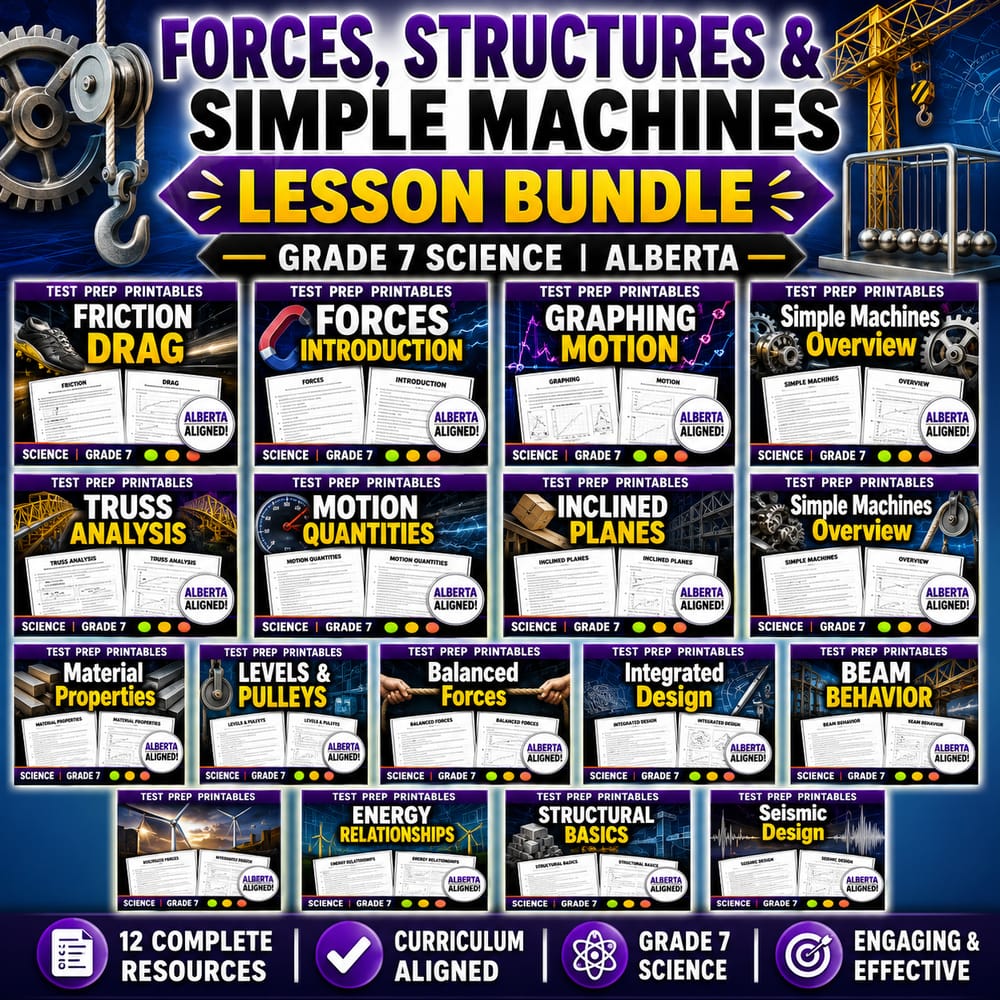


Forces, Structures & Simple Machines Lesson Bundle | Grade 7 Science Alberta
$60.00$75.00Save $15.00
Prism Point Learning
·2 followers·13 sales
SubjectScienceGradeGrade 7
What’s included
15 worksheets · Save $15.00 (20%) · prices shown inside the bundle
 Friction and Drag Worksheet | Grade 7 Science Activities
- Explain how static and kinetic friction oppose relative motion and affect acceleration and stopping distance.
- Describe aerodynamic drag as a force that opposes motion through air and influences speed of moving objects.
- Connect surface texture and normal force to changes in the frictional coefficient and real-world movement outcomes.
$4.00$5.00 Forces Introduction Worksheet | Grade 7 Science Activities
- Explain how push and pull interactions create forces that can change an object's motion
- Differentiate between contact forces and non-contact forces using examples
- Describe how net force influences acceleration (speeding up, slowing down, or changing direction)
$4.00$5.00 Graphing Motion Worksheet | Grade 7 Science Activities
- Interpret distance–time and speed–time graphs by relating graph features to motion in real situations.
- Explain how slope and area under a speed–time graph connect to instantaneous and average rates.
- Translate tabulated measurements into graphs and make quantitative conclusions from them.
$4.00$5.00 Net Force Diagrams Worksheet | Grade 7 Science Practice
- Draw and interpret free-body diagrams to represent forces acting on an object
- Determine net force direction and magnitude by combining perpendicular force components
- Identify how friction, normal force, and gravity affect motion on an incline
$4.00$5.00 Truss Analysis Worksheet | Grade 7 Science Activities
- Explain how truss members form internal force paths of tension and compression
- Use the method of joints concept to reason about forces in individual truss members
- Compare common truss forms (e.g., king post, queen post, and Pratt) by their structural efficiency and redundancy
$4.00$5.00 Motion Quantities Worksheet | Grade 7 Science Practice
- Describe motion using distance, time, and speed, including correct units
- Calculate average speed using distance and time and interpret results
- Identify common sources of measurement error and explain how they affect motion data
$4.00$5.00 Inclined Planes Worksheet | Grade 7 Science Activities
- Explain how inclined planes reduce the required input force by increasing the distance over which the force acts.
- Identify and interpret force components parallel to and perpendicular to the slope.
- Calculate and compare mechanical advantage using input force and load.
$4.00$5.00 Simple Machines Overview Worksheet | Grade 7 Science Activities
- Explain how simple machines change the magnitude or direction of a force to make work easier
- Describe the roles of levers, pulleys, wedges, screws, inclined planes, and wheel-and-axles in everyday tools
- Calculate mechanical advantage from input and output forces and interpret what the result means
$4.00$5.00 Material Properties Worksheet | Grade 7 Science Activities
- Explain how strength, stiffness, density, and environmental resilience affect material selection for load-bearing structures.
- Describe how materials behave under compression, tension, and bending and how that impacts long-term performance and maintenance.
- Use evidence from local conditions (frost and snow) to justify material choices for beams, bridges, and foundations.
$4.00$5.00 Levers and Pulleys Worksheet | Grade 7 Science Practice
- Explain how a lever changes force and direction of a push or pull using fulcrum placement and lever arms.
- Describe how pulley systems can increase mechanical advantage and change the direction of force.
- Calculate and compare input (effort) and output (load) forces using simple mechanical advantage relationships.
$4.00$5.00
Reviews & Feedback
Loading reviews...
Questions & Answers
Loading questions…
About this bundle
Related categories
Frequently asked questions
Who is Forces, Structures & Simple Machines Lesson Bundle | Grade 7 Science Alberta designed for?
Forces, Structures & Simple Machines Lesson Bundle | Grade 7 Science Alberta is designed for Grade 7 students and Science learners and can be used in classrooms, homeschool, or independent practice.
How do I download Forces, Structures & Simple Machines Lesson Bundle | Grade 7 Science Alberta?
Add it to your cart and complete checkout. After payment, you can download immediately from your account, and you'll also receive a download link by email.
Similar Products

Grade 7 Simple Machines and Forces Science Lesson Bundle: Alberta
$60.00$75.00

Grade 7 Structures & Forces Science Lesson Bundle Daily Reading | Alberta
$48.00$60.00

Grade 7 Alberta Science Forces Structures and Motion Worksheet Bundle
$60.00$75.00

Grade 7 Alberta Science: Structures and Forces Learning Stations Bundle
$16.00$20.00

Grade 8 Forces & Motion Science Lesson Bundle – Alberta framework worksheets
$60.00$75.00