
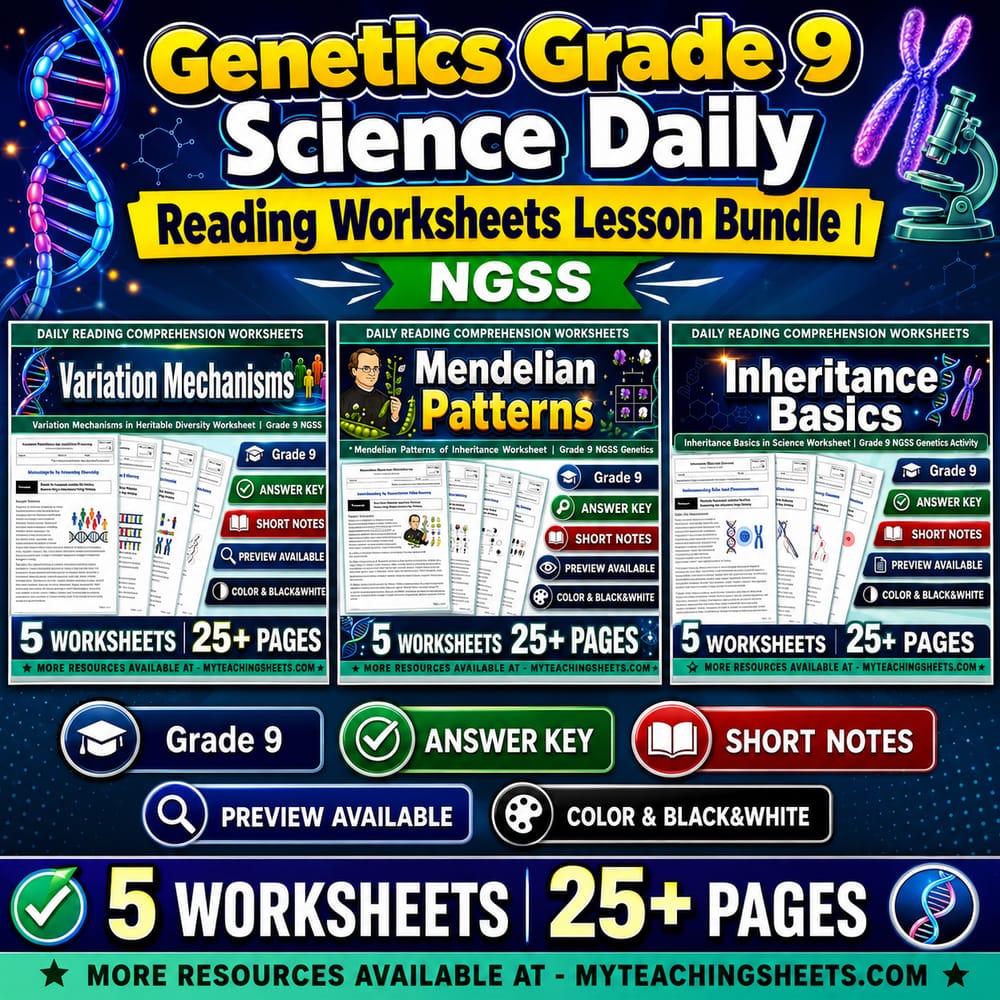
Genetics Grade 9 Science Daily Reading Worksheets Lesson Bundle | NGSS
$12.00$15.00Save $3.00
BRIGHT PATH RESOURCES
·3 followers·23 sales
SubjectScienceGradeGrade 9
What’s included
3 worksheets · Save $3.00 (20%) · prices shown inside the bundle
 Variation Mechanisms in Heritable Diversity Worksheet | Grade 9 NGSS
- Understand key concepts related to Science
- Apply knowledge through practice questions
- Demonstrate comprehension of the material
$4.00$5.00 Mendelian Patterns of Inheritance Worksheet | Grade 9 NGSS Genetics
- Understand the principles of dominant and recessive alleles.
- Describe how traits are inherited according to Mendel's laws.
- Use Punnett squares to predict genetic outcomes.
$4.00$5.00 Inheritance Basics in Science Worksheet | Grade 9 NGSS Genetics Activity
- Understand the structure and function of DNA and chromosomes
- Describe the process of DNA replication and chromosomal segregation during meiosis
- Identify how hereditary information is transmitted across generations
$4.00$5.00
Reviews & Feedback
Loading reviews...
Questions & Answers
Loading questions…
About this bundle
Related categories
Frequently asked questions
Who is Genetics Grade 9 Science Daily Reading Worksheets Lesson Bundle | NGSS designed for?
Genetics Grade 9 Science Daily Reading Worksheets Lesson Bundle | NGSS is designed for Grade 9 students and Science learners and can be used in classrooms, homeschool, or independent practice.
How do I download Genetics Grade 9 Science Daily Reading Worksheets Lesson Bundle | NGSS?
Add it to your cart and complete checkout. After payment, you can download immediately from your account, and you'll also receive a download link by email.
Similar Products

Genetics Grade 10 Science Daily Reading Worksheets Lesson Bundle | NGSS
$12.00$15.00

Grade 10 Evolution & Genetics Science Daily Reading Lesson Bundle | BC
$48.00$60.00

Grade 12 Molecular Genetics & Evolution Lesson Bundle Daily Reading | Alberta
$48.00$60.00

Genetics DNA Traits Grade 8 Science Daily Reading Worksheets Bundle | NGSS
$8.00$10.00

Grade 10 AP Science Daily Reading Lesson Bundle: Ecology, Genetics & Cells
$35.20$44.00