
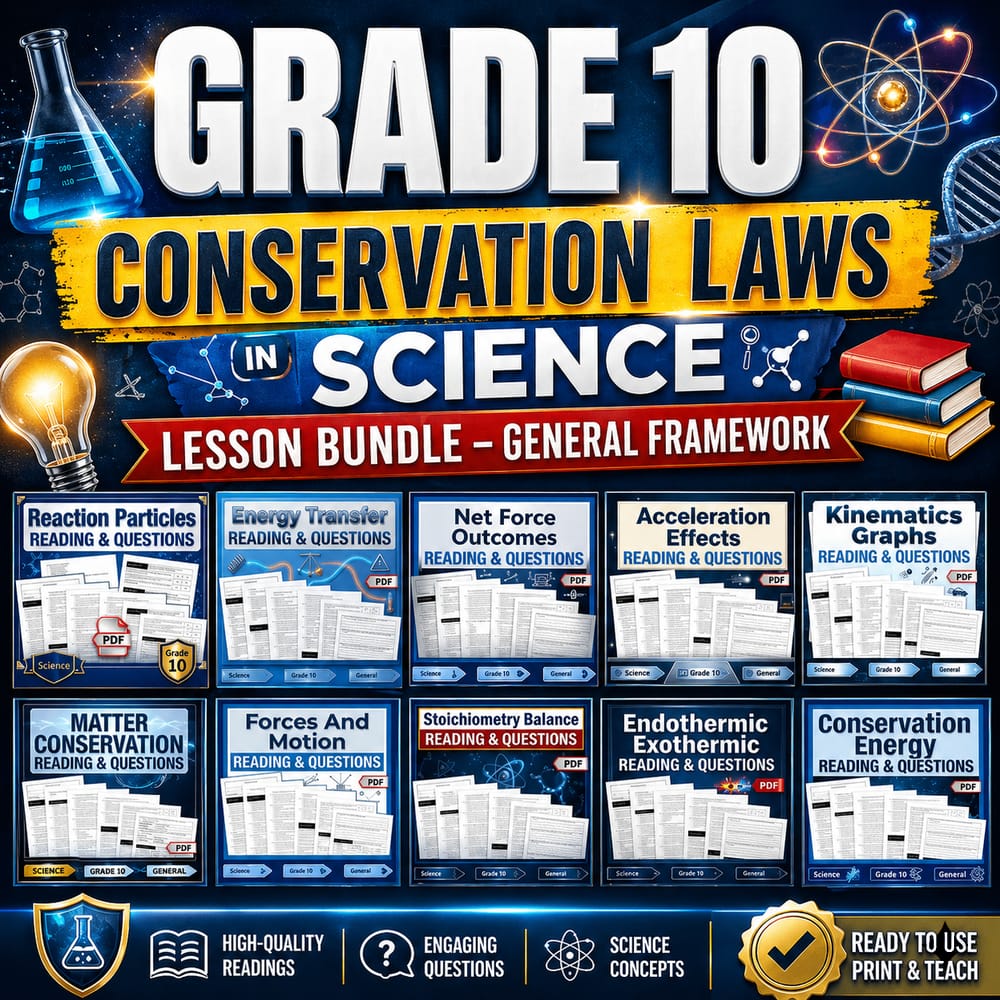
Grade 10 Conservation Laws in Science Lesson Bundle – General Framework
$32.00$40.00Save $8.00
Evergreen Desk Education
·2 followers·17 sales
SubjectScienceGradeGrade 10Pages162 Pages
What’s included
10 worksheets · 162 pages · Save $8.00 (20%) · prices shown inside the bundle
 Grade 10 Science – Reaction Particles Worksheet (Worksheet + Answer Key)
- Explain how collision frequency affects reaction rate using a particle-based model
- Describe how activation energy and energy distribution influence whether collisions produce products
- Use particle and energy-based reasoning to predict how temperature, concentration, and catalysts change reaction probability
$3.20$4.00 Grade 10 Science – Energy Transfer Worksheet (PDF) | General Standards
- Explain how energy transfers between systems and changes form using examples (heating, work, and radiation).
- Relate kinetic energy to particle motion, gravitational potential energy to height, and elastic energy to deformation.
- Use observed changes (temperature, speed, height) to determine the direction of energy transfer.
$3.20$4.00 Grade 10 Science Net Force Worksheet | General Standards Practice (PDF)
- Determine the net force direction and qualitative magnitude when multiple forces act on an object.
- Predict acceleration outcomes when forces oppose or align, including the effect of friction.
- Explain how changing friction can shift an object from speeding up to slowing down.
$3.20$4.00 Grade 10 Science | Acceleration Effects Worksheet (PDF) - General Standards
- Interpret the sign of acceleration and relate it to changes in velocity (speeding up, slowing down, or reversing direction).
- Use velocity-time and position-time graph features (slope, curvature) to reason about acceleration qualitatively.
- Explain acceleration trends using consistent sign conventions and connect them to observed motion outcomes.
$3.20$4.00 Grade 10 Science – Kinematics Graphs Worksheet (PDF) | General Standards
- Interpret displacement-time, velocity-time, and acceleration-time graphs to describe motion.
- Use slope and sign (positive/negative) to relate graphical features to velocity and acceleration.
- Connect acceleration-time patterns to whether acceleration is constant, changing, or reversing direction.
$3.20$4.00 Grade 10 Science Worksheet – Matter Conservation (PDF)
- Explain how the total amount of matter is conserved during physical and chemical changes using particle and atom models.
- Differentiate particle rearrangement in physical changes from atom rearrangement in chemical changes.
- Use atom or particle counts to predict whether mass and number of atoms match on both sides of a reaction.
$3.20$4.00 Grade 10 Science – Forces And Motion Worksheet (PDF) | Standard Aligned
- Explain how net force affects an object's acceleration and changes in velocity
- Distinguish gravity, contact forces, friction, and inertia in everyday motion
- Use qualitative reasoning to connect the direction of net force to the direction of acceleration
$3.20$4.00 Grade 10 Science | Stoichiometry Balance Worksheet (PDF) – General Standards
- Explain how conservation of atoms is used to interpret balanced chemical equations.
- Determine how reaction coefficients relate to whole-number particle ratios in stoichiometry.
- Use qualitative reasoning to predict which reactants or products are present in greater or smaller relative amounts.
$3.20$4.00 Grade 10 Science – Endothermic and Exothermic Worksheet (PDF) | General Standards
- Distinguish endothermic and exothermic reactions using qualitative energy changes in the surroundings and the reacting particles.
- Interpret simple energy profiles and relate them to temperature change and observable evidence such as light release.
- Explain how bond energy and particle kinetic energy shift during endothermic and exothermic processes.
$3.20$4.00 Grade 10 Science | Conservation of Energy Worksheet (PDF)
- Explain energy conservation using the idea that energy is transferred and transformed but not created or destroyed
- Use qualitative energy accounting to track changes in a system’s energy forms across an initial and final state
- Describe how nonconservative forces (like friction and air resistance) can reduce mechanical energy while conserving total energy
$3.20$4.00
Reviews & Feedback
Loading reviews...
Questions & Answers
Loading questions…
About this bundle
Related categories
Frequently asked questions
Who is Grade 10 Conservation Laws in Science Lesson Bundle – General Framework designed for?
Grade 10 Conservation Laws in Science Lesson Bundle – General Framework is designed for Grade 10 students and Science learners and can be used in classrooms, homeschool, or independent practice.
How do I download Grade 10 Conservation Laws in Science Lesson Bundle – General Framework?
Add it to your cart and complete checkout. After payment, you can download immediately from your account, and you'll also receive a download link by email.
Similar Products

Grade 11 Impulse, Forces & Conservation Laws Science Lesson Bundle NGSS
$9.60$12.00

Grade 11 Forces & Conservation Laws Science Lesson Bundle Daily Reading | NGSS
$12.80$16.00

Energy Transfer, Conversion & Conservation Lesson Bundle | Grade 11 Science | NGSS
$14.00$20.00

Grade 8 Science Thermal Transfer & Energy Conservation Lesson Bundle | NGSS
$20.00$25.00

Grade 10 Conservation Laws and Stoichiometry Science Lesson Bundle | General
$40.00$50.00