
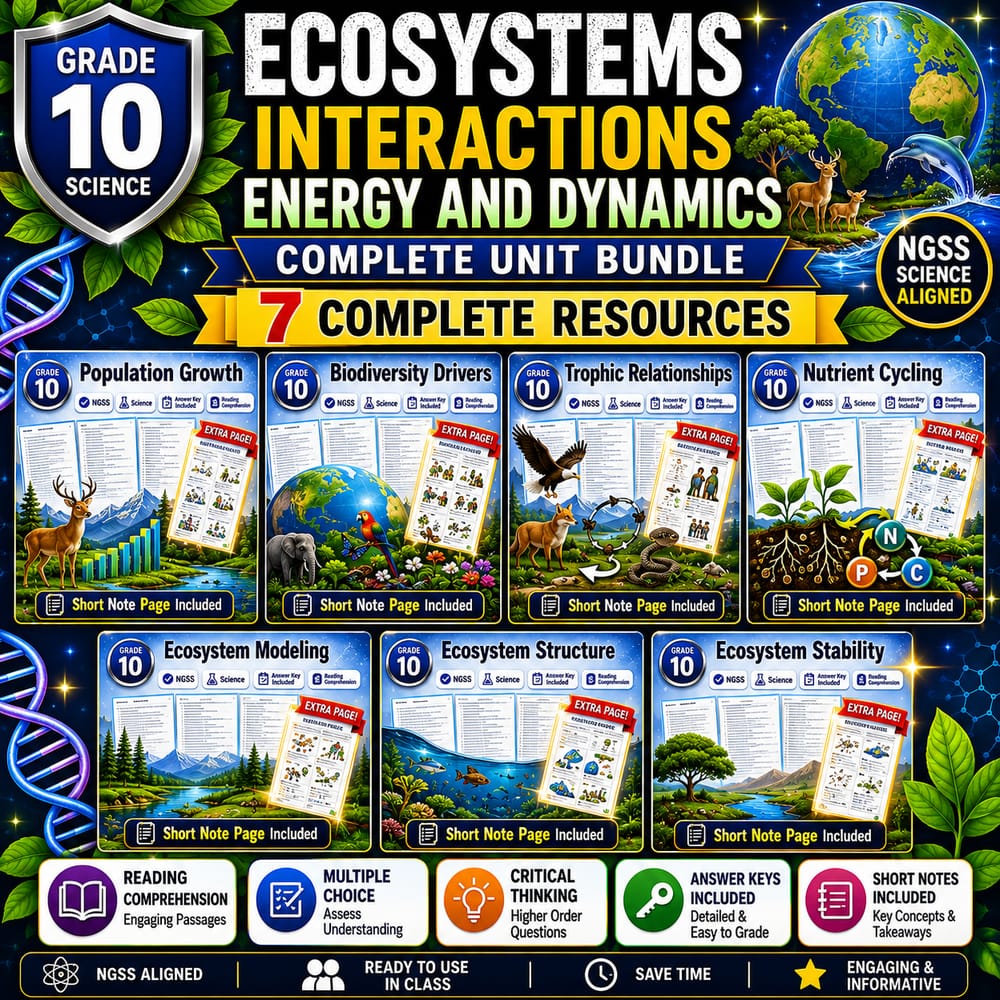
Grade 10 Ecosystem Dynamics Lesson Bundle | NGSS Science Ecology
$28.00$35.00Save $7.00
MTS Resources
New·0 followers·0 sales
SubjectScienceGradeGrade 10
What’s included
7 worksheets · Save $7.00 (20%) · prices shown inside the bundle
 Population Growth Worksheet | Science Grade 10 Assessment & Student Practice
- Use birth rate and death rate ideas to explain how populations increase or decrease over time.
- Compare exponential growth and logistic growth models, including the role of carrying capacity.
- Identify density-dependent and density-independent limiting factors and connect them to changes in population abundance.
$4.00$5.00 Biodiversity Drivers Worksheet | Grade 10 Science Printable PDF Assessment
- Explain how habitat fragmentation, invasive species, land-use change, and climate-driven range shifts can change species richness and community composition.
- Describe how genetic diversity and metapopulation connectivity influence extinction risk and recovery.
- Evaluate how evidence from studies of habitat loss and conservation interventions can inform ecosystem function and long-term viability.
$4.00$5.00 Trophic Relationships Worksheet | Science Grade 10 NGSS printable PDF
- Explain how energy and biomass transfer between trophic levels and why energy generally decreases up a food chain
- Interpret biomass and energy pyramids and describe what they imply about trophic efficiency
- Analyze how trophic cascades and keystone species can restructure communities through top-down and bottom-up effects
$4.00$5.00 Nutrient Cycling Worksheet | NGSS Science Grade 10 PDF | Classroom Assessment
- Explain how major biogeochemical cycles move nutrients among the atmosphere, biosphere, lithosphere, and hydrosphere.
- Describe key carbon and nitrogen transformations (photosynthesis, respiration, nitrification, denitrification, and decomposition).
- Analyze how human activities alter nutrient reservoirs and flux rates, contributing to eutrophication and hypoxia.
$4.00$5.00 Ecosystem Modeling Worksheet | NGSS Grade 10 Science printable PDF
- Explain how ecosystem models represent flows of energy and matter and why they help with predictions
- Interpret the meaning of model parameters, steady states, and system responses to perturbations
- Use conceptual and quantitative reasoning to evaluate resilience, tipping points, and consequences of disturbances
$4.00$5.00 Ecosystem Structure Worksheet | Grade 10 Science Printable PDF NGSS
- Identify biotic and abiotic components of terrestrial and aquatic ecosystems and explain how they relate to energy flow.
- Describe trophic levels and food-web connections, including the roles of producers, consumers, and decomposers.
- Explain how decomposition supports nutrient cycling and how ecological niches and habitat heterogeneity affect ecosystem structure and stability.
$4.00$5.00 Ecosystem Stability Assessment Worksheet | NGSS Grade 10 Science printable PDF
- Explain how feedback mechanisms and thresholds influence ecosystem stability and long-term trajectories
- Analyze how disturbances (natural and anthropogenic) affect resilience, recovery time, and functional redundancy
- Evaluate successional dynamics and alternative stable states in contexts such as forests and coral reefs
$4.00$5.00
Reviews & Feedback
Loading reviews...
Questions & Answers
Loading questions…
About this bundle
Related categories
Frequently asked questions
Who is Grade 10 Ecosystem Dynamics Lesson Bundle | NGSS Science Ecology designed for?
Grade 10 Ecosystem Dynamics Lesson Bundle | NGSS Science Ecology is designed for Grade 10 students and Science learners and can be used in classrooms, homeschool, or independent practice.
How do I download Grade 10 Ecosystem Dynamics Lesson Bundle | NGSS Science Ecology?
Add it to your cart and complete checkout. After payment, you can download immediately from your account, and you'll also receive a download link by email.
Similar Products

Grade 11 Ecology and Ecosystem Dynamics Science Lesson Bundle – NGSS Framework
$28.00$35.00

Grade 10 Science Ecosystems Interactions Energy and Dynamics Lesson Bundle | NGSS
$16.80$21.00

Grade 8 Science Ecosystem Dynamics Lesson Bundle | NGSS
$16.00$20.00

Grade 8 Ecosystem Dynamics NGSS Science Lesson Bundle Practice Worksheets
$16.00$20.00

Grade 9 Ecosystem Dynamics Science Lesson Bundle (NGSS)
$20.00$25.00