
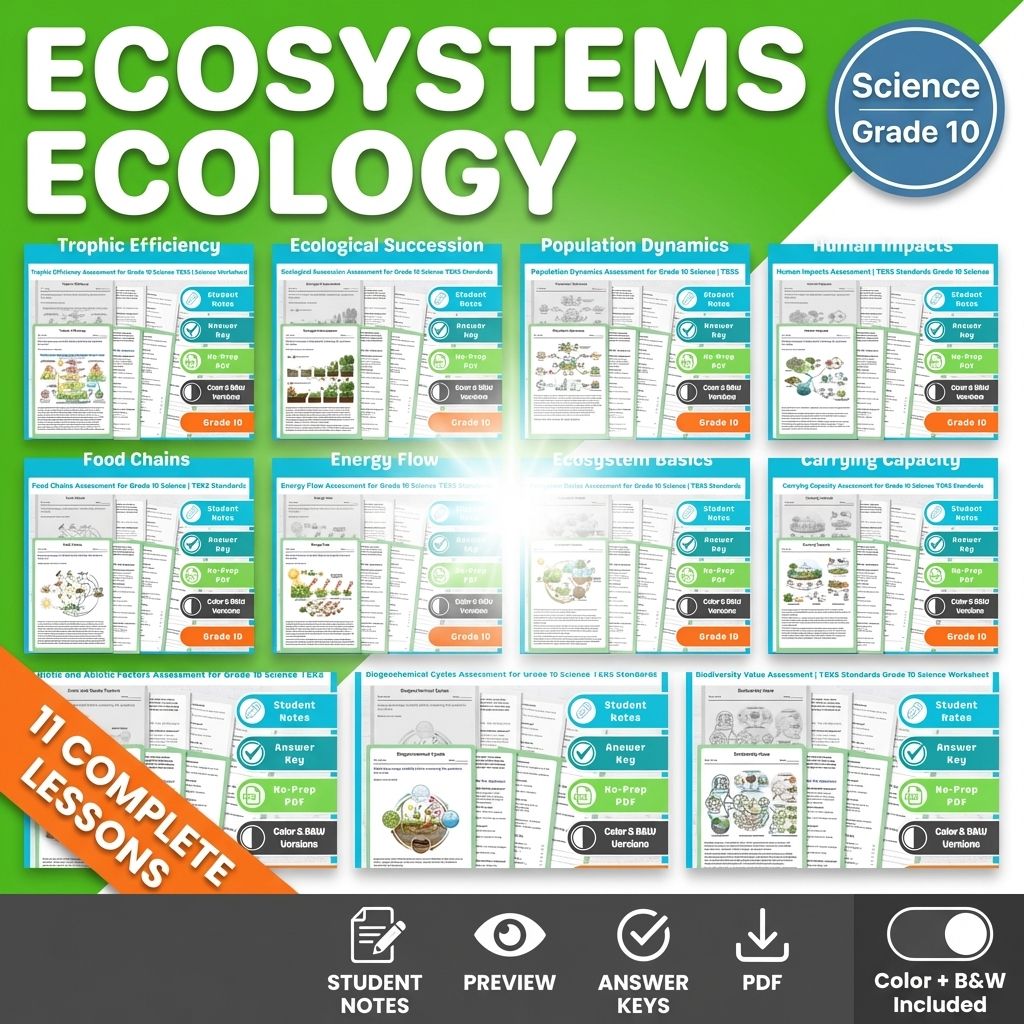

Grade 10 Ecosystems Science Lesson Bundle for TEKS Assessment Worksheets
$44.00$55.00Save $11.00
Prism Point Learning
·2 followers·13 sales
SubjectScienceGradeGrade 10Pages66 Pages
What’s included
11 worksheets · 66 pages · Save $11.00 (20%) · prices shown inside the bundle
 Biogeochemical Cycles Assessment for Grade 10 Science TEKS Standards
- Describe the key processes involved in major biogeochemical cycles such as carbon, nitrogen, phosphorus, and water.
- Explain how biological, physical, and chemical processes interact within nutrient cycles.
- Analyze human impacts on biogeochemical cycles and their effects on ecosystems.
$4.00$5.00 Biotic and Abiotic Factors Assessment for Grade 10 Science TEKS
- Understand the differences between biotic and abiotic factors in ecosystems.
- Identify examples of biotic and abiotic elements and their roles.
- Explain how interactions between biotic and abiotic factors influence habitats.
$4.00$5.00 Population Dynamics Assessment for Grade 10 Science | TEKS
- Understand the factors influencing population changes over time.
- Identify and analyze models used to predict population growth patterns.
- Evaluate the impact of environmental and biological interactions on populations.
$4.00$5.00 Energy Flow Assessment for Grade 10 Science TEKS Standards
- Explain how sunlight enters ecosystems and is used by photosynthetic organisms.
- Describe the transfer and loss of energy through trophic levels in food chains and webs.
- Analyze how energy constraints influence biomass and population sizes in ecosystems.
$4.00$5.00 Ecological Succession Assessment for Grade 10 Science TEKS Standards
- Understand the concepts of primary and secondary succession in ecosystems.
- Identify the processes involved in succession such as colonization, competition, and facilitation.
- Explain how disturbance frequency and intensity influence succession pathways and biodiversity.
$4.00$5.00 Ecosystem Basics Assessment for Grade 10 Science | TEKS Standards
- Understand the key components that make up an ecosystem.
- Identify the flows of energy and matter within ecosystems.
- Describe how different components in an ecosystem interact and influence each other.
$4.00$5.00 Carrying Capacity Assessment for Grade 10 Science TEKS Standards
- Understand the concept of carrying capacity and its importance in ecosystems.
- Identify factors that influence an environment's carrying capacity.
- Apply knowledge of resource limitations, predation, disease, and ecosystem interactions.
$4.00$5.00 Trophic Efficiency Assessment for Grade 10 Science TEKS | Science Worksheet
- Understand the concept of trophic efficiency and its significance in ecosystems.
- Analyze how energy transfer affects biomass pyramids and food web structures.
- Evaluate factors influencing variations in trophic efficiency among different ecosystems.
$4.00$5.00 Food Chains Assessment for Grade 10 Science | TEKS Standards
- Understand the flow of energy through food chains and food webs.
- Identify the roles of producers, consumers, and decomposers in ecosystems.
- Explain the concepts of interconnections and stability in complex food webs.
$4.00$5.00 Human Impacts Assessment | TEKS Standards Grade 10 Science
- Understand how human activities modify ecosystems through habitat alteration and pollution.
- Identify the effects of resource extraction, invasive species, and climate change on biodiversity.
- Explain how human activities influence energy flows and nutrient cycles in ecosystems.
$4.00$5.00
Reviews & Feedback
Loading reviews...
Questions & Answers
Loading questions…
About this bundle
Related categories
Frequently asked questions
Who is Grade 10 Ecosystems Science Lesson Bundle for TEKS Assessment Worksheets designed for?
Grade 10 Ecosystems Science Lesson Bundle for TEKS Assessment Worksheets is designed for Grade 10 students and Science learners and can be used in classrooms, homeschool, or independent practice.
How do I download Grade 10 Ecosystems Science Lesson Bundle for TEKS Assessment Worksheets?
Add it to your cart and complete checkout. After payment, you can download immediately from your account, and you'll also receive a download link by email.
Similar Products

Grade 11 Ecosystem Interactions Science Lesson Bundle TEKS Assessment Packet
$40.00$50.00

TEKS Ecosystems Grade 6 Science Daily Reading Worksheets Lesson Bundle | TEKS
$32.00$40.00

Grade 11 Science Lesson Bundle TEKS Ecosystems and Ecology Worksheets
$24.00$30.00

Grade 10 Ecosystems Science Lesson Bundle Daily Reading | TEKS
$38.40$48.00

Grade 7 Science Ecosystems Lesson Bundle | NGSS Interactions & Energy
$20.00$25.00