
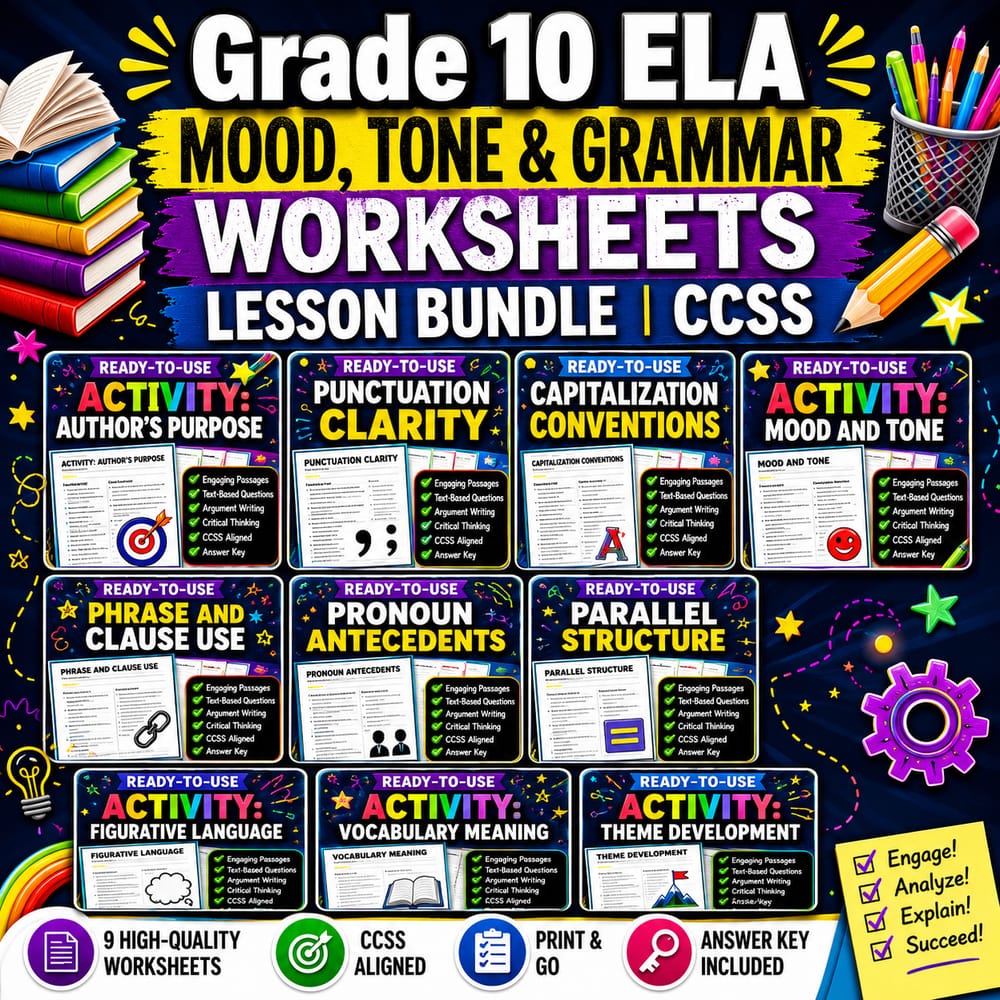
Grade 10 ELA Mood, Tone & Grammar Worksheets Lesson Bundle | CCSS
$24.00$30.00Save $6.00
Sunny Desk Resources
·2 followers·18 sales
SubjectELAGradeGrade 10Pages112 Pages
What’s included
10 worksheets · 112 pages · Save $6.00 (20%) · prices shown inside the bundle
 Syntax for Emphasis Worksheet Grade 10 ELA | CCSS Sentence Structure Analysis
- Explain how syntax choices (word order and clause placement) create emphasis and affect meaning
- Revise sentences by rearranging dependent clauses to highlight cause-and-effect, contrast, and conclusions
- Use syntax strategies to improve clarity and coherence in analytical writing
$2.40$3.00 Punctuation Clarity Worksheet Grade 10 ELA | CCSS Grammar & Writing Skills Practice
- Use commas to manage introductory elements and coordinating structures for clear sentence meaning.
- Correctly use apostrophes for possessives and contractions.
- Apply semicolons and colons to connect independent clauses and introduce explanations.
$2.40$3.00 Capitalization Conventions Worksheet Grade 10 ELA | CCSS Grammar & Writing Mechanics Practice
- Use capitalization conventions to capitalize sentence beginnings and proper nouns in academic writing.
- Apply capitalization rules to titles, abbreviations, headings, and references consistently.
- Revise sentences to correct incorrect capitalization and explain the rule being used.
$2.40$3.00 Spelling and Word Forms Worksheet Grade 10 ELA | CCSS Vocabulary Skills Practice
- Use correct spelling patterns and inflected word forms to improve clarity and professionalism in writing.
- Choose the correct word form for a sentence based on grammar and context (e.g., tense, part of speech, derivatives).
- Differentiate frequently confused words and homophones by meaning and appropriate usage.
$2.40$3.00 Phrase and Clause Use Worksheet Grade 10 ELA | CCSS Grammar & Sentence Structure Practice
- Distinguish phrases from clauses and identify their roles in sentences.
- Use dependent clauses to add reasons, conditions, or details and improve logic in writing.
- Revise sentences by correcting misplaced modifiers and reducing overstuffed structures.
$2.40$3.00 Pronoun Antecedents Worksheet Grade 10 ELA | CCSS Grammar & Agreement Practice
- Explain how pronoun-antecedent agreement improves clarity and coherence in writing.
- Identify ambiguous pronoun references and revise them to match the correct antecedent.
- Apply rules for pronoun number and person when editing analytical writing.
$2.40$3.00 Parallel Structure Worksheet Grade 10 ELA | CCSS Grammar & Sentence Consistency Practice
- Define parallel structure and explain how it improves clarity and rhythm in writing
- Identify grammatical mismatches in lists, comparisons, and contrasts
- Revise sentences to create consistent verb, noun, or phrase patterns
$2.40$3.00 Academic Vocabulary Worksheet Grade 10 ELA | CCSS Word Study & Context Clues Practice
- Use academic vocabulary (e.g., analyze, evaluate, characterize) to express precise meaning in writing.
- Select domain-specific terms and academic verbs to clarify claims, evidence, and explanations.
- Revise vague phrasing by replacing general words with more accurate academic vocabulary.
$2.40$3.00 Figurative Meaning Worksheet Grade 10 ELA | CCSS Literary Devices Practice & Analysis
- Determine how figurative language and connotation influence a text’s meaning and tone.
- Analyze how surrounding context (nearby sentences and ideas) clarifies ambiguous words or phrases.
- Support claims about author purpose by citing specific figurative language.
$2.40$3.00 Tone Through Language Worksheet Grade 10 ELA | CCSS Mood & Tone Analysis
- Explain how word choice and sentence construction create a writer’s tone
- Analyze how evaluative vocabulary and sentence length influence a reader’s interpretation
- Use conventions like grammar consistency and agreement to maintain tone across a passage
$2.40$3.00
Reviews & Feedback
Loading reviews...
Questions & Answers
Loading questions…
About this bundle
Related categories
Frequently asked questions
Who is Grade 10 ELA Mood, Tone & Grammar Worksheets Lesson Bundle | CCSS designed for?
Grade 10 ELA Mood, Tone & Grammar Worksheets Lesson Bundle | CCSS is designed for Grade 10 students and ELA learners and can be used in classrooms, homeschool, or independent practice.
How do I download Grade 10 ELA Mood, Tone & Grammar Worksheets Lesson Bundle | CCSS?
Add it to your cart and complete checkout. After payment, you can download immediately from your account, and you'll also receive a download link by email.
