
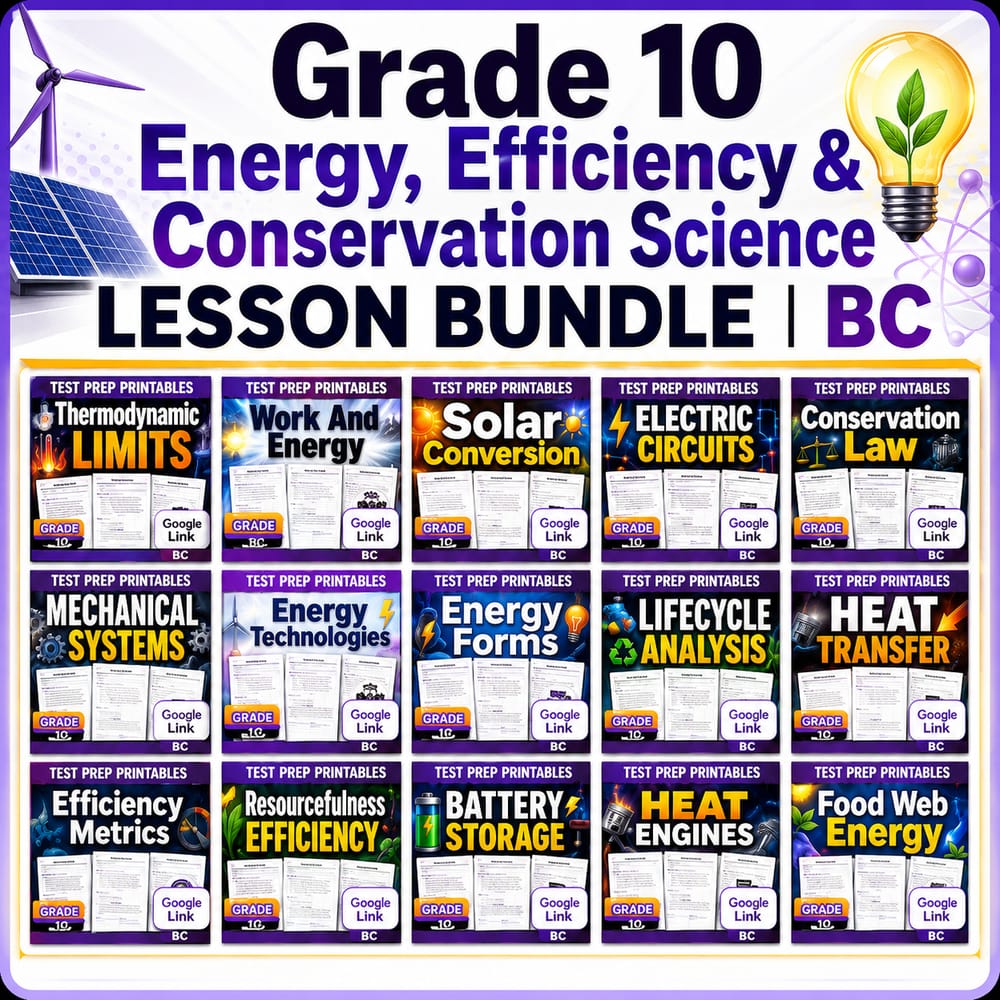


Grade 10 Energy, Efficiency & Conservation Science Lesson Bundle | BC
$60.00$75.00Save $15.00
Prism Point Learning
·2 followers·13 sales
SubjectScienceGradeGrade 10
What’s included
15 worksheets · Save $15.00 (20%) · prices shown inside the bundle
 Thermodynamic Limits Worksheet | Grade 10 Science Practice
- Explain how the first and second laws of thermodynamics constrain energy use and work production
- Use Carnot’s relationship to describe the maximum efficiency between two temperature reservoirs
- Describe how irreversibility (entropy production) reduces the performance of real heat engines and refrigerators
$4.00$5.00 Work And Energy Worksheet | Grade 10 Science Activities
- Explain how work transfers energy into or out of a system and how it relates to kinetic energy changes.
- Use the work–energy principle and conservation ideas to describe motion and energy changes in real situations.
- Distinguish between work, power, and energy stores (kinetic and potential) and apply them to sample problems.
$4.00$5.00 Solar Conversion Worksheet | Grade 10 Science Activities
- Explain how solar conversion turns radiant energy into electrical or chemical energy using photon-driven processes
- Describe the roles of semiconductor bandgaps, quantum efficiency, and loss pathways in determining conversion output
- Compare physical (photovoltaic/photoelectrochemical) and biological (photosynthesis) conversion in terms of mechanisms and integration into energy systems
$4.00$5.00 Electric Circuits Worksheet | Grade 10 Science Activities
- Explain how electric circuits move energy from sources through components to the load
- Describe how resistance, reactance, and transmission distance affect power delivery and efficiency
- Compare centralized and distributed generation using reliability and environmental impacts
$4.00$5.00 Conservation Law Worksheet | Grade 10 Science Activities
- Explain the law of conservation of energy in both closed and open systems.
- Identify how energy changes form (kinetic, potential, internal/chemical, thermal) during common processes.
- Use energy accounting to interpret energy “losses” as transformations into less useful forms.
$4.00$5.00 Mechanical Systems Worksheet | Grade 10 Science Practice
- Explain how mechanical systems transfer and transform energy through forces and motion
- Describe mechanical advantage using gears, pulleys, and levers
- Analyze how efficiency is affected by losses such as resistance and non-elastic collisions
$4.00$5.00 Energy Technologies Worksheet | Grade 10 Science Practice
- Explain how energy technologies convert energy into usable power and identify common devices used for conversion
- Evaluate energy technologies using efficiency, emissions over the lifecycle, and fuel renewability
- Compare technologies for specific applications by considering trade-offs such as scalability and infrastructure demands
$4.00$5.00 Energy Forms Worksheet | Grade 10 Science Practice Activities
- Identify major forms of energy (kinetic, potential, thermal, chemical, radiant, and nuclear) and describe what systems store them.
- Explain how energy can shift between forms during everyday processes such as heating, motion, or respiration.
- Distinguish between different kinds of potential energy and relate them to real-world examples.
$4.00$5.00 Lifecycle Analysis Worksheet | Grade 10 Science Activities
- Explain cradle-to-grave lifecycle analysis and identify its main energy stages: extraction, manufacturing, operation, and disposal.
- Apply conservation of energy to compare total embodied energy and operational energy with outputs such as waste heat.
- Interpret lifecycle analysis results to evaluate net energy benefits or deficits and recognize hidden upstream impacts.
$4.00$5.00 Heat Transfer Worksheet | Grade 10 Science Activities
- Explain how heat moves through conduction, convection, and radiation
- Describe how material properties and temperature differences affect the rate of heat transfer
- Interpret real-world examples of heating and cooling using heat-transfer mechanisms
$4.00$5.00
Reviews & Feedback
Loading reviews...
Questions & Answers
Loading questions…
About this bundle
Related categories
Frequently asked questions
Who is Grade 10 Energy, Efficiency & Conservation Science Lesson Bundle | BC designed for?
Grade 10 Energy, Efficiency & Conservation Science Lesson Bundle | BC is designed for Grade 10 students and Science learners and can be used in classrooms, homeschool, or independent practice.
How do I download Grade 10 Energy, Efficiency & Conservation Science Lesson Bundle | BC?
Add it to your cart and complete checkout. After payment, you can download immediately from your account, and you'll also receive a download link by email.
Similar Products

Grade 8 Science Thermal Transfer & Energy Conservation Lesson Bundle | NGSS
$20.00$25.00

Grade 5 Science Energy Transfer, Efficiency & Sustainability Lesson Bundle
$40.00$50.00

Energy Transfer, Conversion & Conservation Lesson Bundle | Grade 11 Science | NGSS
$14.00$20.00

Energy Conservation Grade 9 Science Daily Reading Lesson Bundle | NGSS
$20.00$25.00

Grade 9 Science Energy Conservation & Transfer Lesson Bundle – NGSS
$20.00$25.00