
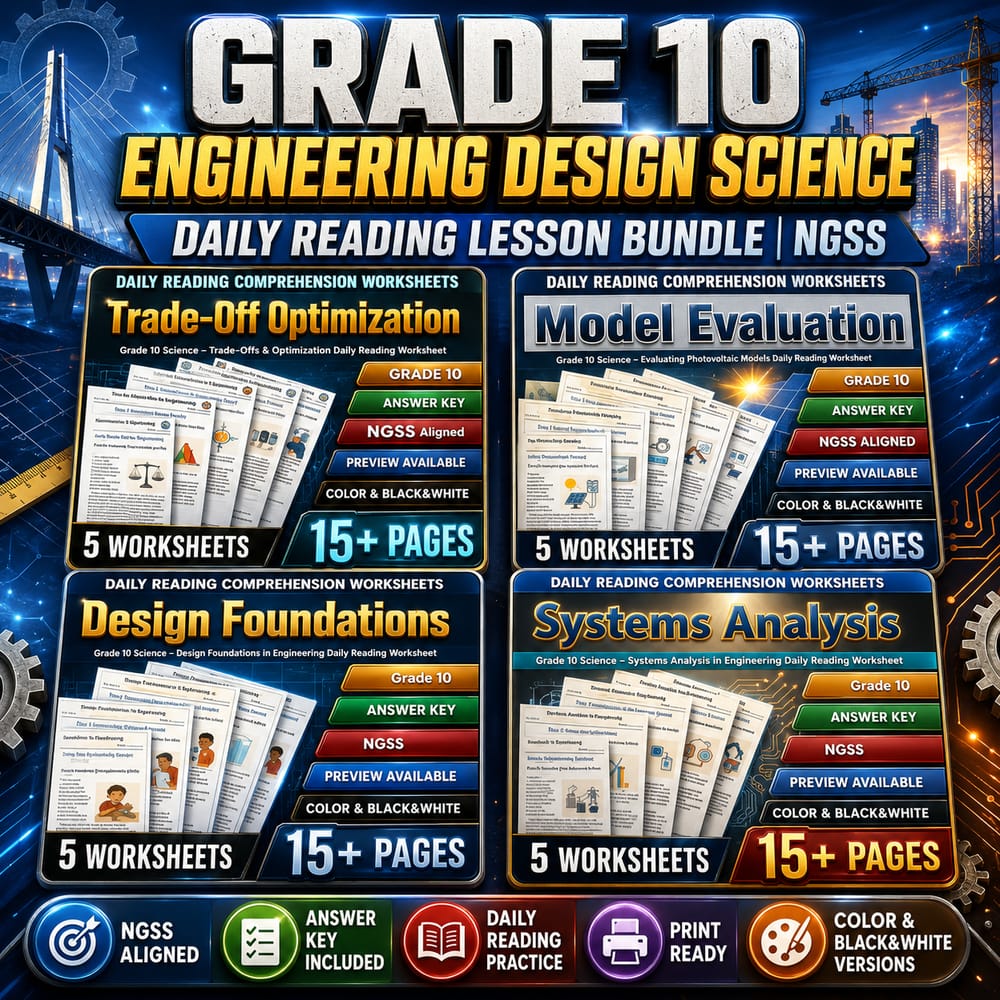
Grade 10 Engineering Design Science Daily Reading Lesson Bundle | NGSS
$12.80$16.00Save $3.20
Bright Mind Resources
New·1 followers·12 sales
SubjectScienceGradeGrade 10
What’s included
4 worksheets · Save $3.20 (20%) · prices shown inside the bundle
 Grade 10 Science – Trade-Offs & Optimization Daily Reading Worksheet
- Understand the concept of trade-offs in engineering design.
- Learn how to analyze multiple objectives using cost-benefit matrices.
- Explore Pareto fronts and sensitivity analysis for optimization.
$3.20$4.00 Grade 10 Science – Evaluating Photovoltaic Models Daily Reading Worksheet
- Understand the importance of comparing simulation predictions with empirical data
- Learn methods for validating models using real-world measurements
- Analyze data to identify reliability and failure modes in photovoltaic systems
$3.20$4.00 Grade 10 Science – Design Foundations in Engineering Daily Reading Worksheet
- Understand the importance of defining criteria and constraints in engineering problems.
- Identify key components of the engineering design process, including model construction and solution generation.
- Apply qualitative and quantitative measures to evaluate design solutions.
$3.20$4.00 Grade 10 Science – Systems Analysis & Engineering | Daily Reading Worksheet
- Identify key components of engineering systems
- Understand system boundaries and interfaces
- Recognize emergent behaviors in multi-component designs
$3.20$4.00
Reviews & Feedback
Loading reviews...
Questions & Answers
Loading questions…
About this bundle
Related categories
Frequently asked questions
Who is Grade 10 Engineering Design Science Daily Reading Lesson Bundle | NGSS designed for?
Grade 10 Engineering Design Science Daily Reading Lesson Bundle | NGSS is designed for Grade 10 students and Science learners and can be used in classrooms, homeschool, or independent practice.
How do I download Grade 10 Engineering Design Science Daily Reading Lesson Bundle | NGSS?
Add it to your cart and complete checkout. After payment, you can download immediately from your account, and you'll also receive a download link by email.
Similar Products

Engineering Design Grade 7 Science Daily Reading Worksheets Lesson Bundle | TEKS
$32.00$40.00

Engineering Design Grade 11 Science Daily Reading Worksheets Bundle | NGss
$16.00$20.00

Engineering Design Grade 12 Science Daily Reading Worksheets Bundle | General
$22.40$28.00

Grade 10 Ecology Lesson Bundle | Daily Reading | ngss Science
$28.00$35.00

Grade 8 Tradeoff Analysis Science Daily Reading Worksheets Lesson Bundle | NGSS
$16.00$20.00