
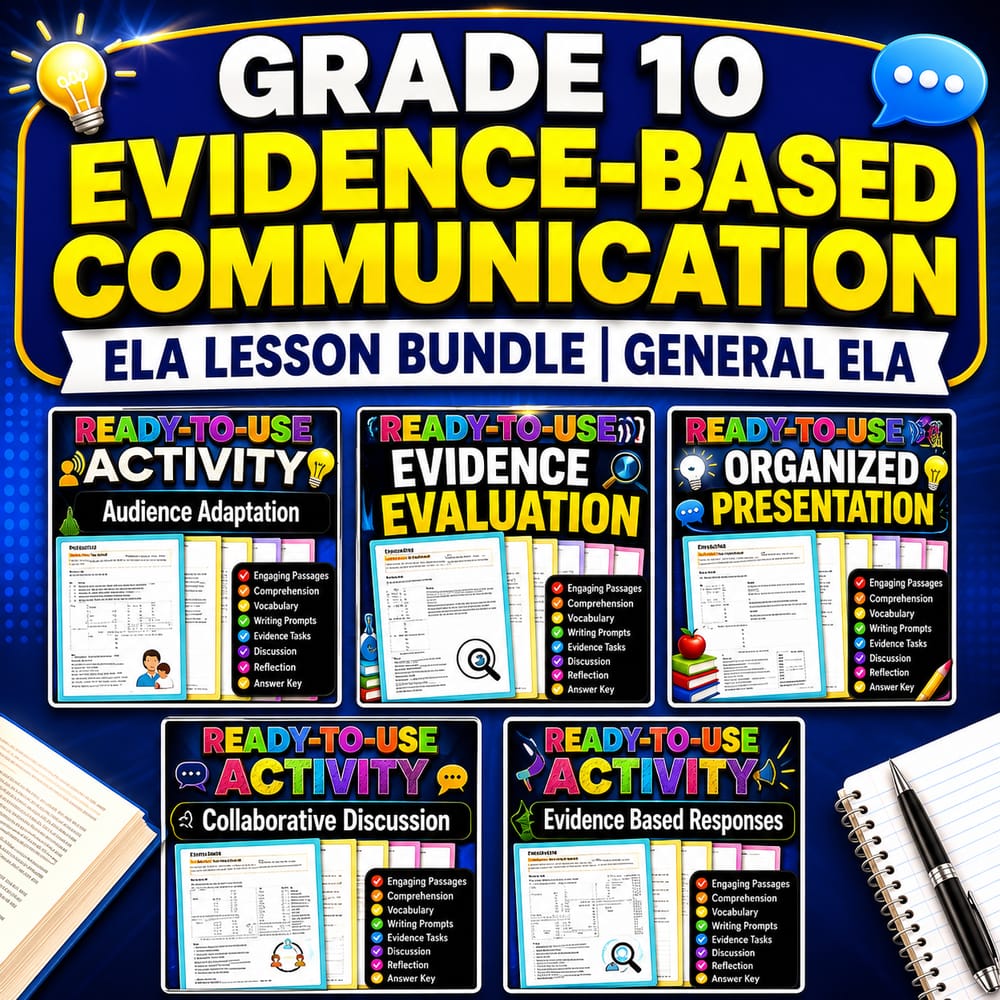
Grade 10 Evidence-Based Communication ELA Lesson Bundle | General ELA
$12.00$15.00Save $3.00
Sunny Desk Resources
·2 followers·18 sales
SubjectELAGradeGrade 10Pages55 Pages
What’s included
5 worksheets · 55 pages · Save $3.00 (20%) · prices shown inside the bundle
 Grade 10 Audience Adaptation Worksheet | ELA Writing & Communication
- Explain how audience adaptation changes speaking and listening strategies to meet specific communication goals.
- Identify tone and language choices appropriate for different audiences (formal conference, peer discussion, public audience).
- Use listening strategies such as rhetorical cues and keyword attention to improve understanding and clarification.
$2.40$3.00 Grade 10 Evidence Evaluation Worksheet | ELA Argument & Critical Thinking
- Evaluate how well a presentation’s claims are supported by relevant and sufficient evidence
- Determine whether reasoning is logical and whether conclusions match the information presented
- Assess whether counterarguments or limitations are addressed fairly and accurately
$2.40$3.00 Grade 10 Organized Presentation Worksheet | ELA Speaking & Writing Skills
- Identify the central claim of an organized presentation and describe how supporting evidence proves it
- Use logical sequencing and transitions to connect ideas clearly in an informative speech or brief report
- Apply language choices that maintain clarity, precision, and coherence for an audience
$2.40$3.00 Grade 10 Collaborative Discussion Worksheet | ELA Speaking & Listening
- Enter a discussion prompt with a clear claim supported by relevant evidence and reasoning.
- Use discussion moves such as paraphrasing, acknowledging agreement/differences, and building on prior ideas.
- Practice attentive listening to respond accurately and maintain focus across turn-taking.
$2.40$3.00 Grade 10 Evidence Based Responses Worksheet | ELA Writing & Text Evidence
- Identify the difference between an assertion and evidence during a discussion
- Use evidence-based responses to clarify unclear ideas and connect to others’ claims
- Strengthen an argument by restating underlying reasoning and adding relevant support
$2.40$3.00
Reviews & Feedback
Loading reviews...
Questions & Answers
Loading questions…
About this bundle
Related categories
Frequently asked questions
Who is Grade 10 Evidence-Based Communication ELA Lesson Bundle | General ELA designed for?
Grade 10 Evidence-Based Communication ELA Lesson Bundle | General ELA is designed for Grade 10 students and ELA learners and can be used in classrooms, homeschool, or independent practice.
How do I download Grade 10 Evidence-Based Communication ELA Lesson Bundle | General ELA?
Add it to your cart and complete checkout. After payment, you can download immediately from your account, and you'll also receive a download link by email.
Similar Products

Grade 8 Evidence-Based Communication in ELA Lesson Bundle – Alberta
$19.20$24.00

Grade 8 Evidence-Based Writing ELA Lesson Bundle for Alberta Class Instruction
$40.00$50.00

Grade 10 Evidence-Based Communication ELA Lesson Bundle: General ELA
$12.80$16.00

Grade 11 ELA Writing & Evidence-Based Analysis Lesson Bundle | General ELA
$24.00$30.00

Grade 8 Oral Presentations & Evidence-Based Discussion ELA lesson bundle TEKS
$12.00$15.00