
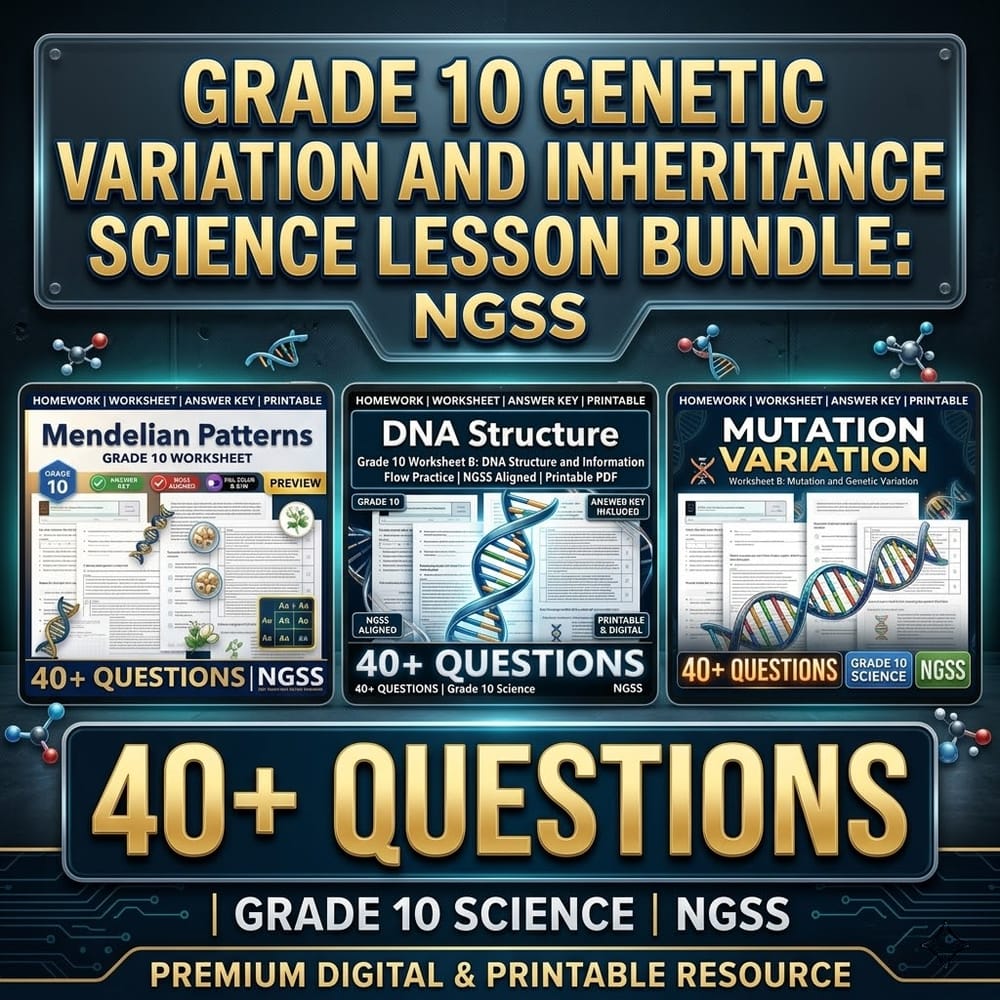
Grade 10 Genetic Variation and Inheritance Science Lesson Bundle: NGSS
$12.00$15.00Save $3.00
Clear Sky Classroom
·1 followers·19 sales
SubjectScienceGradeGrade 10
What’s included
3 worksheets · Save $3.00 (20%) · prices shown inside the bundle
 Grade 10 Worksheet B: Mendelian Patterns and Inheritance Practice | NGSS PDF
- Use Mendelian principles (dominance, segregation, and independent assortment) to predict offspring phenotypes from parental genotypes.
- Interpret pedigree information and relate inheritance patterns to probability outcomes.
- Apply Punnett-square reasoning to single-gene traits and identify common misconceptions.
$4.00$5.00 Grade 10 Worksheet B: DNA Structure and Information Flow Practice | NGSS
- Explain how DNA’s double helix geometry and antiparallel strands support accurate replication.
- Use complementary base pairing rules (A–T and C–G) to predict how DNA sequences can be copied.
- Describe semi-conservative DNA replication and the roles of helicase and DNA polymerase.
$4.00$5.00 Grade 10 Worksheet B: Mutation and Genetic Variation Worksheet | NGSS
- Explain how mutations create genetic variation at the nucleotide and chromosomal levels
- Describe common mechanisms that cause mutations and how they can change gene function
- Use examples to connect mutation type to changes in phenotype and population variation
$4.00$5.00
Reviews & Feedback
Loading reviews...
Questions & Answers
Loading questions…
About this bundle
Related categories
Frequently asked questions
Who is Grade 10 Genetic Variation and Inheritance Science Lesson Bundle: NGSS designed for?
Grade 10 Genetic Variation and Inheritance Science Lesson Bundle: NGSS is designed for Grade 10 students and Science learners and can be used in classrooms, homeschool, or independent practice.
How do I download Grade 10 Genetic Variation and Inheritance Science Lesson Bundle: NGSS?
Add it to your cart and complete checkout. After payment, you can download immediately from your account, and you'll also receive a download link by email.
Similar Products

Grade 6 Genetics Variation & Inheritance Lesson Bundle | NGSS
$8.00$10.00

Grade 11 Genetics Science Lesson Bundle: NGSS Mutation & Inheritance
$12.00$15.00

Grade 11 Molecular Genetics & Inheritance Science Lesson Bundle | NGSS
$12.00$15.00

Grade 6 Science Herbity Lesson Bundle | Inheritance & Trait Variation
$6.40$8.00

Genetic Variation & Inheritance Lesson Bundle — Grade 9 Science ngss
$9.60$12.00