
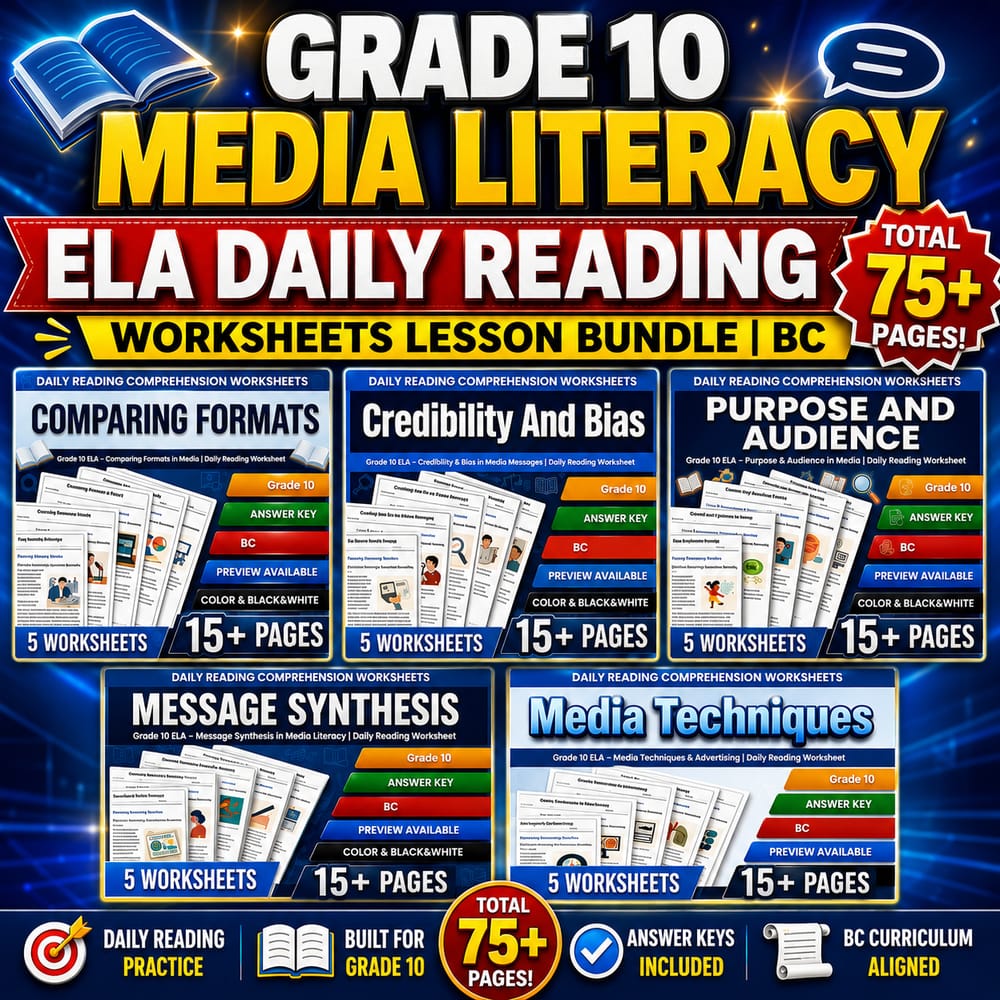
Grade 10 Media Literacy ELA Daily Reading Worksheets Lesson Bundle | BC
$16.00$20.00Save $4.00
Quiet Forest Education
·3 followers·20 sales
SubjectELAGradeGrade 10Pages153 Pages
What’s included
5 worksheets · 153 pages · Save $4.00 (20%) · prices shown inside the bundle
 Grade 10 ELA – Comparing Formats in Media | Daily Reading Worksheet
- Analyze how different media formats present the same information.
- Identify main ideas and supporting details across articles, videos, and podcasts.
- Understand how timing, visuals, and audio influence interpretation.
$3.20$4.00 Grade 10 ELA – Credibility & Bias in Media Messages | Daily Reading Worksheet
- Identify characteristics of credible sources
- Recognize signs of bias and exaggeration in media
- Develop skills to assess evidence quality
$3.20$4.00 Grade 10 ELA – Purpose & Audience in Media | Daily Reading Worksheet
- Identify persuasive techniques used in media.
- Analyze how audience influences media presentation.
- Compare different media approaches based on purpose and audience.
$3.20$4.00 Grade 10 ELA – Message Synthesis & Media Literacy | Daily Reading Worksheet
- Understand how different media formats convey messages.
- Analyze the techniques used in various media platforms.
- Evaluate credibility and audience goals across formats.
$3.20$4.00 Grade 10 ELA – Media Techniques & Advertising | Daily Reading Worksheet
- Understand the concept of framing in media messages.
- Identify different media techniques used to influence audience perception.
- Analyze how framing alters the meaning and emotional impact of a message.
$3.20$4.00
Reviews & Feedback
Loading reviews...
Questions & Answers
Loading questions…
About this bundle
Related categories
Frequently asked questions
Who is Grade 10 Media Literacy ELA Daily Reading Worksheets Lesson Bundle | BC designed for?
Grade 10 Media Literacy ELA Daily Reading Worksheets Lesson Bundle | BC is designed for Grade 10 students and ELA learners and can be used in classrooms, homeschool, or independent practice.
How do I download Grade 10 Media Literacy ELA Daily Reading Worksheets Lesson Bundle | BC?
Add it to your cart and complete checkout. After payment, you can download immediately from your account, and you'll also receive a download link by email.
Similar Products

Grade 4 Media Literacy Lesson Bundle | Ontario ELA Worksheets
$12.00$15.00

Grade 12 ELA Daily Reading & Literary Media Literacy Lesson Bundle | Ontario
$112.00$160.00

Grade 12 ELA Media Literacy Worksheets | Ontario Media Literacy
$14.40$18.00

Grade 10 Media Literacy ELA Lesson Bundle Daily Reading Worksheets | Ontario
$16.00$20.00

Media Literacy Grade 8 ELA Daily Reading Worksheets Lesson Bundle | Ontario
$25.60$32.00