
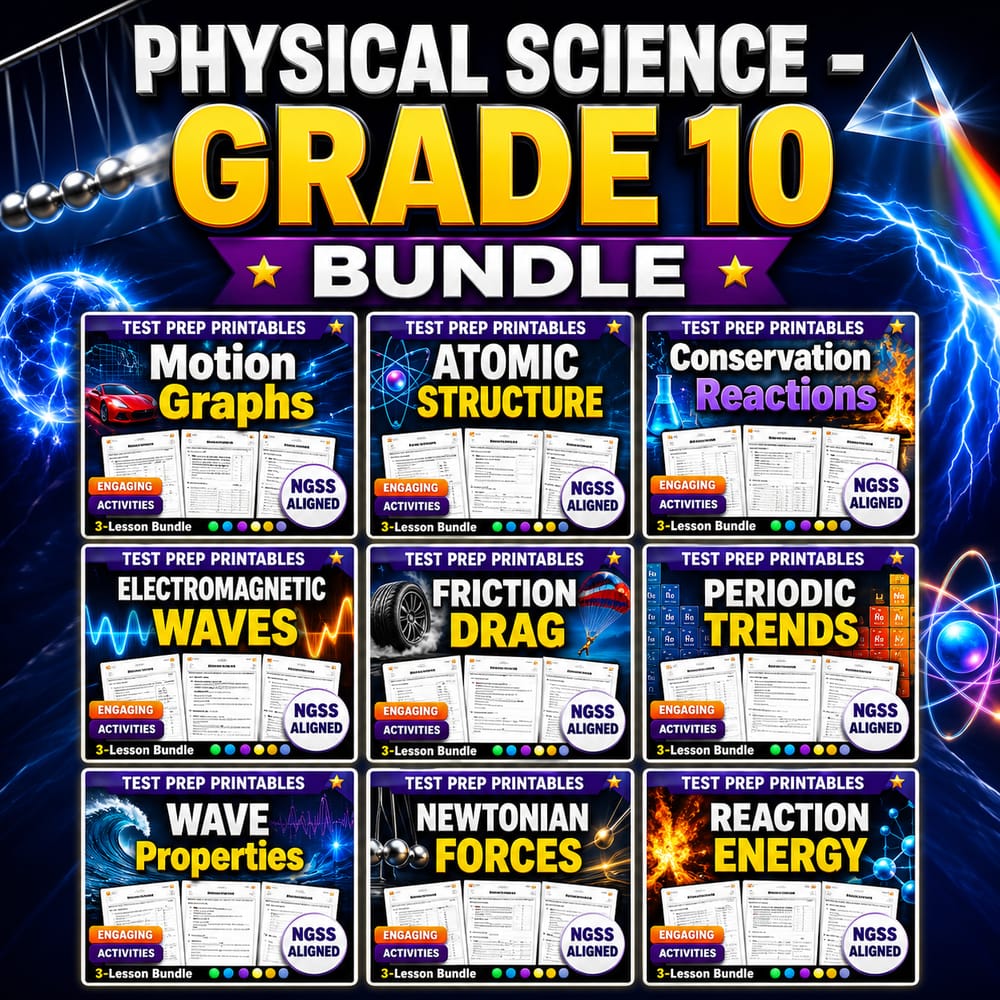
Grade 10 Physical Science Lesson Bundle | Florida NGSSS
$36.00$45.00Save $9.00
Prism Point Learning
·2 followers·14 sales
SubjectScienceGradeGrade 10
What’s included
9 worksheets · Save $9.00 (20%) · prices shown inside the bundle
 Motion Graphs Worksheet Grade 10 Science Activities | NGSSS Practice
- Interpret slope on position-time and velocity-time graphs to determine velocity and acceleration.
- Use graph features (sign, curvature, and flat sections) to reason about changing direction and acceleration.
- Connect motion graph representations to how forces affect an object over time.
$4.00$5.00 Atomic Structure Worksheet Grade 10 Science Activity | NGSSS Aligned
- Explain how protons, neutrons, and electrons determine an atom’s identity and mass.
- Describe what isotopes are and how they differ by neutron number and mass number.
- Use electron energy-level ideas to interpret how atoms absorb and emit light.
$4.00$5.00 Conservation in Reactions Worksheet Grade 10 Chemistry Practice NGSSS
- Explain chemical reactions using evidence that atoms are conserved from reactants to products
- Interpret balanced chemical equations as models that conserve atoms (and mass) across both sides
- Use system boundaries to account for measured mass changes in chemical systems
$4.00$5.00 Electromagnetic Waves Worksheet Grade 10 Science Activities & NGSSS
- Explain how oscillating electric and magnetic fields form electromagnetic waves that can travel through a vacuum
- Relate frequency and wavelength to the energy of electromagnetic waves across the electromagnetic spectrum
- Describe how reflection, transmission, and absorption depend on a material’s response to different wavelengths and frequencies
$4.00$5.00 Friction and Drag Worksheet Grade 10 Science Practice | NGSSS
- Explain how friction and drag act as nonconservative forces that oppose motion and change acceleration over time.
- Describe how velocity can approach a new value (including terminal velocity) when opposing forces increase with speed.
- Differentiate between static friction and kinetic friction and relate their effects to real-world motion.
$4.00$5.00 Periodic Trends Worksheet Grade 10 Chemistry Practice & Activities NGSSS
- Explain how effective nuclear charge and shielding affect atomic size across periods and groups.
- Predict how ion formation and ionization energy trends change for main-group elements.
- Use valence electrons to infer typical bonding tendencies and common ion charges.
$4.00$5.00 Wave Properties Worksheet Grade 10 Science Activity | Waves & Energy
- Explain how amplitude, wavelength, frequency, and wave speed describe repeating wave behavior
- Relate frequency and wavelength for waves traveling at the same speed
- Describe how reflection, refraction, and superposition affect what we observe
$4.00$5.00 Newtonian Forces Worksheet Grade 10 Science Practice & Assessment NGSSS
- Explain how net force relates to changes in velocity and acceleration.
- Connect equilibrium to balanced forces and predict motion outcomes.
- Use Newton’s second law to predict how changing force or mass affects acceleration.
$4.00$5.00 Reaction Energy Worksheet Grade 10 Chemistry Activities & NGSSS Practice
- Explain how energy changes in chemical reactions by comparing the total energy of reactants and products.
- Distinguish endothermic and exothermic processes using energy profiles and the direction of heat transfer.
- Relate bond breaking, bond forming, and activation energy to the overall energy change and reaction pathway.
$4.00$5.00
Reviews & Feedback
Loading reviews...
Questions & Answers
Loading questions…
About this bundle
Related categories
Frequently asked questions
Who is Grade 10 Physical Science Lesson Bundle | Florida NGSSS designed for?
Grade 10 Physical Science Lesson Bundle | Florida NGSSS is designed for Grade 10 students and Science learners and can be used in classrooms, homeschool, or independent practice.
How do I download Grade 10 Physical Science Lesson Bundle | Florida NGSSS?
Add it to your cart and complete checkout. After payment, you can download immediately from your account, and you'll also receive a download link by email.


