
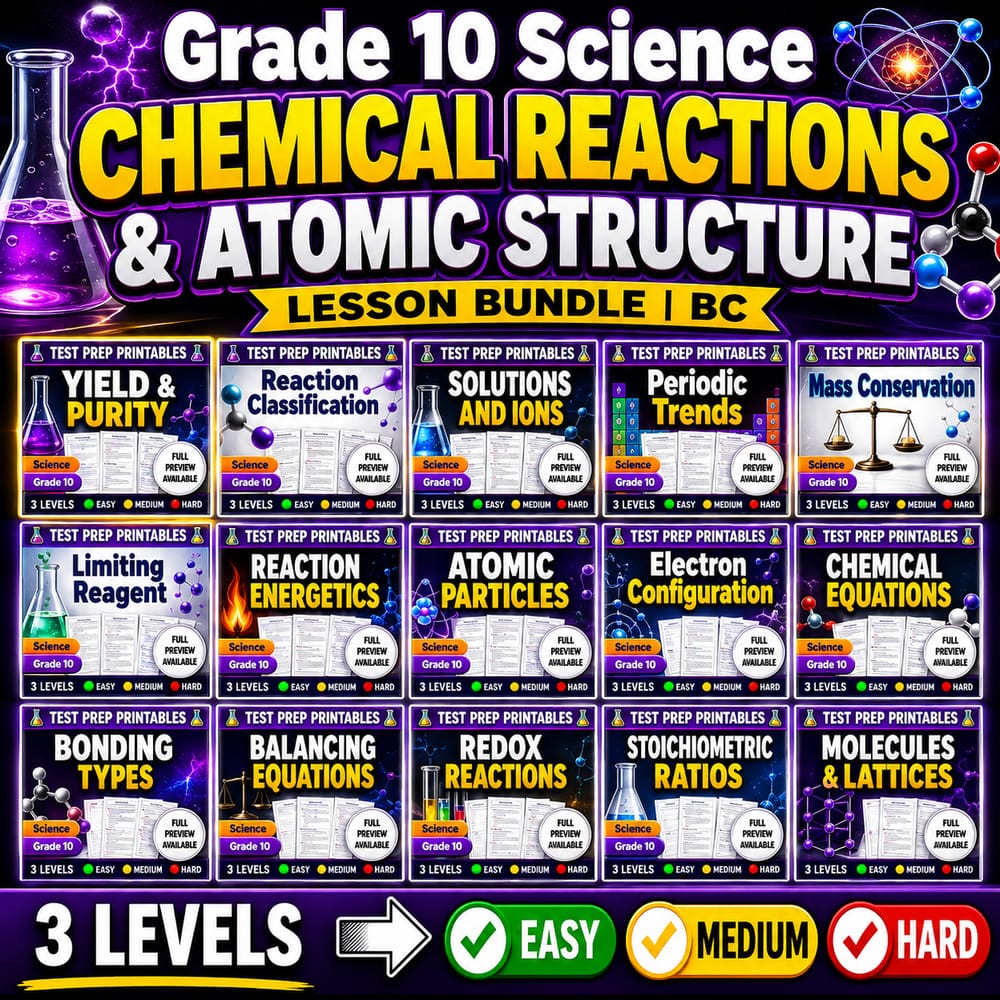


Grade 10 Science Chemical Reactions & Atomic Structure Lesson Bundle | Bc
$60.00$75.00Save $15.00
Prism Point Learning
·2 followers·13 sales
SubjectScienceGradeGrade 10
What’s included
15 worksheets · Save $15.00 (20%) · prices shown inside the bundle
 Yield And Purity Worksheet Pack | Grade 10 Science Activities
- Explain percent yield using actual and theoretical product amounts from a balanced chemical equation.
- Distinguish yield from purity and describe how impurities affect measured mass and stoichiometric calculations.
- Use purity to correct product mass and connect chemical calculations to realistic lab outcomes.
$4.00$5.00 Reaction Classification Worksheet | Grade 10 Science Practice
- Classify chemical reactions into major types (synthesis, decomposition, displacement, combustion, acid–base neutralization, and precipitation) using reactant and product evidence.
- Predict likely products and observable signs (gas, heat, color change, precipitate) based on reaction type and reactant identities.
- Explain how balancing equations and using periodic trends help rationalize reaction conditions and energy changes.
$4.00$5.00 Isotopes And Ions Worksheet | Grade 10 Science Activities
- Explain how isotopes differ by neutron count and how this affects atomic mass without changing chemical identity.
- Describe how ions form when atoms gain or lose electrons, producing charged particles with different properties.
- Use periodic table information and particle charge/mass ideas to distinguish isotopic and ionic variations.
$4.00$5.00 Periodic Trends Worksheet | Grade 10 Science Activities
- Explain how changes in nuclear charge and electron shielding produce periodic trends across periods and down groups
- Predict whether atomic radius increases or decreases and whether ionization energy and electronegativity increase or decrease
- Use periodic trends to reason about bonding, metallic character, and reactivity
$4.00$5.00 Mass Conservation Worksheet | Grade 10 Science Activities
- Explain conservation of mass in chemical reactions and identify what must be included for a closed system mass balance.
- Use balanced chemical equations and correct bookkeeping of reactants and products to predict how mass is accounted for.
- Describe how gases and dissolved ions affect total mass measurements in real laboratory systems.
$4.00$5.00 Limiting Reagent Worksheet | Grade 10 Science Activities
- Explain what a limiting reagent is and how it determines the maximum amount of product in a reaction.
- Use stoichiometric ratios and mole amounts to identify the limiting reactant.
- Connect limiting reagents to theoretical yield and the idea of conservation of mass in a closed system.
$4.00$5.00 Reaction Energetics Worksheet | Grade 10 Science Activities
- Explain how bond energies relate to whether a chemical reaction is exothermic or endothermic
- Interpret how enthalpy changes and temperature observations support reaction energetics
- Apply periodic and structural factors to predict typical bond-strength trends
$4.00$5.00 Atomic Particles Worksheet Pack | Grade 10 Science Activities
- Explain how protons and neutrons in the nucleus determine atomic number and mass number
- Describe how electrons in energy levels (shells) affect an atom’s chemical behavior
- Connect subatomic particles to how elements are organized on the periodic table
$4.00$5.00 Electron Configuration Worksheet | Grade 10 Science Activities
- Explain how electrons fill quantized energy levels and orbitals in an atom.
- Use electron configuration and valence electrons to predict bonding behavior and chemical reactivity.
- Connect electron configuration patterns to periods and groups on the periodic table.
$4.00$5.00 Chemical Equations Worksheet Grade 10 Science Practice
- Explain how chemical equations represent reactants, products, and conserved atoms
- Interpret the meaning of coefficients and state symbols in chemical equations
- Use balanced equations to make qualitative predictions about reactants and products
$4.00$5.00
Reviews & Feedback
Loading reviews...
Questions & Answers
Loading questions…
About this bundle
Related categories
Frequently asked questions
Who is Grade 10 Science Chemical Reactions & Atomic Structure Lesson Bundle | Bc designed for?
Grade 10 Science Chemical Reactions & Atomic Structure Lesson Bundle | Bc is designed for Grade 10 students and Science learners and can be used in classrooms, homeschool, or independent practice.
How do I download Grade 10 Science Chemical Reactions & Atomic Structure Lesson Bundle | Bc?
Add it to your cart and complete checkout. After payment, you can download immediately from your account, and you'll also receive a download link by email.
Similar Products

Reaction Stoichiometry & Chemical Reaction Structure Lesson Bundle | Grade 11 Science | NGSS
$19.60$28.00

Phase Changes, Chemical Reactions & Atomic Structure Lesson Bundle | Grade 9 Science | Alberta
$36.00$45.00

Atomic Structure & Chemical Reactions Lesson Bundle | Grade 9 Science | NGSS
$28.00$35.00

Chemical Reactions & Atomic Structure Lesson Bundle | Grade 12 Science | Alberta
$60.00$75.00

Grade 9 Chemical Reactions and Atomic Structure Science Lesson Bundle – NGSS
$28.00$35.00