Are your Grade 10 students exploring the fundamental principles of collisions and momentum in physics?
This Worksheet Elena is specifically designed to help Ontario science educators deepen students' understanding of motion interactions, momentum, and impulse. Crafted to complement your curriculum, this PDF worksheet package includes opportunities for students to analyze real-world collision scenarios, understand the conservation of momentum, and develop critical thinking skills in physics through varied question formats. The accompanying PDF answer key with rubric ensures clear, efficient assessment and seamless grading, all in a printable format perfect for classroom instruction or homework assignments.
What's Included
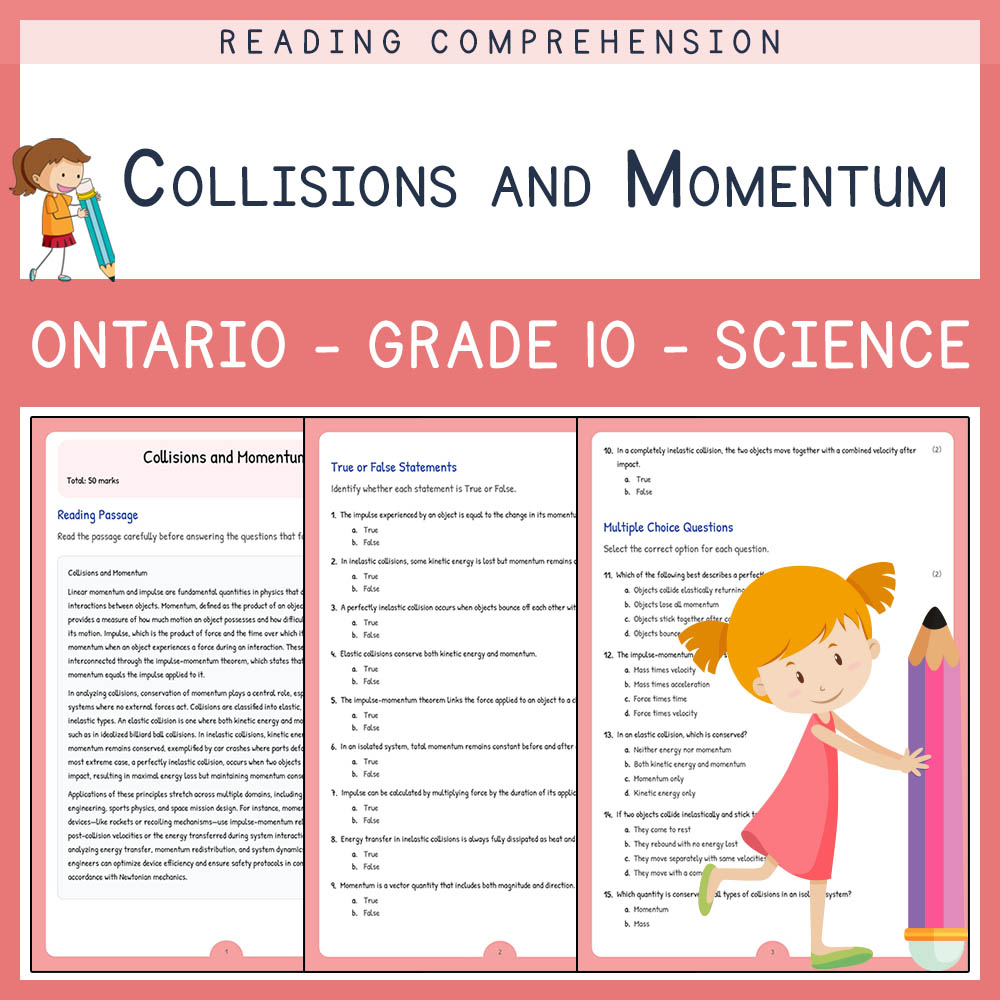
✅ Reading passage containing a comprehensive overview of linear momentum and impulse, promoting deep conceptual understanding
✅ 10 true or false statements designed to reinforce fundamental concepts such as conservation of momentum and energy loss in collisions
✅ 5 multiple choice questions focusing on collision types and the impulse-momentum theorem
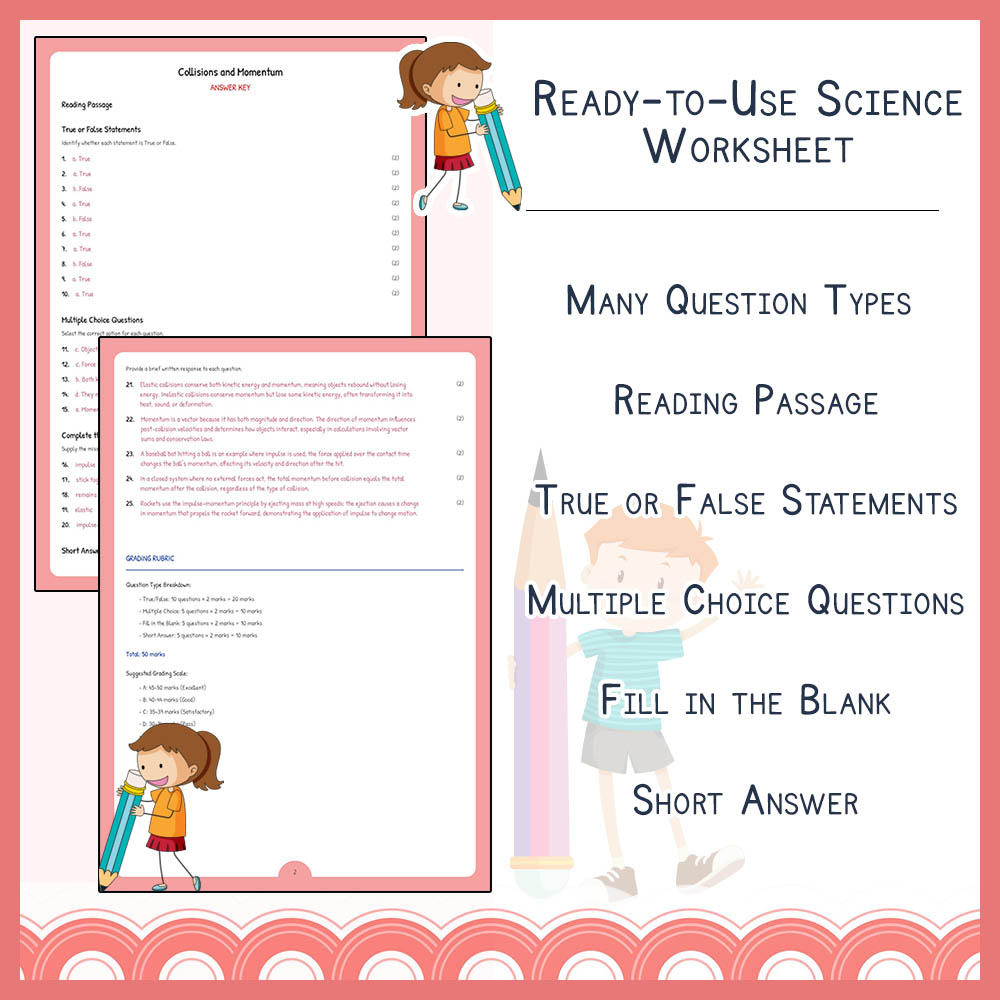
✅ 5 fill-in-the-blank statements to assess precise understanding of key terminology and concepts
✅ 5 short answer questions prompting explanation of differences between elastic and inelastic collisions and the significance of momentum direction
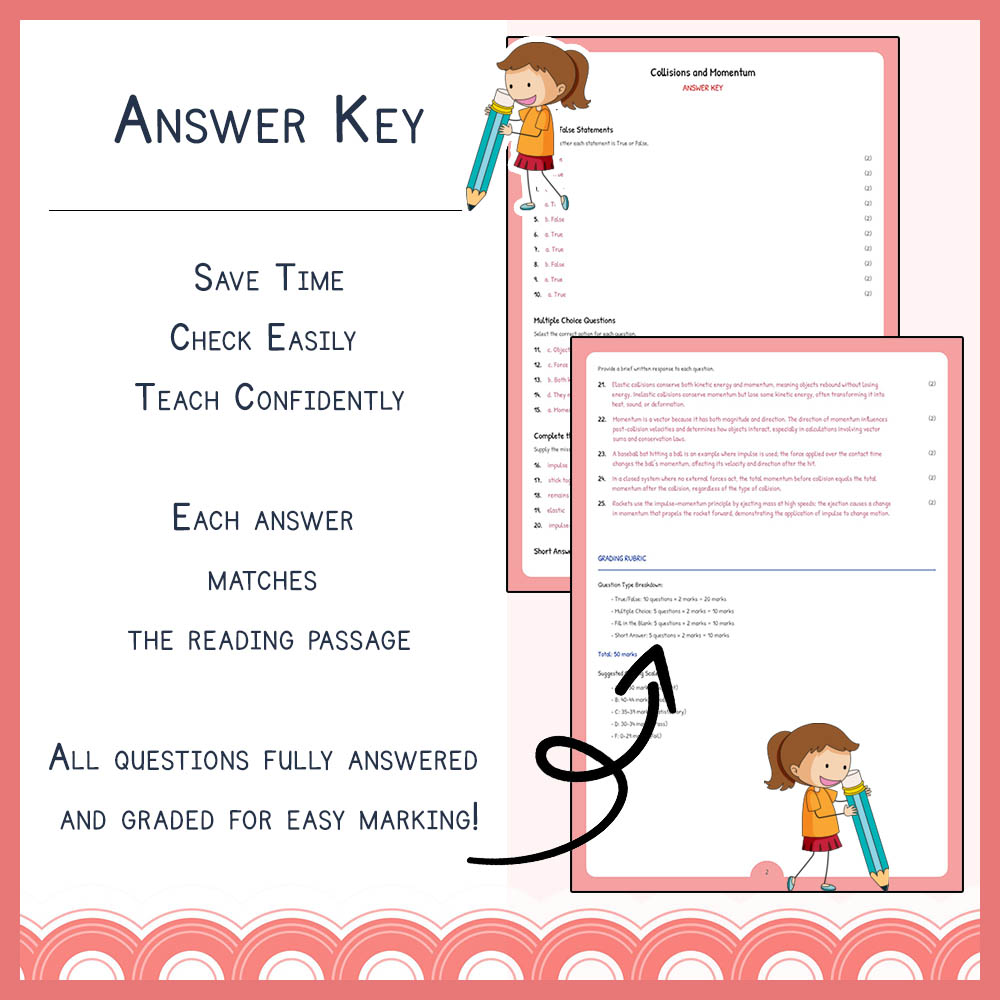
✅ PDF worksheet and PDF answer key with rubric for easy annotation and grading
✅ Designed specifically for Grade 10 Science aligned with Ontario standards to ensure curriculum relevance
Key Concepts Covered
➡️ Linear momentum – The product of an object's mass and velocity, describing motion and interactions
➡️ Impulse – The change in momentum resulting from a force applied over a time interval
➡️ Conservation of momentum – The principle that in isolated systems, total momentum remains constant during collisions
➡️ Elastic and inelastic collisions – Types of collisions distinguished by energy conservation and deformation
➡️ Impulse-momentum theorem – The relationship between impulse and the change in momentum, fundamental to collision analysis
Question Types / Formats
1. Reading comprehension passage to introduce and reinforce core concepts
2. True or false statements testing foundational knowledge
3. Multiple choice questions focusing on specific collision concepts
4. Fill-in-the-blank to assess understanding of terminology and principles
5. Short answer questions encouraging detailed explanations and reasoning
Teacher Benefits
✅ Provides comprehensive assessment items aligned with Ontario Grade 10 Science standards to reduce planning time
✅ Clear, step-by-step PDF worksheets facilitate easy classroom distribution and student completion
✅ Includes an answer key with rubric for quick grading and feedback, saving valuable prep time
✅ Assists in identifying student misconceptions about momentum and collisions
✅ Enhances lesson engagement through varied question formats for diverse learning styles
Student Benefits
✅ Reinforces core physics concepts through diverse question types, promoting deeper understanding
✅ Encourages critical thinking and application of physics principles in real-world contexts
✅ Develops precise scientific vocabulary and conceptual clarity
✅ Enhances problem-solving skills related to momentum and collision analysis
✅ Prepares students for assessments with structured, supportive practice exercises
Perfect For
➡️ Classroom instruction to introduce collision concepts effectively
✅ Homework quizzes for reinforcing learning outside class
➡️ Individual or group practice sessions focused on physics fundamentals
✅ Review sessions before unit assessments
➡️ Quick print-and-go activities for discrete lessons or review days
Ready to enhance your Science teaching? Download this dynamic worksheet today and inspire your students to master collisions and momentum! 🚀