Grade 10 Science | Matter and Chemical Change Unit Bundle | Ontario Standard — bundle cover
Grade 10 Science | Matter and Chemical Change Unit Bundle | Ontario Standard — included worksheet 1
Grade 10 Science | Matter and Chemical Change Unit Bundle | Ontario Standard — included worksheet 2
Grade 10 Science | Matter and Chemical Change Unit Bundle | Ontario Standard — included worksheet 3
Grade 10 Science | Matter and Chemical Change Unit Bundle | Ontario Standard — included worksheet 4
Grade 10 Science | Matter and Chemical Change Unit Bundle | Ontario Standard — included worksheet 5
Grade 10 Science | Matter and Chemical Change Unit Bundle | Ontario Standard — included worksheet 6
Grade 10 Science | Matter and Chemical Change Unit Bundle | Ontario Standard — included worksheet 7
Grade 10 Science | Matter and Chemical Change Unit Bundle | Ontario Standard — included worksheet 8
Grade 10 Science | Matter and Chemical Change Unit Bundle | Ontario Standard — included worksheet 9
Grade 10 Science | Matter and Chemical Change Unit Bundle | Ontario Standard — included worksheet 10
Grade 10 Science | Matter and Chemical Change Unit Bundle | Ontario Standard — included worksheet 11
Grade 10 Science | Matter and Chemical Change Unit Bundle | Ontario Standard — included worksheet 12
Grade 10 worksheet — Grade 10 Science | Matter and Chemical Change Unit Bundle | Ontario Standard

Description

Overview


Matter and Chemical Change gives Grade 10 Science learners a focused, Ontario-aligned path from particle-level explanations to predicting observable changes, with 12 worksheets in one coherent unit.

Students connect atomic structure and bonding to physical and chemical properties, then use chemical equations and stoichiometric reasoning to explain reaction outcomes. Throughout the unit, they practice using models, evidence, and scientific terminology to make defensible claims about matter.

What's Included


  • ✅ Grade 10 Science | Stoichiometry Basics Worksheet | Ontario Standard – Build a foundation for interpreting amounts in chemical reactions using stoichiometric thinking.
  • ✅ Grade 10 Science | Reaction Yield Worksheet Elena | Ontario Standard – Practice calculating and interpreting theoretical yield versus actual yield.
  • ✅ Grade 10 Science | Reaction Types Worksheet Elena | Ontario Standard – Identify and classify common reaction types using observable and chemical clues.
  • ✅ Grade 10 Science | Physical Properties Worksheet Elena | Ontario Standard – Distinguish physical properties and connect them to what can be measured without changing substances.
  • ✅ Grade 10 Science | Periodic Trends Worksheet | Ontario Standard – Use periodic trends to predict how atomic properties change across the periodic table.
  • ✅ Grade 10 Science | Nomenclature Worksheet | Ontario Standard – Apply naming rules for key chemical substances to support accurate communication.
  • ✅ Grade 10 Science | Mixture Separation Worksheet Elena | Ontario Standard – Choose appropriate separation methods and explain how they work for different mixtures.
  • ✅ Grade 10 Science | Chemical Properties Worksheet Elena | Ontario Standard – Analyze chemical properties by predicting whether substances form new materials under conditions.
  • ✅ Grade 10 Science | Classification Basics Worksheet Elena | Ontario Standard – Strengthen categorization skills by classifying matter using properties and particle ideas.
  • ✅ Grade 10 Science | Bonding Types Worksheet Elena | Ontario Standard – Compare bonding types and link bonding structure to expected properties of substances.
  • ✅ Grade 10 Science | Balancing Equations Worksheet | Ontario Standard – Balance chemical equations and justify changes to coefficients using conservation of matter.
  • ✅ Grade 10 Science | Atomic Structure Worksheet Elena | Ontario Standard – Review atomic structure and use particle models to support later chemistry reasoning.

Skills & Standards


Aligned to the Ontario framework, this Matter and Chemical Change unit emphasizes disciplinary core ideas and scientific practices: learners use particle models to describe and explain observable phenomena, connect energy and structure to chemical behavior, and interpret patterns in atomic properties.

Students strengthen analytical reasoning by translating between representations (symbols, equations, and particle-level ideas), then applying evidence-based explanations when classifying reaction types, bonding types, and matter properties. They practice modeling by balancing equations, using stoichiometry to connect reactant amounts to product amounts, and evaluating reaction yield to reason about discrepancies between theoretical and actual results.

Specific skills built in this unit include predicting outcomes from periodic trends, using nomenclature accurately, selecting mixture separation techniques based on properties, and justifying classifications of matter and chemical properties with clear, testable explanations.

Perfect For


  • Teachers seeking structured instruction
  • Sub plans
  • Homework or review
  • Intervention or centers
  • Assessment preparation

How to Use


Use this unit over a typical 1–3 weeks as a cohesive sequence: begin with atomic structure and periodic trends, move into bonding and properties, then finish with balancing equations, stoichiometry, and yield. You can also run it as station-based practice by pairing worksheets that share a representation focus (e.g., particle ideas → bonding → properties).

  • Start with a short warm-up that connects periodic trends to bonding types, then collect quick exit tickets predicting a property change.
  • During guided practice, work through balancing equations together, then have students apply the same conservation logic to the stoichiometry and reaction yield questions.
  • At the end, run an end-of-unit review that combines classification (matter and reactions) with nomenclature and one mixture separation scenario to check transfer.

Closing


With Matter and Chemical Change practice spanning models, equations, and evidence-based vocabulary, students learn to predict and explain how matter changes in real-world contexts.

Grade 10 Science | Matter and Chemical Change Unit Bundle | Ontario Standard

$28.80$36.00Save $7.20
Lumora Learning
·3 followers·12 sales
GradeGrade 10

What’s included

12 worksheets · Save $7.20 (20%) · prices shown inside the bundle
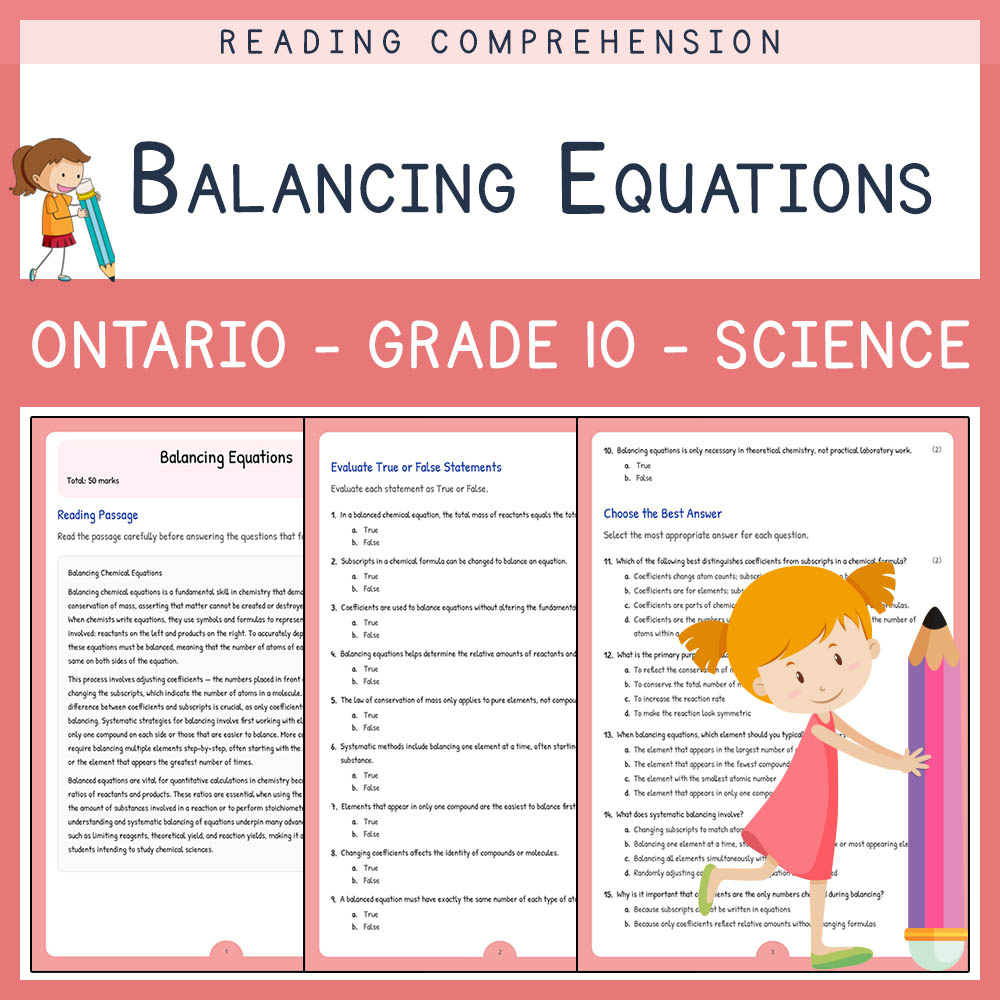
  1. Grade 10 Science | Balancing Equations Worksheet | Ontario Standard
    Grade 10 Science | Balancing Equations Worksheet | Ontario Standard

    Grade 10 · Science

    • Understand the principle of conservation of mass in chemical reactions.
    • Learn how to assign and balance coefficients in chemical equations.
    • Distinguish between coefficients and subscripts in chemical formulas.
    $2.40$3.00
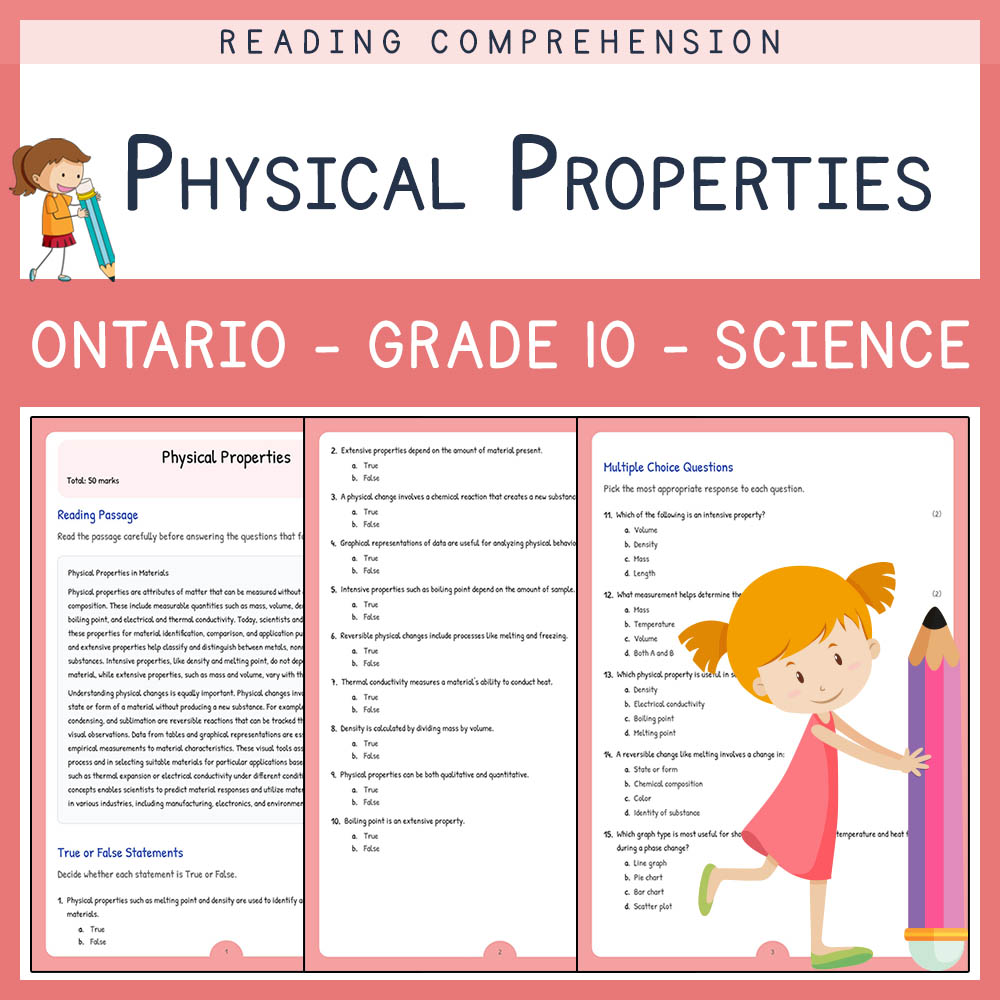
  2. Grade 10 Science | Physical Properties Worksheet Elena | Ontario Standard
    Grade 10 Science | Physical Properties Worksheet Elena | Ontario Standard

    Grade 10 · Science

    • Understand the measurable attributes that define physical properties of matter.
    • Differentiate between intensive and extensive properties.
    • Interpret tabulated and graphical data to compare substances based on physical characteristics.
    $2.40$3.00
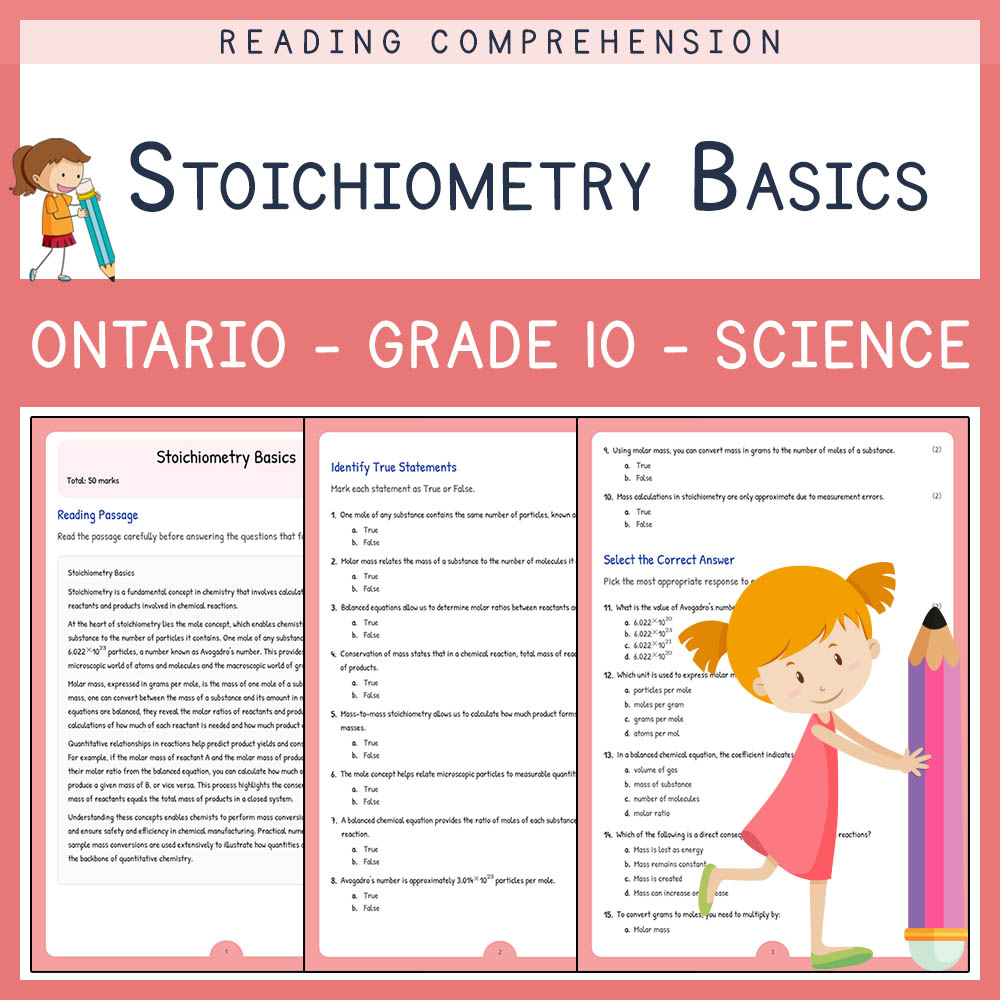
  3. Grade 10 Science | Stoichiometry Basics Worksheet | Ontario Standard
    Grade 10 Science | Stoichiometry Basics Worksheet | Ontario Standard

    Grade 10 · Science

    • Introduce the mole concept, Avogadro's number, and molar mass as tools for converting between mass and amount of substance.
    • Explain how balanced chemical equations are used to derive molar ratios for stoichiometry calculations.
    • Perform mass-to-mass conversions using stoichiometric relationships while emphasizing conservation of mass.
    $2.40$3.00
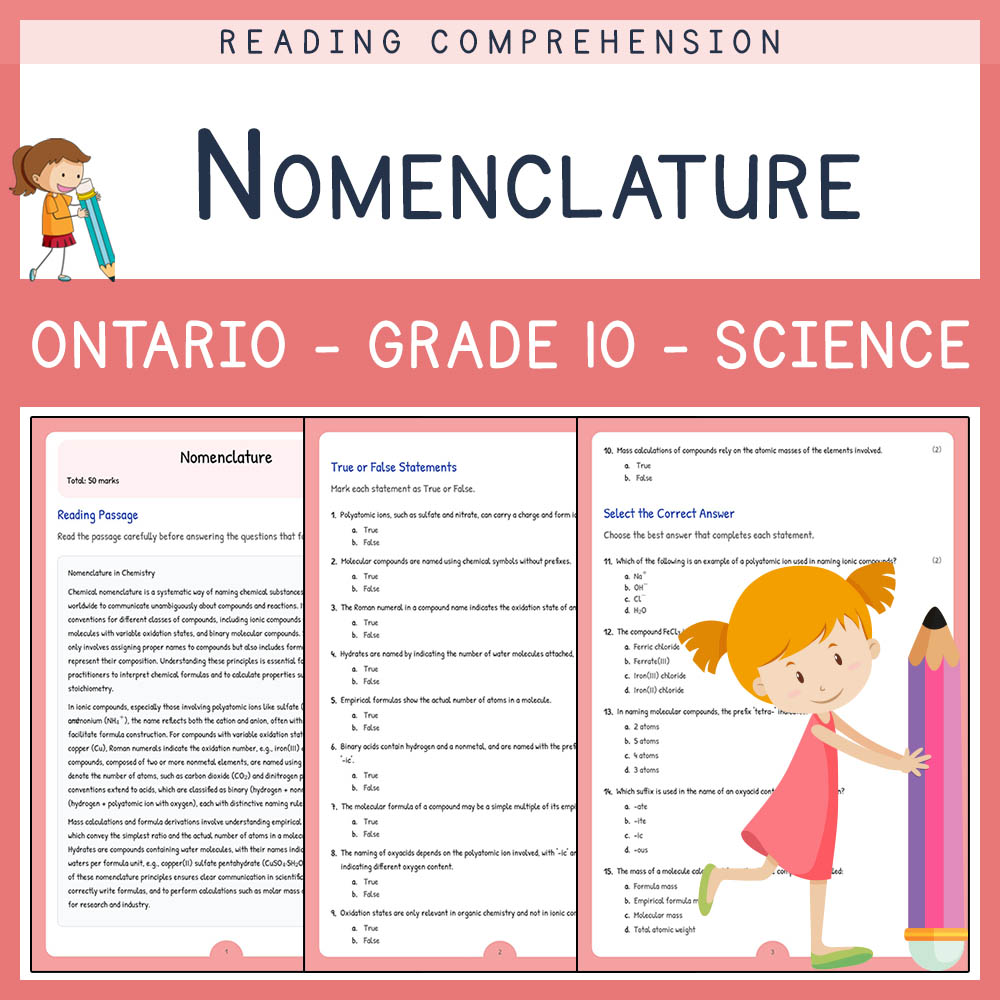
  4. Grade 10 Science | Nomenclature Worksheet | Ontario Standard
    Grade 10 Science | Nomenclature Worksheet | Ontario Standard

    Grade 10 · Science

    • Understand systematic naming conventions for ionic and molecular compounds.
    • Identify and construct formulas for compounds with polyatomic ions and variable oxidation states.
    • Differentiate between empirical and molecular formulas and apply charge balance principles.
    $2.40$3.00
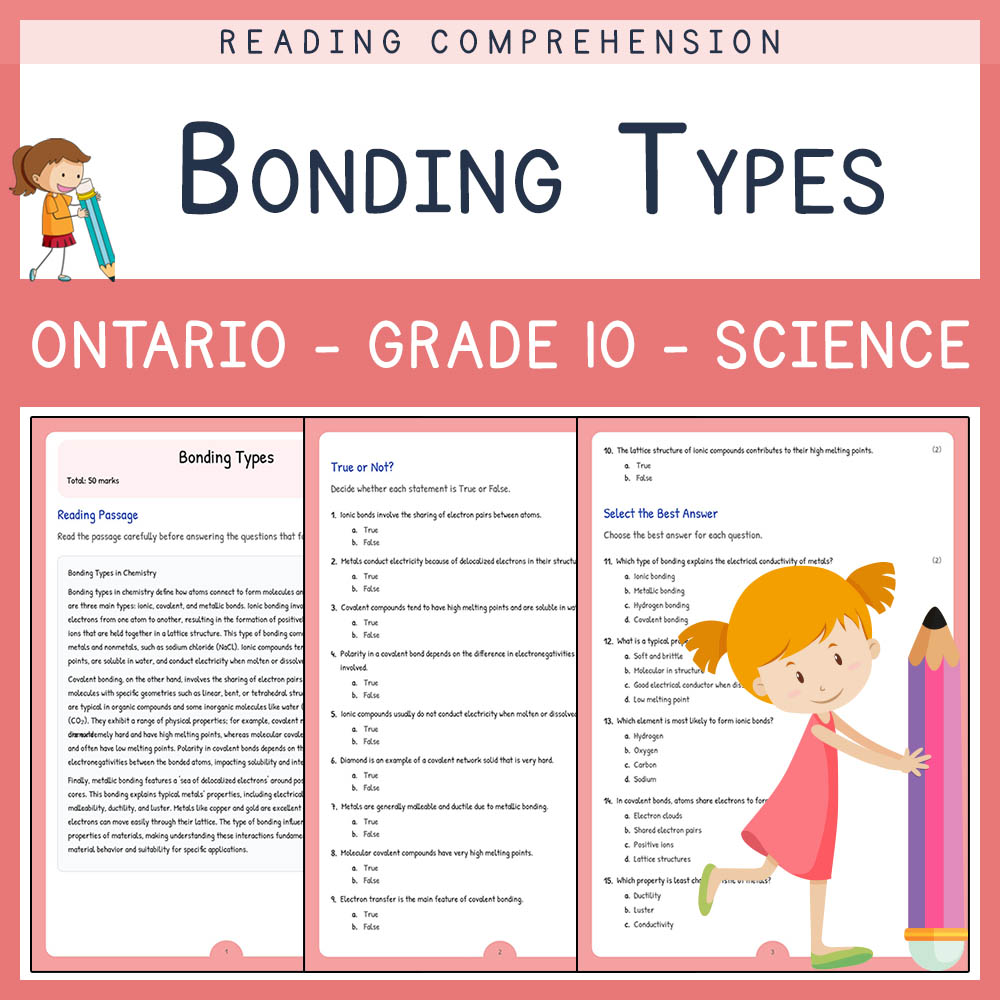
  5. Grade 10 Science | Bonding Types Worksheet Elena | Ontario Standard
    Grade 10 Science | Bonding Types Worksheet Elena | Ontario Standard

    Grade 10 · Science

    • Understand the differences between ionic, covalent, and metallic bonding.
    • Identify how electron transfer and sharing models explain bonding.
    • Relate bonding types to lattice structures, molecular geometries, and physical properties.
    $2.40$3.00
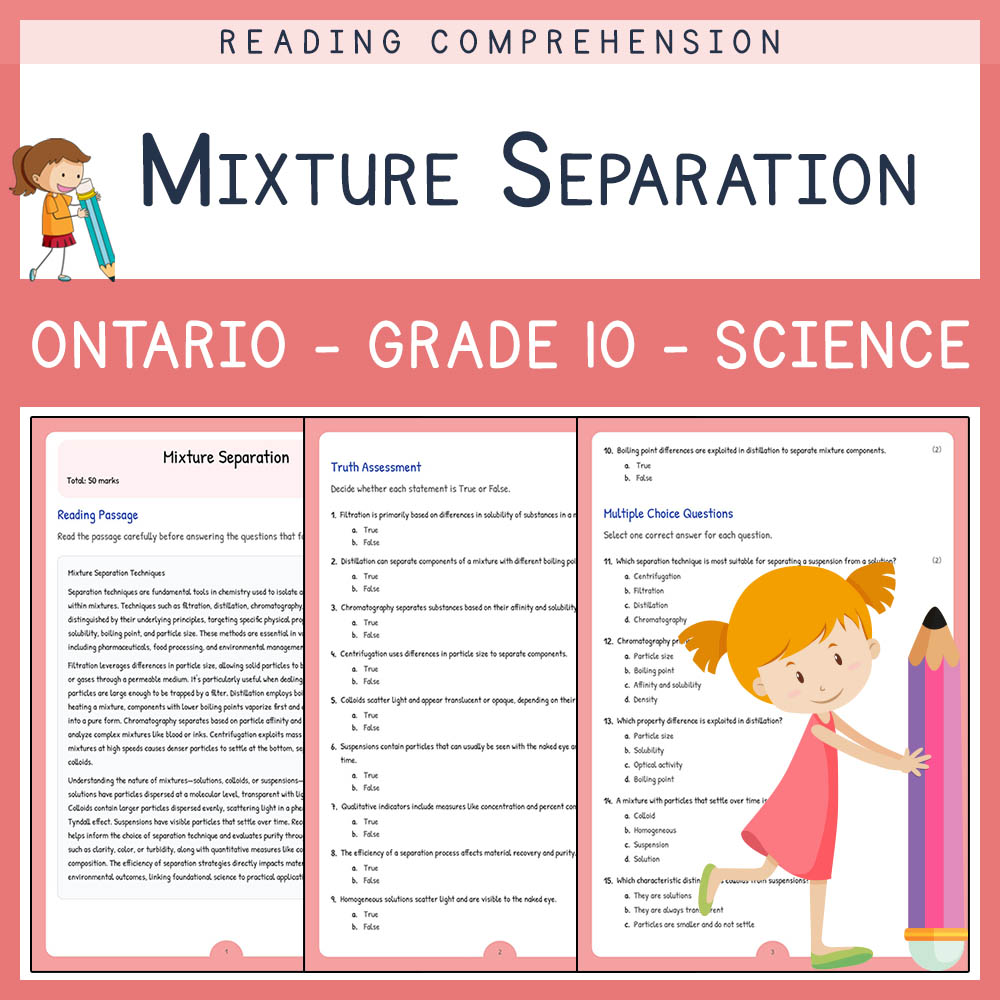
  6. Grade 10 Science | Mixture Separation Worksheet Elena | Ontario Standard
    Grade 10 Science | Mixture Separation Worksheet Elena | Ontario Standard

    Grade 10 · Science

    • Understand and differentiate between various separation techniques such as filtration, distillation, chromatography, and centrifugation.
    • Describe how particle size, solubility, and boiling point influence separation methods.
    • Compare solutions, colloids, and suspensions based on particle dispersion and optical properties.
    $2.40$3.00
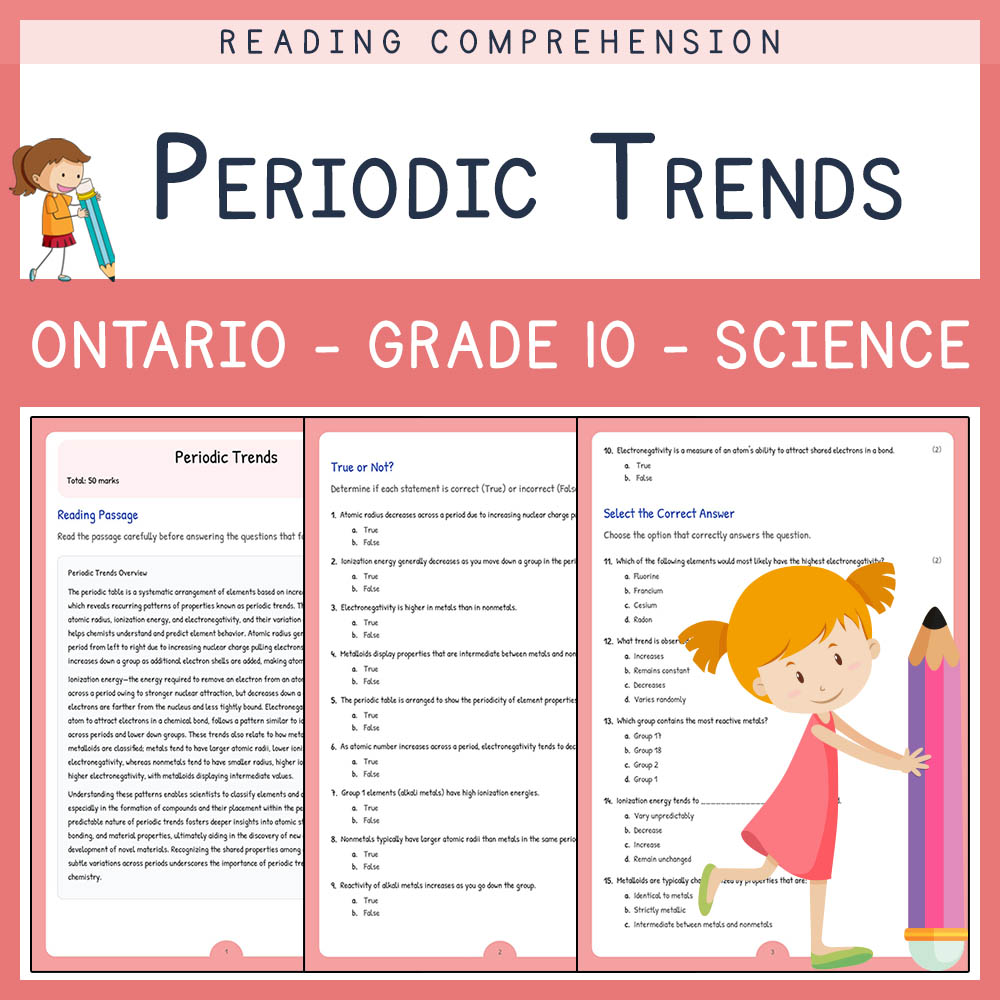
  7. Grade 10 Science | Periodic Trends Worksheet | Ontario Standard
    Grade 10 Science | Periodic Trends Worksheet | Ontario Standard

    Grade 10 · Science

    • Understand the concept of periodic trends and their significance in chemistry.
    • Analyze patterns of atomic radius, ionization energy, and electronegativity across periods and groups.
    • Classify elements as metals, nonmetals, or metalloids based on shared properties and trends.
    $2.40$3.00
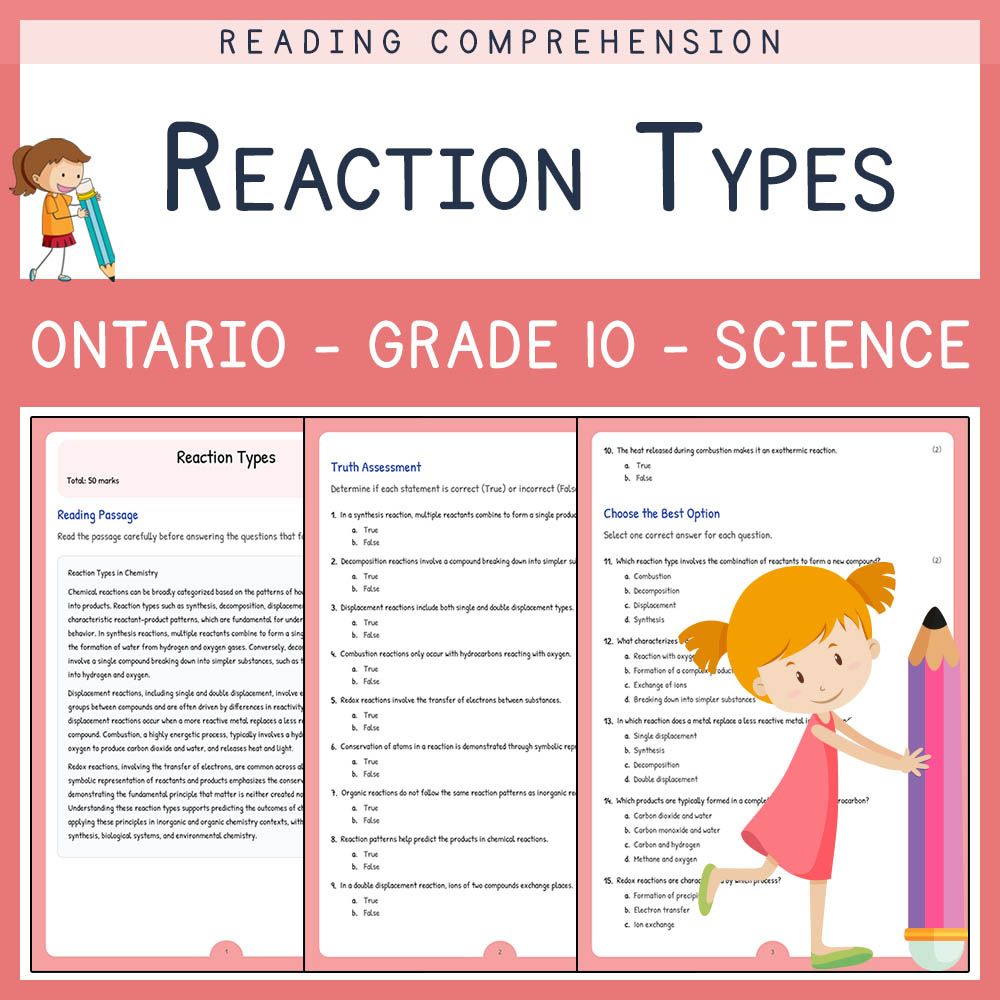
  8. Grade 10 Science | Reaction Types Worksheet Elena | Ontario Standard
    Grade 10 Science | Reaction Types Worksheet Elena | Ontario Standard

    Grade 10 · Science

    • Classify various chemical reactions into synthesis, decomposition, single displacement, double displacement, and combustion categories.
    • Identify characteristic reactant-product patterns in different reaction types.
    • Understand redox considerations and predict product classes in chemical reactions.
    $2.40$3.00
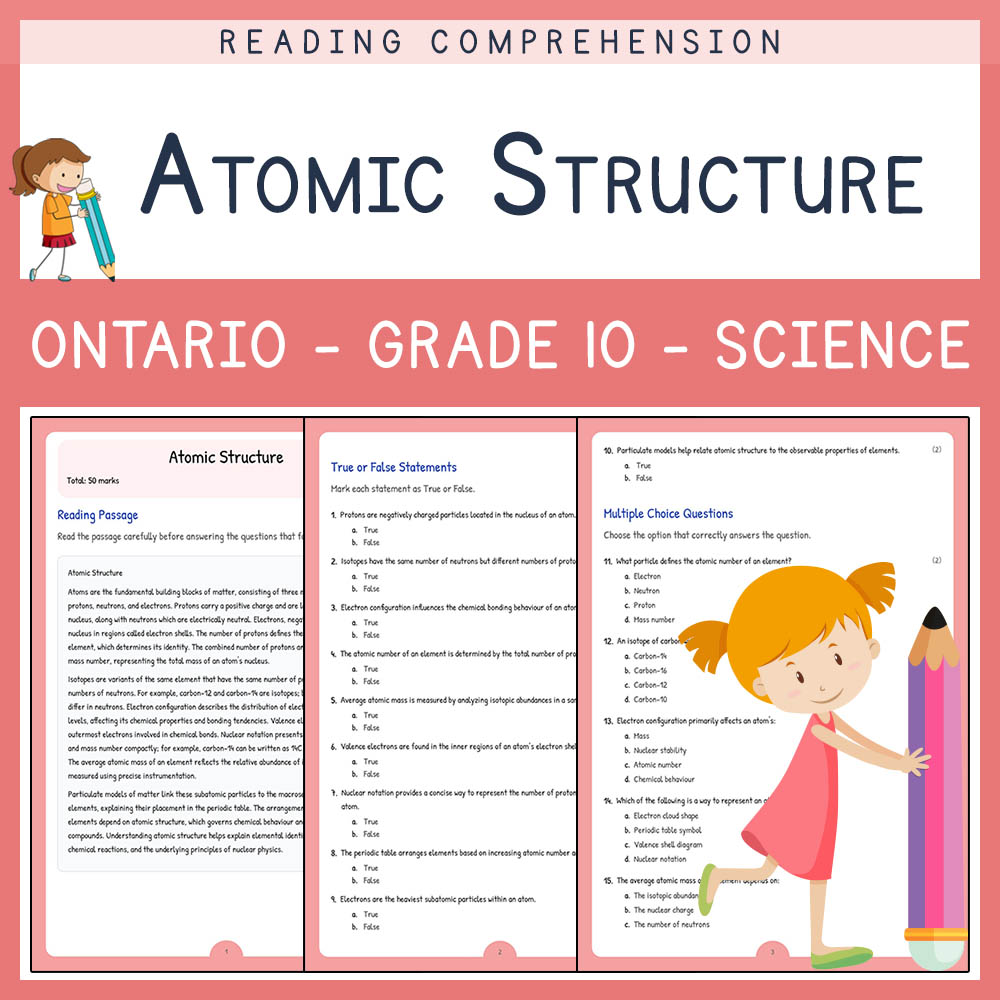
  9. Grade 10 Science | Atomic Structure Worksheet Elena | Ontario Standard
    Grade 10 Science | Atomic Structure Worksheet Elena | Ontario Standard

    Grade 10 · Science

    • Describe the components of atomic structure, including protons, neutrons, and electrons.
    • Explain the concepts of atomic number, mass number, and isotopes with examples.
    • Understand basic electron configuration and valence electrons in relation to chemical behaviour.
    $2.40$3.00
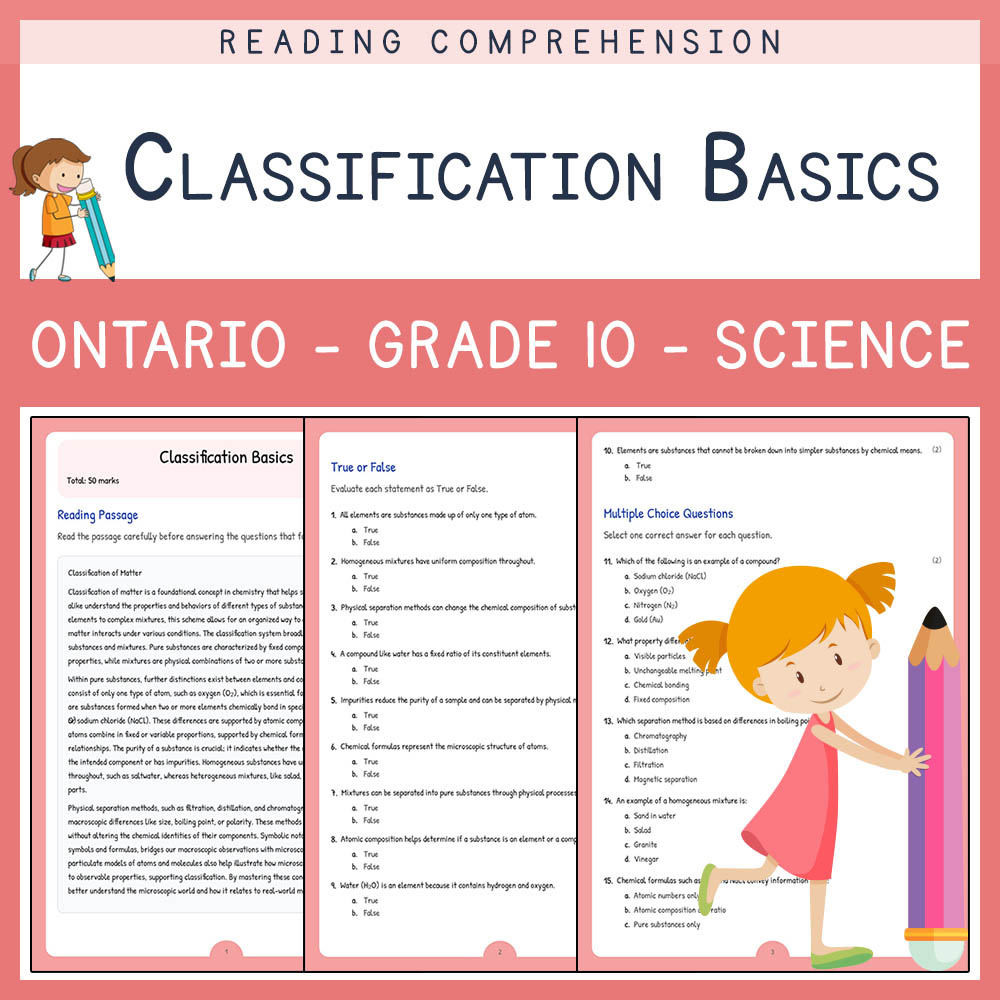
  10. Grade 10 Science | Classification Basics Worksheet Elena | Ontario Standard
    Grade 10 Science | Classification Basics Worksheet Elena | Ontario Standard

    Grade 10 · Science

    • Understand the fundamental schemes used to classify matter into states, pure substances, and mixtures.
    • Distinguish elements from compounds with representative examples such as oxygen, water, and sodium chloride.
    • Explain how atomic composition, chemical formulas, and empirical relationships support classification.
    $2.40$3.00

Reviews & Feedback

Loading reviews...

Questions & Answers

Loading questions…

About this bundle

Related categories

Frequently asked questions

Who is Grade 10 Science | Matter and Chemical Change Unit Bundle | Ontario Standard designed for?
Grade 10 Science | Matter and Chemical Change Unit Bundle | Ontario Standard is designed for Grade 10 students and can be used in classrooms, homeschool, or independent practice.
How do I download Grade 10 Science | Matter and Chemical Change Unit Bundle | Ontario Standard?
Add it to your cart and complete checkout. After payment, you can download immediately from your account, and you'll also receive a download link by email.