
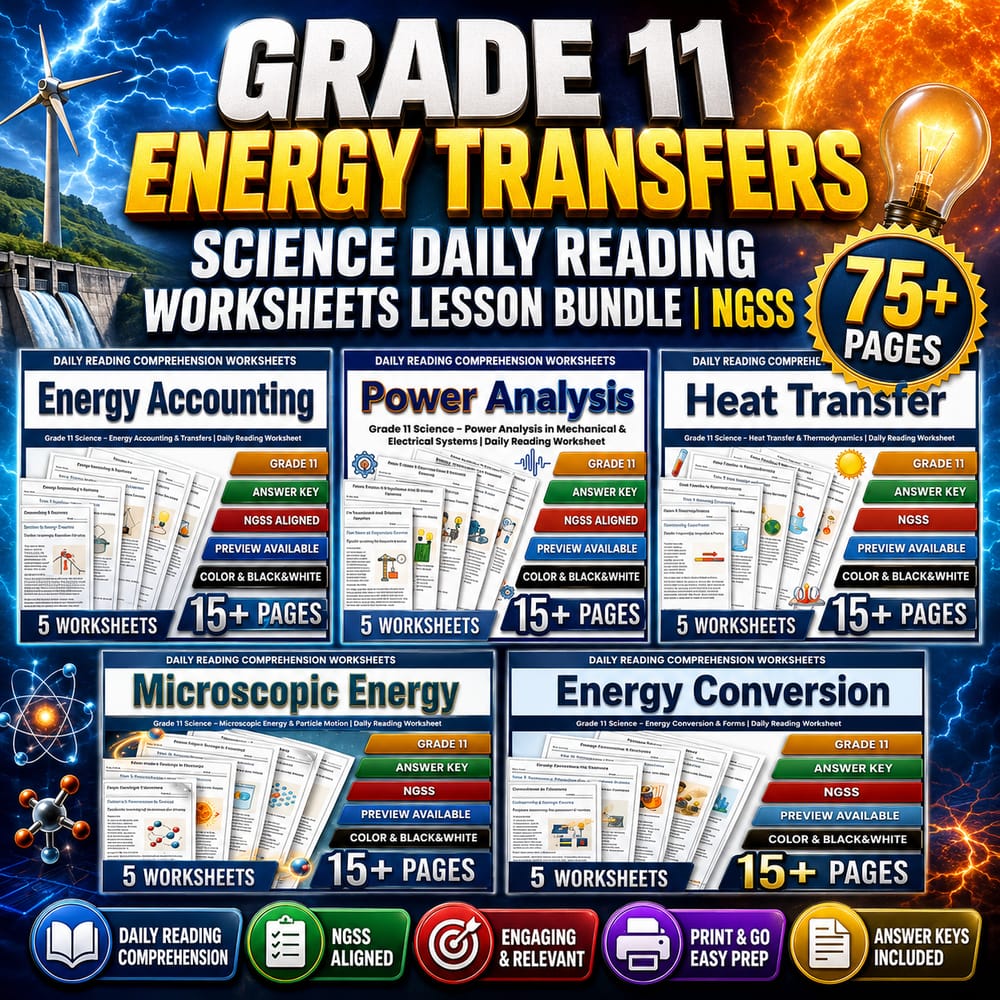
Grade 11 Energy Transfers Science Daily Reading Worksheets Lesson Bundle | NGSS
$16.00$20.00Save $4.00
Bright Mind Resources
New·1 followers·12 sales
SubjectScienceGradeGrade 11
What’s included
5 worksheets · Save $4.00 (20%) · prices shown inside the bundle
 Grade 11 Science – Energy Accounting & Transfers | Daily Reading Worksheet
- Understand the concept of energy transfer among system components.
- Identify different forms of energy including heat, work, gravitational, and elastic energy.
- Use simple models to predict energy exchanges in various systems.
$3.20$4.00 Grade 11 Science – Power Analysis in Mechanical & Electrical Systems | Worksheet
- Understand the concept of power in mechanical and electrical contexts.
- Calculate power using work and time (P = W/t).
- Calculate power in electrical systems using voltage and current (P = IV).
$3.20$4.00 Grade 11 Science – Heat Transfer & Thermodynamics | Daily Reading Worksheet
- Understand the mechanisms of heat transfer—conduction, convection, and radiation.
- Identify examples of conduction through metal, convection in fluids, and radiation from hot surfaces.
- Explain the process of heat flow during phase changes and temperature change.
$3.20$4.00 Grade 11 Science – Microscopic Energy & Particle Motion| Daily Reading Worksheet
- Understand how energy at the microscopic level relates to macroscopic phenomena
- Describe molecular motion and its connection to thermal energy
- Identify how energy changes occur during particle collisions and vibrations
$3.20$4.00 Grade 11 Science – Energy Conversion & Forms | Daily Reading Worksheet
- Identify different types of energy: mechanical, electrical, chemical, thermal
- Understand basic energy conversion processes
- Recognize examples of energy conversion in everyday devices
$3.20$4.00
Reviews & Feedback
Loading reviews...
Questions & Answers
Loading questions…
About this bundle
Related categories
Frequently asked questions
Who is Grade 11 Energy Transfers Science Daily Reading Worksheets Lesson Bundle | NGSS designed for?
Grade 11 Energy Transfers Science Daily Reading Worksheets Lesson Bundle | NGSS is designed for Grade 11 students and Science learners and can be used in classrooms, homeschool, or independent practice.
How do I download Grade 11 Energy Transfers Science Daily Reading Worksheets Lesson Bundle | NGSS?
Add it to your cart and complete checkout. After payment, you can download immediately from your account, and you'll also receive a download link by email.
Similar Products

Matter-Energy Grade 7 Science Daily Reading Worksheets Lesson Bundle | TEKS
$40.00$50.00

Forces & Energy Grade 7 Science Daily Reading Worksheets Lesson Bundle | TEKS
$32.00$40.00

Energy Grade 11 Science Daily Reading Worksheets Lesson Bundle | NGSS
$20.00$25.00

Energy Work Power Grade 10 Science Daily Reading Worksheets Lesson Bundle | ngss
$20.00$25.00

Energy Transfer Grade 4 Science Daily Reading Worksheets Lesson Bundle | NGSS
$12.00$15.00