
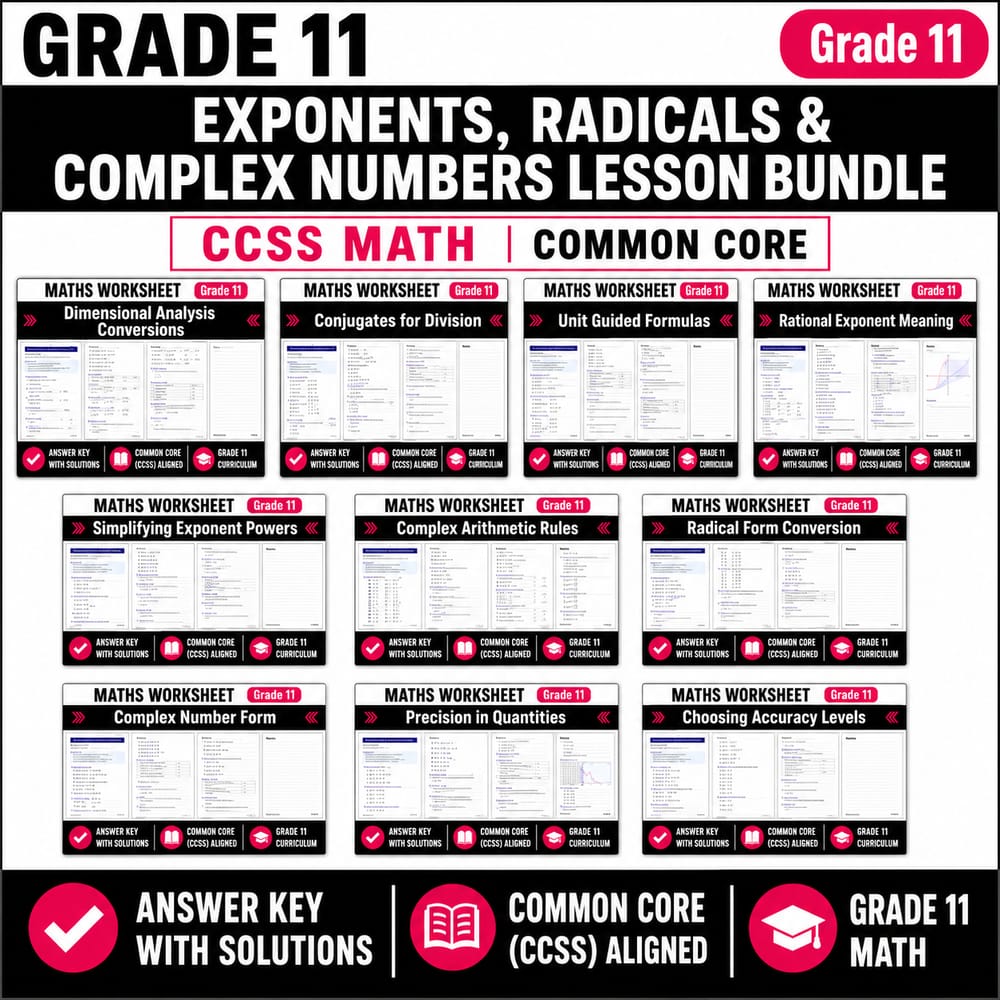
Grade 11 Exponents, Radicals & Complex Numbers Lesson Bundle | CCSS Math
$40.00$50.00Save $10.00
BRIGHT PATH RESOURCES
·3 followers·23 sales
SubjectMathsGradeGrade 11Pages82 Pages
What’s included
10 worksheets · 82 pages · Save $10.00 (20%) · prices shown inside the bundle
 Grade 11 Dimensional Analysis Conversions Worksheet | Units & Rates
- Use unit conversion factors written as ratios to cancel unwanted units
- Convert quantities that include derived units (e.g., speed, density, area, volume per time)
- Apply a multi-step conversion chain while keeping units consistent throughout
$4.00$5.00 Grade 11 Conjugates for Division Worksheet | Rationalizing Denominators
- Find the conjugate of a complex number and use it to rationalise denominators in division
- Simplify complex-number quotients into standard form a+bi by eliminating the imaginary part of the denominator
- Identify the real and imaginary parts of a quotient after conjugate multiplication
$4.00$5.00 Grade 11 Unit Guided Formulas Worksheet | Unit Consistency & CCSS
- Write and use formulas while tracking units so that numerators and denominators match correctly across steps
- Compute values from formulas and check that the resulting units make sense for the context
- Rearrange formulas and interpret what each term represents in terms of units
$4.00$5.00 Grade 11 Rational Exponents Worksheet | Meaning & Properties CCSS
- State what a rational exponent m/n means in terms of roots and powers
- Rewrite a^(m/n) using radical notation: (n√a)^m
- Evaluate expressions with rational exponents by taking the n-th root first (for a>0)
$4.00$5.00 Grade 11 Simplifying Exponent Powers Worksheet | Laws of Exponents
- Use the power of a power rule to simplify expressions with exponents raised to other exponents.
- Use product and quotient rules for powers to combine or divide exponential terms.
- Convert between radicals and rational exponents correctly, including negative exponents.
$4.00$5.00 Grade 11 Complex Arithmetic Rules Worksheet | Complex Numbers CCSS
- Add and subtract complex numbers by combining real parts with real parts and imaginary parts with imaginary parts
- Multiply complex numbers using distributive and associative laws before replacing i² with -1
- Rewrite results clearly in the form a + bi by collecting like terms
$4.00$5.00 Grade 11 Radical Form Conversion Worksheet | Radicals & Exponents
- Convert between radical notation and rational exponent notation using a^(1/n)=ⁿ√(a)
- Rewrite expressions like √(a^m) and ∛(a^m) as a^(m/n) (and vice versa) using exponent rules
- Simplify expressions by applying rational exponent laws after conversion
$4.00$5.00 Grade 11 Complex Number Form Worksheet | Imaginary Numbers CCSS
- Write complex numbers in standard form a + bi and identify the real part a and imaginary part b
- Simplify expressions involving i using i^2 = -1
- Add and multiply complex numbers by combining real and imaginary parts correctly
$4.00$5.00 Grade 11 Precision in Quantities Worksheet | Mathematical Modeling
- Choose appropriate quantities and definitions so that a model’s calculated values represent the intended measurements.
- Read and interpret values accurately from absolute value graphs and linear inequality graphs used in quantity modeling.
- Justify whether a given point or computed value is consistent with a model (including strict vs inclusive conditions).
$4.00$5.00 Grade 11 Choosing Accuracy Levels Worksheet | Precision & Modeling
- Choose an appropriate reporting accuracy (decimal places or significant figures) based on the smallest measurement precision.
- Apply rounding rules correctly for addition/subtraction and multiplication/division while keeping precision consistent through calculations.
- Avoid misleading precision by rounding final answers to match what the data can support.
$4.00$5.00
Reviews & Feedback
Loading reviews...
Questions & Answers
Loading questions…
About this bundle
Related categories
Frequently asked questions
Who is Grade 11 Exponents, Radicals & Complex Numbers Lesson Bundle | CCSS Math designed for?
Grade 11 Exponents, Radicals & Complex Numbers Lesson Bundle | CCSS Math is designed for Grade 11 students and Maths learners and can be used in classrooms, homeschool, or independent practice.
How do I download Grade 11 Exponents, Radicals & Complex Numbers Lesson Bundle | CCSS Math?
Add it to your cart and complete checkout. After payment, you can download immediately from your account, and you'll also receive a download link by email.


