
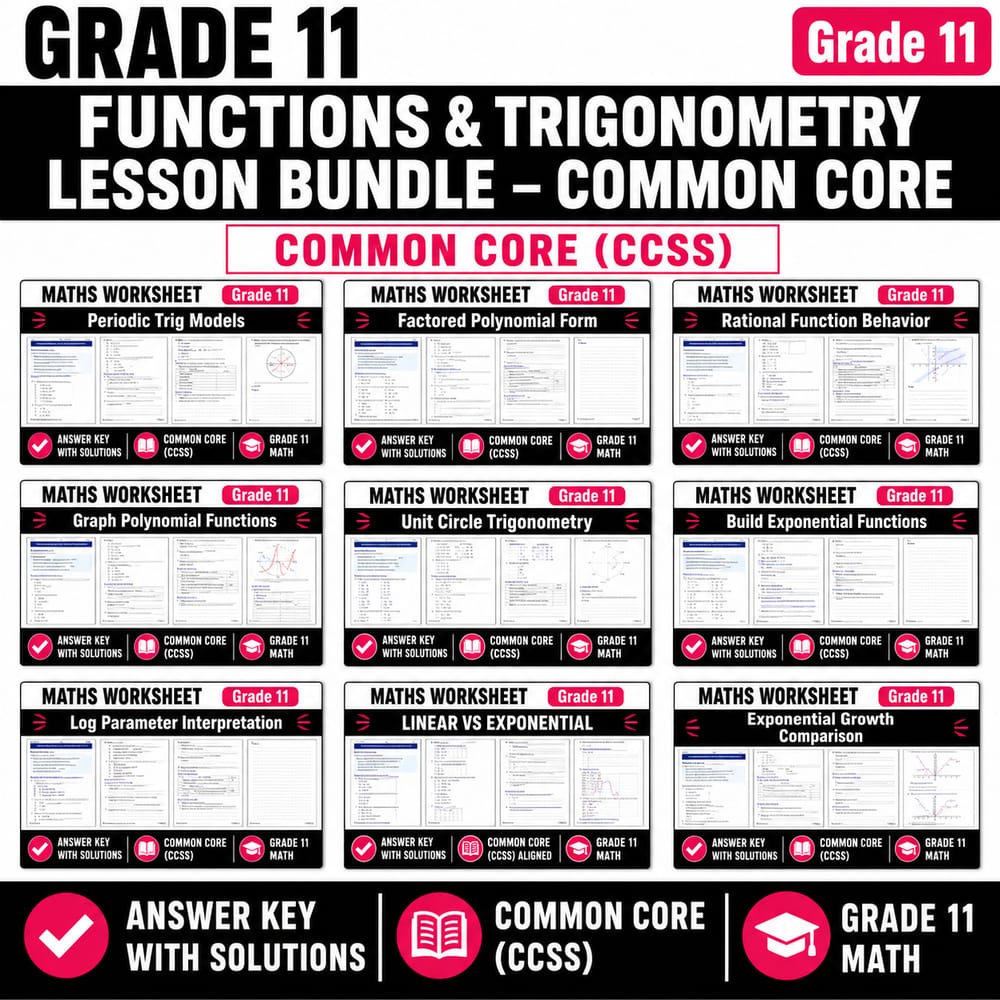
Grade 11 Functions & Trigonometry Lesson Bundle – Common Core (CCSS)
$36.00$45.00Save $9.00
BRIGHT PATH RESOURCES
·3 followers·23 sales
SubjectMathsGradeGrade 11Pages73 Pages
What’s included
9 worksheets · 73 pages · Save $9.00 (20%) · prices shown inside the bundle
 Grade 11 Periodic Trig Models Worksheet | Trigonometric Functions CCSS
- Identify amplitude, period, phase shift, and vertical shift from a given sine or cosine model
- Use unit-circle angle reasoning to determine when a periodic trig model reaches maximum or minimum values
- Solve for the timing of repeated values using the period and the model’s parameter B
$4.00$5.00 Grade 11 Factored Polynomial Form Worksheet | Algebra 2 Functions CCSS
- Write a polynomial function in factored form from given zeros and multiplicities
- Use multiplicity to determine whether the graph crosses or bounces at each x-intercept
- Determine end behavior from the degree and leading coefficient of a factored polynomial
$4.00$5.00 Grade 11 Rational Function Behavior Worksheet | CCSS Algebra Practice
- Identify domain restrictions, including excluded x-values, from rational functions
- Determine vertical asymptotes and holes by factoring and checking canceled factors
- Find x- and y-intercepts by using zeros of the numerator with nonzero denominators
$4.00$5.00 Grade 11 Graphing Polynomial Functions Worksheet | Symbolic Form CCSS
- Identify the degree and leading coefficient of a polynomial and use them to describe end behavior
- Use factored form to find x-intercepts (zeros) and determine whether the graph crosses or touches the x-axis from factor multiplicity
- Determine key turning-point information using derivatives (critical points) for polynomial functions
$4.00$5.00 Grade 11 Unit Circle Trigonometry Worksheet | Angles & Functions
- Use the unit circle to match an angle θ with its point (cosθ, sinθ).
- Evaluate sine and cosine for special angles using x- and y-coordinates.
- Apply quadrant sign rules to determine the signs of sinθ and cosθ.
$4.00$5.00 Grade 11 Build Exponential Functions Worksheet | CCSS Algebra 2 Math
- Identify the parameters a and b in an exponential function f(x)=a·b^x
- Construct an exponential model from initial value and growth/decay factor
- Use the model to make predictions by evaluating f(x) for given x
$4.00$5.00 Grade 11 Log Parameter Interpretation Worksheet | Logarithmic Functions
- Interpret the meaning of a logarithm as an exponent required to reach a target output.
- Use parameters (shifts and base) in logarithmic models to solve for unknown inputs.
- Relate changes in the base to changes in sensitivity (how quickly the output increases).
$4.00$5.00 Grade 11 Linear vs Exponential Worksheet | Function Comparison CCSS
- Distinguish linear change from exponential growth/decay using constant difference versus constant percent change
- Interpret tables to decide whether data are better modeled by a linear trend or exponential behavior
- Use percent change to predict future values in exponential growth/decay situations
$4.00$5.00 Grade 11 Exponential Growth Comparison Worksheet | CCSS Functions
- Identify how exponential growth changes multiplicatively from one step to the next.
- Compare exponential and linear patterns to determine which grows faster and when a crossover occurs.
- Use limits to describe long-term behavior of exponential decay toward a nonzero value.
$4.00$5.00
Reviews & Feedback
Loading reviews...
Questions & Answers
Loading questions…
About this bundle
Related categories
Frequently asked questions
Who is Grade 11 Functions & Trigonometry Lesson Bundle – Common Core (CCSS) designed for?
Grade 11 Functions & Trigonometry Lesson Bundle – Common Core (CCSS) is designed for Grade 11 students and Maths learners and can be used in classrooms, homeschool, or independent practice.
How do I download Grade 11 Functions & Trigonometry Lesson Bundle – Common Core (CCSS)?
Add it to your cart and complete checkout. After payment, you can download immediately from your account, and you'll also receive a download link by email.
Similar Products

Grade 12 Maths Lesson Bundle | Trigonometry and Functions Ontario Standards
$20.00$25.00

Grade 10 Functions Lesson Bundle | Math | CCSS-Aligned
$40.00$50.00

Grade 11 Trigonometric Functions Lesson Bundle for Ontario Mathematics
$20.00$25.00

Grade 11 Maths Exponential and Logarithmic Functions Lesson Bundle
$20.00$25.00

Functions & Function Operations Lesson Bundle | Grade 9 Maths | Common Core
$40.00$50.00