
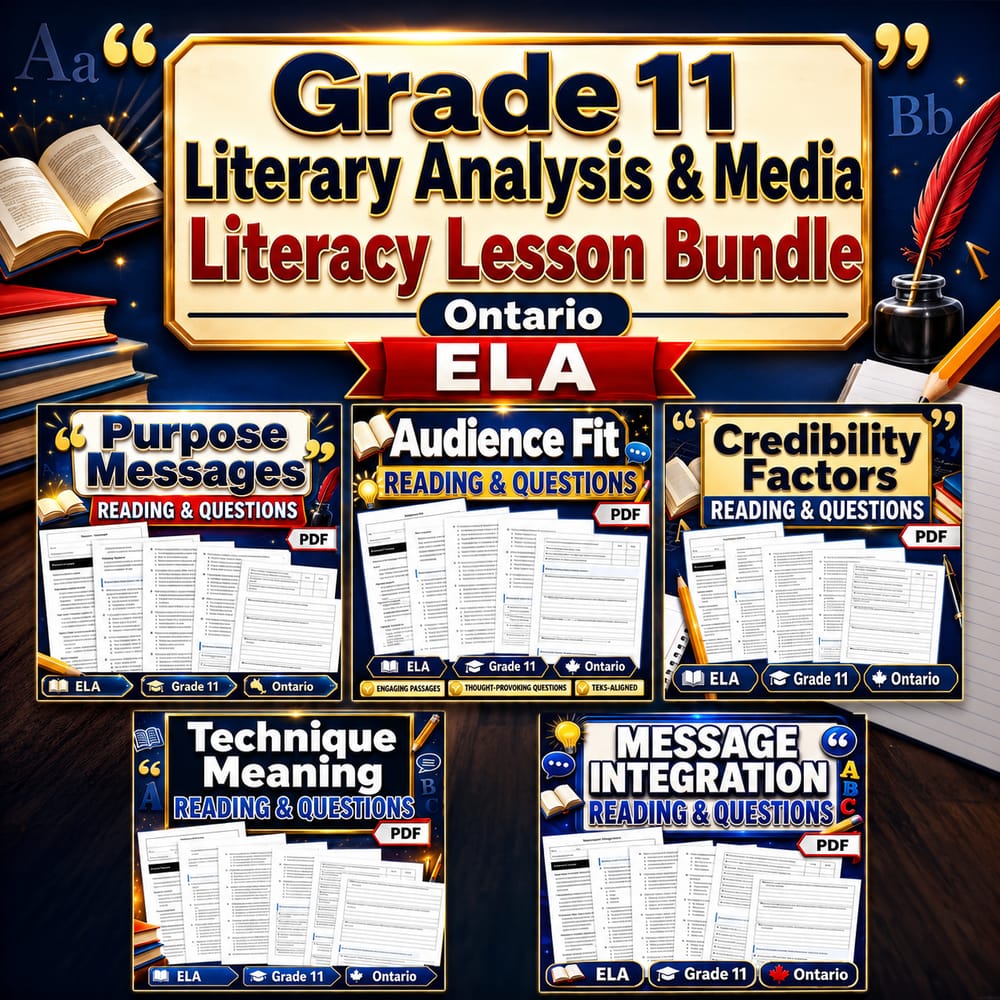
Grade 11 Literary Analysis & Media Literacy Lesson Bundle | Ontario ELA
$16.00$20.00Save $4.00
Golden Apple Studio
New·2 followers·3 sales
SubjectELAGradeGrade 11Pages79 Pages
What’s included
5 worksheets · 79 pages · Save $4.00 (20%) · prices shown inside the bundle
 Purpose Messages Worksheet Grade 11 ELA Ontario | Answer Key PDF
- Analyze how a media message’s overall structure helps reveal its purpose (inform, persuade, entertain, or recruit support).
- Identify how topic selection, emphasis, tone, and implied or explicit claims shape the audience’s interpretation.
- Use evidence from a text to justify a claim about the message’s intended purpose.
$3.20$4.00 Grade 11 Audience Fit Worksheet | Ontario ELA Writing & Communication
- Identify how audience, purpose, and context influence choices in media texts (genre, tone, vocabulary, and length).
- Revise a draft by improving audience fit using specific conventions and accessibility considerations.
- Evaluate whether information is clearly represented and appropriately complex for a target audience.
$3.20$4.00 Grade 11 Credibility Factors Worksheet | Ontario ELA Media Literacy
- Evaluate credibility by analyzing evidence quality, transparency of sources, and consistency between claims and details.
- Identify bias and point of view in texts by examining what is highlighted, omitted, and how language frames interpretation.
- Apply a comparison process to political ads, opinion columns, and infographics using representative facts and perspective-aware reasoning.
$3.20$4.00 Grade 11 Technique Meaning Worksheet | Ontario ELA Literary Analysis
- Analyze how specific media techniques (e.g., camera angle, pacing, sound, color, editing) influence meaning and credibility.
- Explain how sequencing and contrast help audiences infer relationships among events.
- Use evidence from a visual or audio example to justify an interpretation of the author’s purpose.
$3.20$4.00 Message Integration Worksheet Grade 11 ELA Ontario | Answer Key
- Analyze how purpose, audience, and media techniques work together to create a coherent message.
- Evaluate how framing, tone, visuals, and evidence shape interpretation and manage how claims are received.
- Identify where bias may appear through emphasis, omission, or persuasive language and explain its effect.
$3.20$4.00
Reviews & Feedback
Loading reviews...
Questions & Answers
Loading questions…
About this bundle
Related categories
Frequently asked questions
Who is Grade 11 Literary Analysis & Media Literacy Lesson Bundle | Ontario ELA designed for?
Grade 11 Literary Analysis & Media Literacy Lesson Bundle | Ontario ELA is designed for Grade 11 students and ELA learners and can be used in classrooms, homeschool, or independent practice.
How do I download Grade 11 Literary Analysis & Media Literacy Lesson Bundle | Ontario ELA?
Add it to your cart and complete checkout. After payment, you can download immediately from your account, and you'll also receive a download link by email.
Similar Products

Grade 12 ELA Daily Reading & Literary Media Literacy Lesson Bundle | Ontario
$112.00$160.00

Grade 11 Literary & Informational Text Analysis Lesson Bundle | Ontario ELA
$32.00$40.00

Grade 11 Literary Analysis: Character Evidence Lesson Bundle | CCSS ELA
$21.60$27.00

Grade 11 Literary Analysis ELA Lesson Bundle for Daily Reading | CCSS
$28.80$36.00

Grade 4 Literary Analysis and Character Development ELA Lesson Bundle - TEKS
$19.20$24.00