
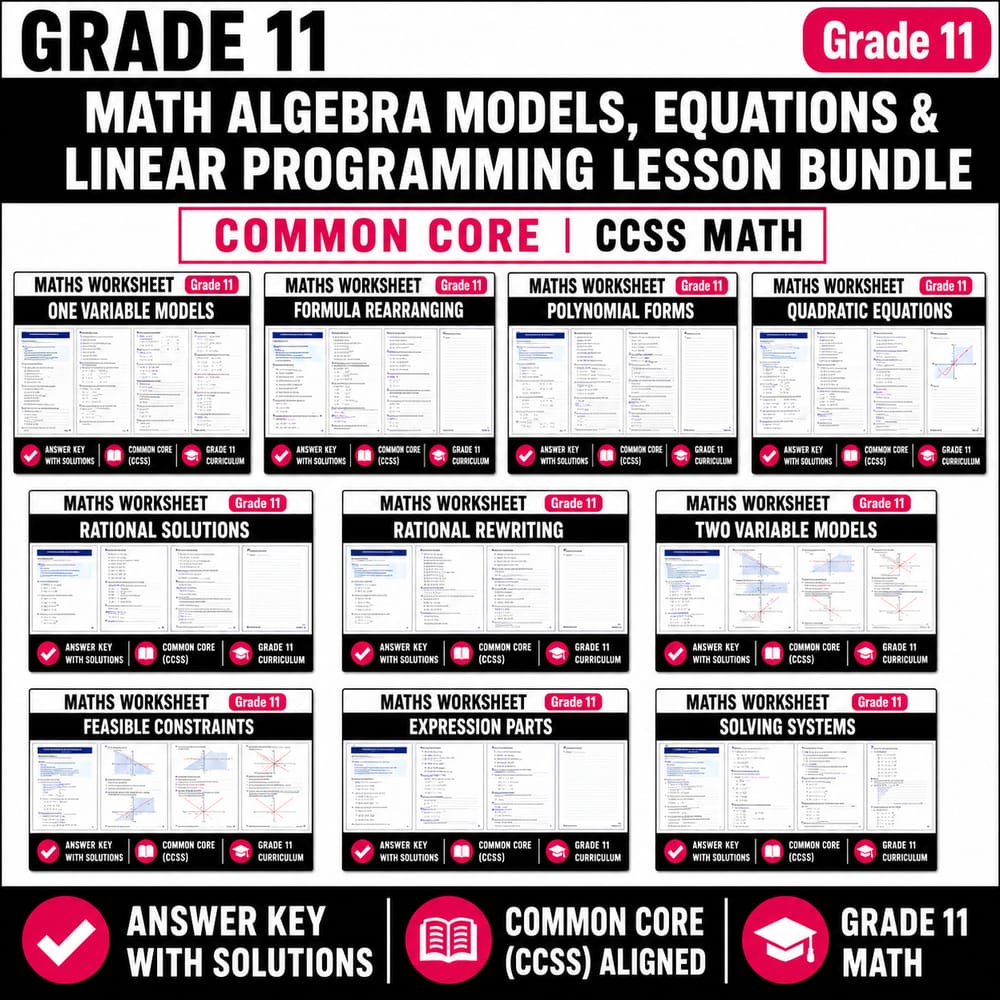
Grade 11 Maths Algebra Models, Equations & Linear Programming Lesson Bundle
$40.00$50.00Save $10.00
BRIGHT PATH RESOURCES
·3 followers·23 sales
SubjectMathsGradeGrade 11Pages115 Pages
What’s included
10 worksheets · 115 pages · Save $10.00 (20%) · prices shown inside the bundle
 Grade 11 One Variable Models Equations & Inequalities Worksheet CCSS
- Solve one-variable equations and interpret the solution in context
- Solve and interpret one-variable inequalities, including checking boundary values
- Translate a real-world scenario into an equation or inequality in one variable
$4.00$5.00 Rearranging Formulas Worksheet Grade 11 Algebra CCSS Math Practice
- Rearrange algebraic formulas to isolate a chosen variable using inverse operations.
- Maintain algebraic equivalence by performing the same operation to both sides of an equation.
- Substitute into rearranged formulas accurately and interpret results using constraints (e.g., non-zero denominators, non-negative roots).
$4.00$5.00 Polynomial Forms Worksheet: Factoring & Completing the Square CCSS
- Convert between equivalent polynomial forms (expanded, factored, and vertex form) for quadratics
- Use factoring to identify zeros and x-intercepts of polynomial functions
- Use completing the square to rewrite quadratics in a form that reveals the vertex and maximum/minimum value
$4.00$5.00 Zeros & Intersections of Quadratic Equations Worksheet | Grade 11
- Solve quadratic equations in one variable by factoring or using algebraic methods
- Connect the zeros of a quadratic to the x-intercepts of its graph
- Use the discriminant to predict the number of real solutions and x-intersections
$4.00$5.00 Rational Solutions Worksheet | Grade 11 Algebra CCSS Practice Pack
- Solve rational equations by clearing denominators and using domain restrictions
- Identify and reject extraneous solutions by checking answers in the original equation
- Write the set of values excluded by denominators and explain why they must be excluded
$4.00$5.00 Rational Rewriting & Domain Restrictions Worksheet | Grade 11 CCSS
- Rewrite rational expressions into equivalent simplified forms by using factoring and canceling common factors.
- Identify excluded values by tracking when original denominators would be zero, even after cancellation.
- Explain why two algebraically similar rational forms may differ in domain and solution validity.
$4.00$5.00 Two Variable Models Worksheet | Grade 11 Math CCSS Assessment
- Use an equation to model a relationship between two variables and interpret what ordered pairs satisfy the equation.
- Connect the form of a function (including absolute value transformations) to key features on its graph, such as the vertex.
- Interpret and describe linear inequalities in two variables using a coordinate-plane model and test points.
$4.00$5.00 Feasible Constraints Worksheet Grade 11 Linear Programming CCSS Math
- Translate real situations into inequalities that describe feasible (allowed) variable values.
- Interpret the meaning of solutions by checking whether candidate points satisfy all constraints at once.
- Use boundary cases (where equality holds) correctly for both strict and inclusive inequalities.
$4.00$5.00 Grade 11 Algebra Expressions Worksheet | Coefficients & Factors CCSS
- Identify the role of coefficients and constant terms in algebraic expressions
- Explain how each part of an expression affects the overall value in context
- Use structure (addition and multiplication in particular) to simplify and interpret expressions
$4.00$5.00 Solving Systems Worksheet | Grade 11 Algebra CCSS Practice & Review
- Solve systems of two linear equations using substitution and elimination.
- Interpret a system’s solution as the intersection point that satisfies both equations at the same time.
- Check whether an ordered pair satisfies both equations in a system.
$4.00$5.00
Reviews & Feedback
Loading reviews...
Questions & Answers
Loading questions…
About this bundle
Related categories
Frequently asked questions
Who is Grade 11 Maths Algebra Models, Equations & Linear Programming Lesson Bundle designed for?
Grade 11 Maths Algebra Models, Equations & Linear Programming Lesson Bundle is designed for Grade 11 students and Maths learners and can be used in classrooms, homeschool, or independent practice.
How do I download Grade 11 Maths Algebra Models, Equations & Linear Programming Lesson Bundle ?
Add it to your cart and complete checkout. After payment, you can download immediately from your account, and you'll also receive a download link by email.
Similar Products

Grade 7 Algebra Bundle: Coding, Modelling, and Linear Equations for Ontario
$56.00$70.00

Grade 6 Equations & Expressions Maths Lesson Bundle (CCSS)
$40.00$50.00

Grade 6 Algebra and Mathematical Modelling Lessons | Ontario Standards
$52.00$65.00

Grade 8 Expressions, Equations & Systems Lesson Bundle | Common Core
$56.00$70.00

Grade 10 Algebra Lesson Bundle | Math CCSS Expressions & Equations
$48.00$60.00