
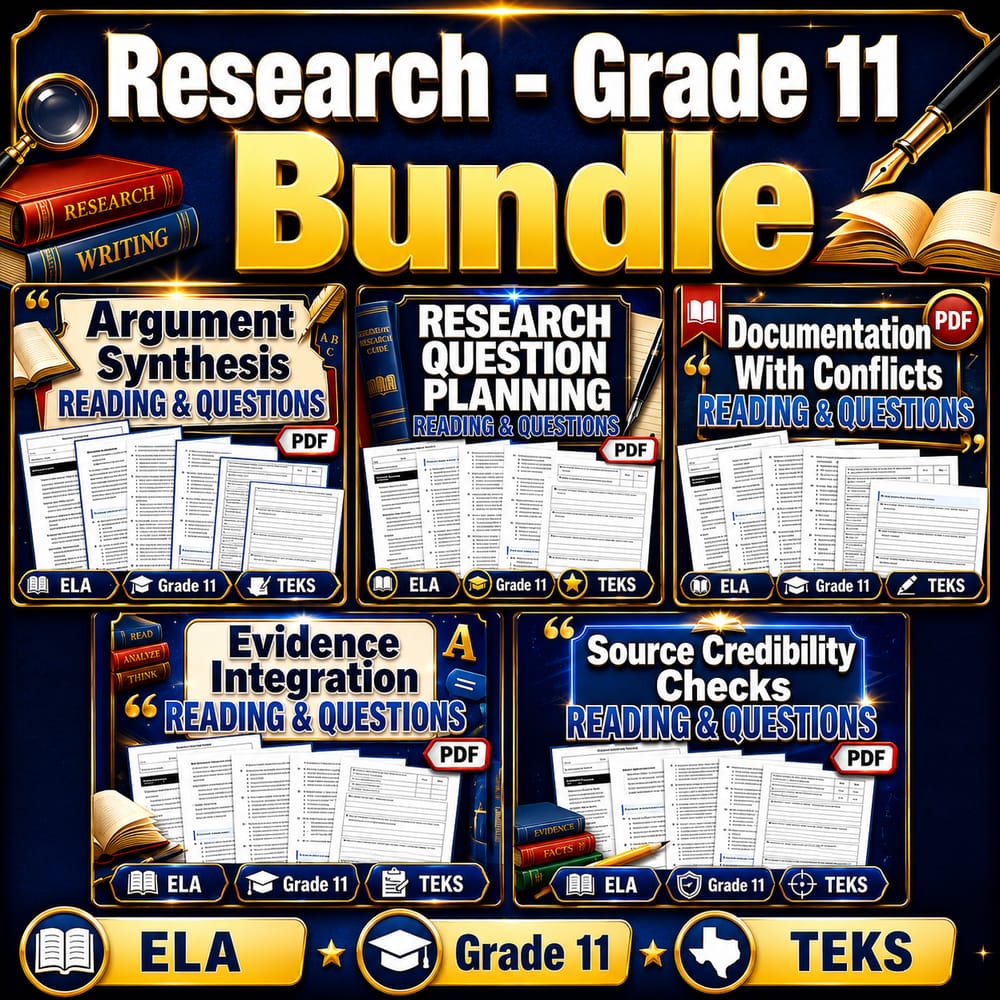
Grade 11 Research Lesson Bundle | TEKS ELA | Evidence & Argument
$16.00$20.00Save $4.00
Golden Apple Studio
New·2 followers·3 sales
SubjectELAGradeGrade 11Pages80 Pages
What’s included
5 worksheets · 80 pages · Save $4.00 (20%) · prices shown inside the bundle
 Argument Synthesis Worksheet Grade 11 ELA TEKS Critical Thinking
- Synthesize multiple research findings to build a coherent, evidence-based argument.
- Explain how specific evidence supports a main claim using clear reasoning and logical sequencing.
- Acknowledge contradictions by refining claims or narrowing reasoning based on source differences.
$3.20$4.00 Research Question Planning Worksheet Grade 11 ELA TEKS Research Skills
- Explain how a focused, arguable research question guides inquiry and narrows scope.
- Identify what counts as credible evidence and how it supports specific claims.
- Select an organizational structure that aligns with supporting claims and boundaries.
$3.20$4.00 Documentation With Conflicts Worksheet Grade 11 ELA TEKS Research Skills
- Apply documentation practices that clearly distinguish quotations from paraphrases and accurately credit sources.
- Explain conflicts between sources using context such as dates, methods, and definitions rather than ignoring contradictions.
- Evaluate whether citations provide verifiable locations and consistent formatting for online and print materials.
$3.20$4.00 Evidence Integration Worksheet Grade 11 ELA TEKS Writing Skills
- Integrate research evidence into writing using summaries, paraphrases, and quotations that directly support claims.
- Explain how evidence clarifies relationships between information and reasoning rather than repeating the text.
- Apply consistent citation practices to attribute sources and prevent plagiarism.
$3.20$4.00 Source Credibility Checks Worksheet Grade 11 ELA TEKS Research Skills
- Evaluate source credibility by analyzing author qualifications, publication context, evidence quality, and timeliness.
- Distinguish fact, evidence, and interpretation by checking how claims are supported (data, methods, references).
- Cross-check information across multiple sources to identify bias, missing context, and unreliable claims.
$3.20$4.00
Reviews & Feedback
Loading reviews...
Questions & Answers
Loading questions…
About this bundle
Related categories
Frequently asked questions
Who is Grade 11 Research Lesson Bundle | TEKS ELA | Evidence & Argument designed for?
Grade 11 Research Lesson Bundle | TEKS ELA | Evidence & Argument is designed for Grade 11 students and ELA learners and can be used in classrooms, homeschool, or independent practice.
How do I download Grade 11 Research Lesson Bundle | TEKS ELA | Evidence & Argument?
Add it to your cart and complete checkout. After payment, you can download immediately from your account, and you'll also receive a download link by email.
Similar Products

Grade 8 Research and Evidence Synthesis ELA Lesson Bundle with Short Notes TEKS
$12.00$15.00

Grade 10 Transitions, Research & Argument Writing Lesson Bundle | CCSS ELA
$21.60$27.00

Text Evidence & Research Writing Lesson Bundle | Grade 5 ELA | Common Core
$32.00$40.00

TEKS Writing & Argument Research Skills Lesson Bundle | Grade 10 ELA | TEKS
$28.80$36.00

Writing & Argument Grade 11 ELA Daily Reading Worksheets Lesson Bundle | TEKS
$38.40$48.00