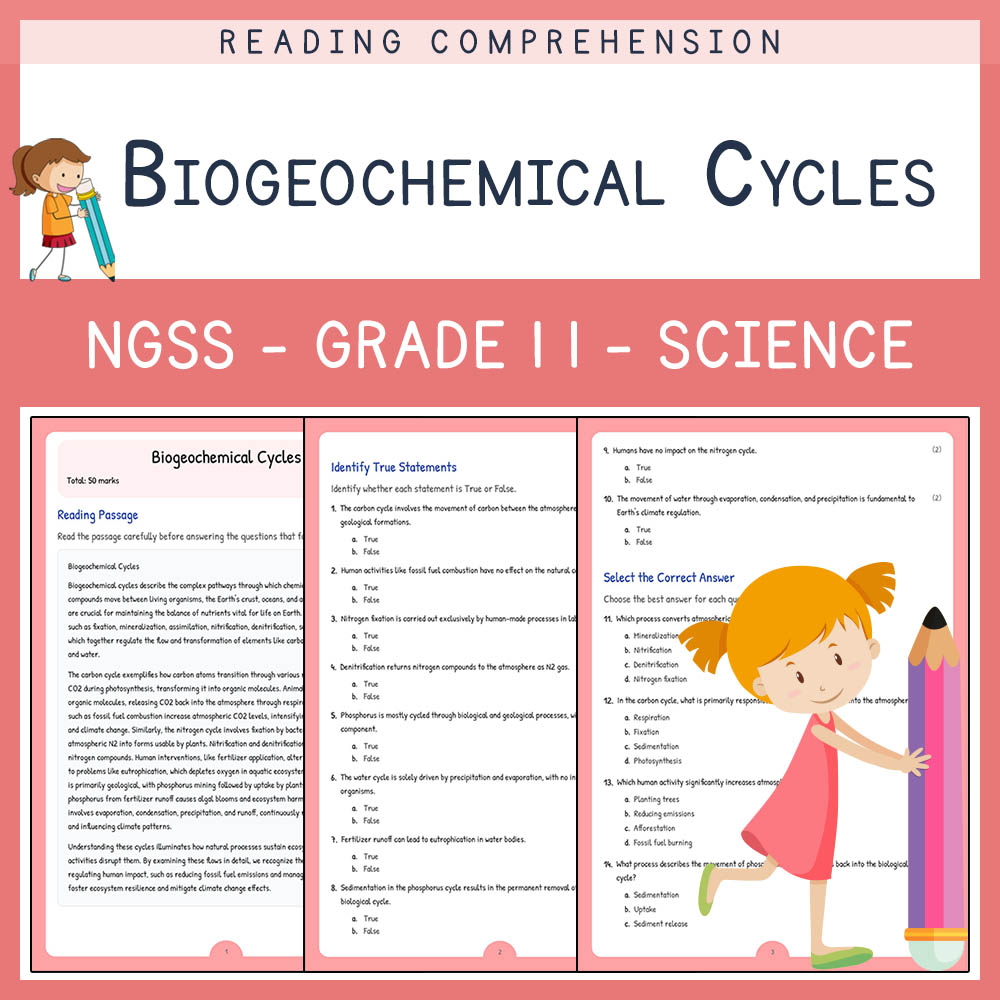
Are your Grade 11 students exploring the intricate pathways of biogeochemical cycles? ✅ This engaging worksheet is designed to deepen understanding of Earth's vital nutrient cycles, aligned with Next Generation Science Standards (NGSS). It offers a comprehensive approach to examining how chemical elements like carbon, nitrogen, and water flow through our ecosystems, helping students connect theoretical concepts to real-world environmental issues.
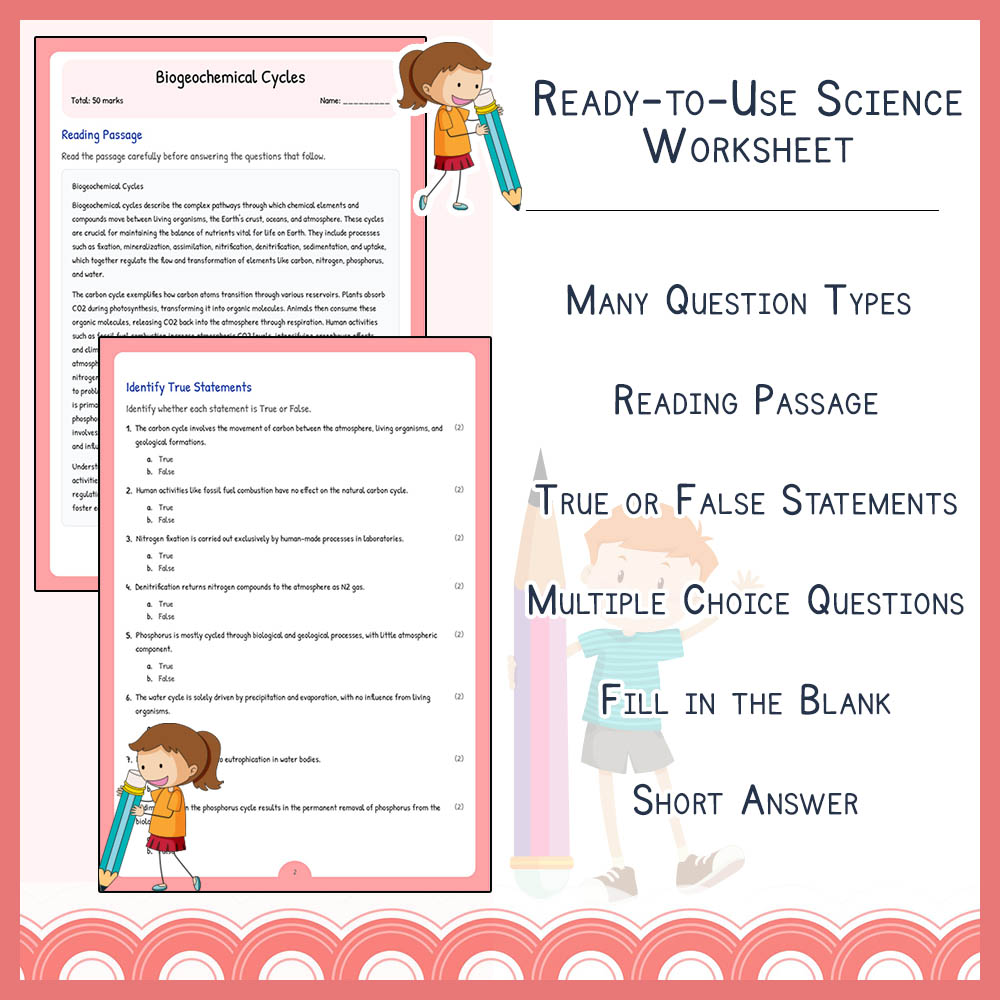
🌿 Designed as a PDF worksheet with an accompanying PDF answer key and rubric, this resource provides a structured, teacher-friendly tool for fostering clarity and mastery in complex scientific processes. Your students will develop critical thinking skills while solidifying their grasp of elemental cycling, climate impacts, and ecological balance. By integrating reading comprehension, true/false analyses, multiple-choice questions, fill-in-the-blank exercises, and short answer prompts, this resource encourages diverse learning styles and supports assessment of both factual knowledge and conceptual understanding.
What's Included
✅ 1 detailed reading passage explaining biogeochemical cycles
✅ 10 true/false questions to evaluate core concepts
✅ 5 multiple choice questions for comprehension and application
✅ 5 fill-in-the-blank sentences to reinforce terminology
✅ 5 short answer questions for critical thinking and synthesis
✅ PDF worksheet and PDF answer key with rubric for easy grading and distribution
Note: This resource is provided as a printable PDF, ideal for classroom use and student homework assignments.
Key Concepts Covered
➡️ Biogeochemical cycles – The complex pathways that chemical elements follow through living organisms and Earth’s environment
➡️ Carbon cycle – The movement of carbon atoms between the atmosphere, biosphere, and geosphere, including processes such as photosynthesis, respiration, and combustion
➡️ Nitrogen cycle – The series of processes transforming nitrogen into usable forms for organisms, including fixation, nitrification, and denitrification
➡️ Water cycle – The continuous movement of water on, above, and below the surface of the Earth, through processes like evaporation, condensation, and precipitation
➡️ Human impacts on nutrient cycles – How activities like burning fossil fuels, deforestation, and pollution alter natural biogeochemical flow and affect climate change.
Question Types / Formats
1. Reading passage understanding and interpretation
2. True/false questions assessing key facts
3. Multiple choice questions testing application and analysis
4. Fill-in-the-blank sentences for vocabulary reinforcement
5. Short answer prompts encouraging critical thinking and explanation
Teacher Benefits
✅ Provides a comprehensive, NGSS-aligned resource for teaching biogeochemical cycles
✅ Facilitates differentiation through varied question formats
✅ Easy to print and distribute in PDF format for seamless classroom integration
✅ Supports formative assessment and student self-evaluation
✅ Enhances student engagement with real-world environmental issues
Student Benefits
✅ Reinforces understanding of complex scientific concepts
✅ Develops critical thinking and analytical skills
✅ Improves scientific vocabulary and terminology
✅ Prepares students for higher-level environmental science courses
✅ Promotes awareness of human impact on Earth’s systems
Perfect For
➡️ Classroom instruction on biogeochemical cycles and ecosystems
✅ Homework and independent practice activities
➡️ Science stations and group work on Earth science topics
✅ Review sessions before assessments
➡️ Science clubs and environmental project preparation
Ready to enhance your Science teaching? Download this dynamic worksheet today and inspire your students to explore Earth's vital nutrient cycles! 🚀