
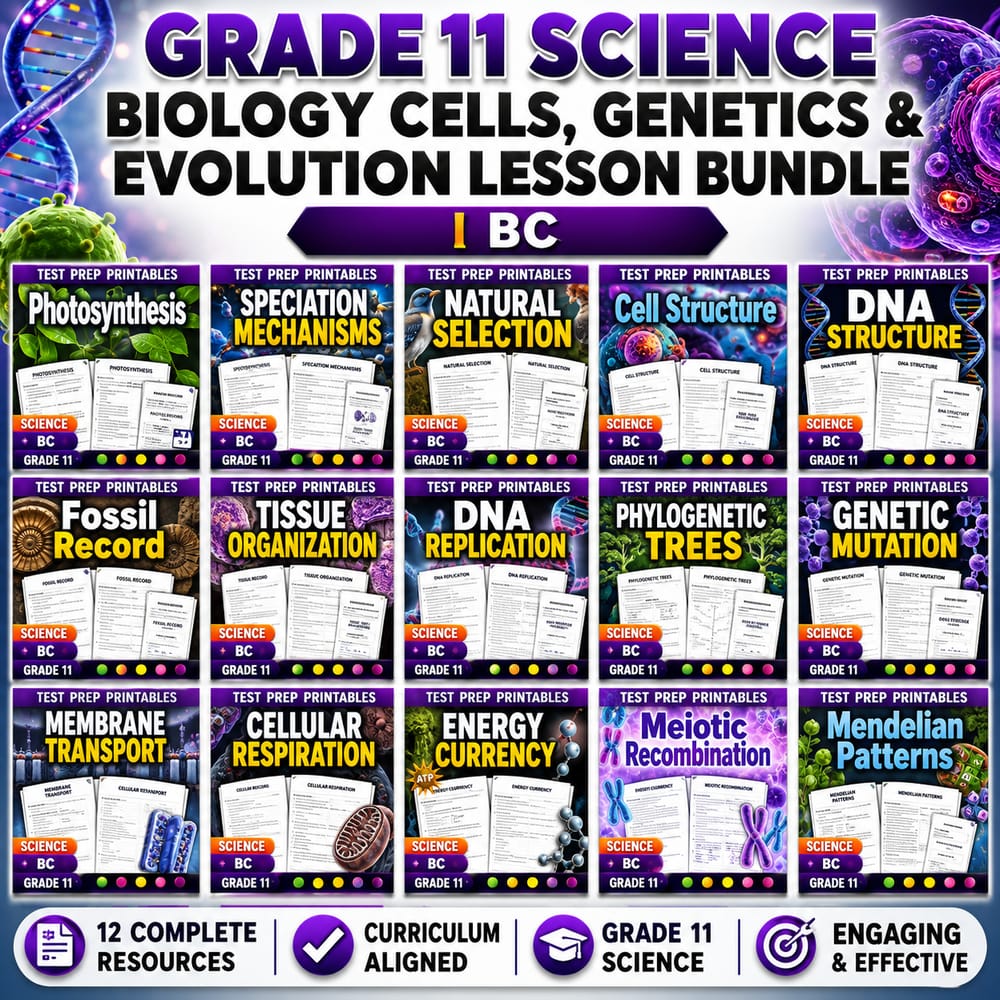


Grade 11 Science Biology Cells, Genetics & Evolution Lesson Bundle | BC
$60.00$75.00Save $15.00
Prism Point Learning
·2 followers·13 sales
SubjectScienceGradeGrade 11
What’s included
15 worksheets · Save $15.00 (20%) · prices shown inside the bundle
 Photosynthesis Worksheet | Grade 11 Science Activities
- Explain how the light-dependent reactions transform light energy into chemical energy (ATP and NADPH).
- Describe how the Calvin cycle uses ATP and NADPH to fix CO2 into carbohydrates.
- Connect electron flow and proton gradients in the thylakoid membranes to energy coupling in photosynthesis.
$4.00$5.00 Speciation Mechanisms Worksheet | Grade 11 Science Activities
- Explain how reproductive isolation can lead to the formation of distinct species through genetic divergence.
- Differentiate allopatric and sympatric speciation and describe key drivers such as ecological divergence and polyploidy.
- Identify prezygotic and postzygotic barriers and predict how they reduce interbreeding.
$4.00$5.00 Natural Selection Worksheet | Grade 11 Science Activities
- Explain how natural selection acts on heritable variation to change allele frequencies over generations.
- Distinguish directional, stabilizing, and disruptive selection using real environmental scenarios.
- Describe how environmental pressures (e.g., predation and resource availability) shape selective regimes.
$4.00$5.00 Cell Structure Worksheet | Grade 11 Science Practice
- Describe major cell structures and explain what they do in eukaryotic cells.
- Compare prokaryotic and eukaryotic cells in terms of internal organization and compartmentalization.
- Interpret simple microscopy and schematic models to reason about relative organelle placement and function.
$4.00$5.00 DNA Structure Worksheet | Grade 11 Science Practice
- Describe the major structural parts of DNA, including nucleotide monomers, the sugar-phosphate backbone, and antiparallel strands.
- Explain complementary base pairing (A–T and G–C) and how base sequence information is stored in DNA.
- Connect DNA structure to how replication and mutations (substitutions, insertions, deletions) can change genetic information.
$4.00$5.00 Fossil Record Worksheet | Grade 11 Science Activities
- Explain how the stratigraphic distribution of fossils helps establish relative time sequences in Earth history
- Describe how radiometric dating and taphonomic context support fossil-based timelines
- Use fossil evidence, including transitional fossils, to evaluate evolutionary hypotheses
$4.00$5.00 Tissue Organization Worksheet Practice | Grade 11 Science BC Standards
- Explain how specialized cells form tissues, and how tissues work together to support organ-level function
- Describe how cell differentiation produces unique structures that affect transport, support, or signaling
- Use models of tissue architecture and intercellular communication to predict how tissue organization supports whole-organism physiology
$4.00$5.00 DNA Replication Worksheet | Grade 11 Science Practice
- Explain how semi-conservative DNA replication produces two DNA molecules using complementary base pairing
- Describe the roles of helicase, DNA polymerase, ligase, Okazaki fragments, and proofreading/repair in maintaining sequence integrity
- Distinguish leading-strand and lagging-strand synthesis and connect errors to genetic variation
$4.00$5.00 Phylogenetic Trees Worksheet | Grade 11 Science Practice and Review
- Explain what phylogenetic trees represent and how shared characters and genetic similarity support evolutionary relationships.
- Compare how parsimony, maximum likelihood, and molecular clock methods are used to infer tree topology and divergence times.
- Distinguish homology from analogy and interpret how clades and branching patterns relate to speciation.
$4.00$5.00 Genetic Mutation Worksheet | Grade 11 Science Activities
- Describe the major types of genetic mutations and how they change DNA sequence or chromosome structure
- Explain common sources of mutations, including replication errors, spontaneous chemical changes, and environmental mutagens
- Predict how mutations can affect gene function through coding regions or regulatory elements
$4.00$5.00
Reviews & Feedback
Loading reviews...
Questions & Answers
Loading questions…
About this bundle
Related categories
Frequently asked questions
Who is Grade 11 Science Biology Cells, Genetics & Evolution Lesson Bundle | BC designed for?
Grade 11 Science Biology Cells, Genetics & Evolution Lesson Bundle | BC is designed for Grade 11 students and Science learners and can be used in classrooms, homeschool, or independent practice.
How do I download Grade 11 Science Biology Cells, Genetics & Evolution Lesson Bundle | BC?
Add it to your cart and complete checkout. After payment, you can download immediately from your account, and you'll also receive a download link by email.
Similar Products

Grade 12 Science Genetics & Evolution Worksheets Lesson Bundle
$19.20$24.00

Grade 10 Science Worksheet Bundle | Genetics, Cell Biology & Ecosystems (TEKS Aligned)
$126.00$180.00

Grade 10 Science Worksheet Bundle – Genetics, Cell Biology & Ecology (PDF)
$84.00$120.00

Grade 10 Science UNIT Worksheet Bundle – Genetics, Ecosystems & Cell Biology
$17.60$22.00

Grade 9 Science Unit Bundle | Genetics, Cell Biology & Biotechnology Worksheets
$36.00$45.00