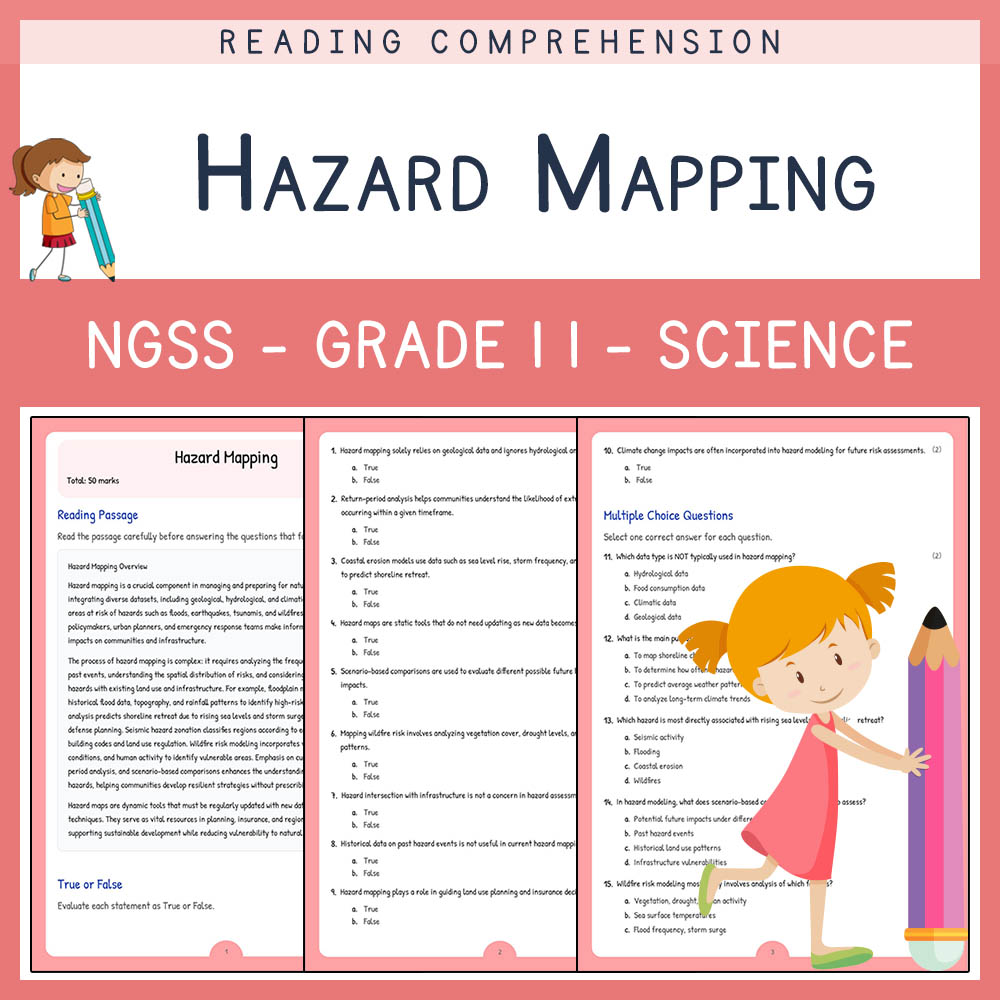
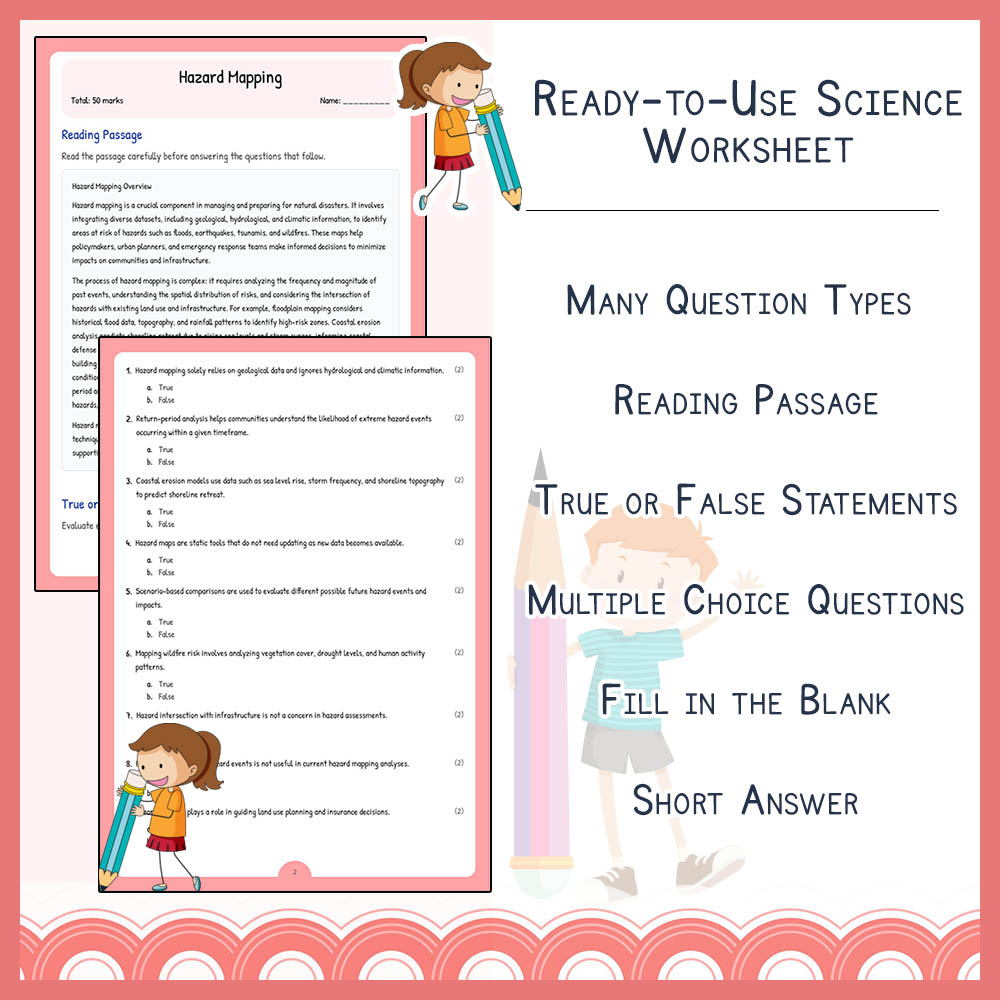
Are your Grade 11 students exploring the critical topic of hazard mapping and disaster preparedness? This engaging worksheet set offers a comprehensive exploration of hazard assessment techniques essential for understanding natural disaster management, all aligned with the Next Generation Science Standards (NGSS). Designed to deepen students’ grasp of hazard analysis, these worksheets support your efforts to foster scientific inquiry and critical thinking skills in your classroom.
🌿 What's Included
✅ A detailed reading passage explaining the significance of hazard mapping and its role in disaster risk reduction
✅ 10 true/false questions to assess comprehension of hazard data types, analysis techniques, and concepts
✅ 5 multiple choice questions focusing on hazard data sources, analysis methods, and application of hazard maps
✅ 5 fill-in-the-blank exercises emphasizing key terminology like risk assessment and return-period analysis
✅ 5 short-answer questions encouraging students to articulate the importance of integrating multiple data sources and how return-periods inform hazard preparedness
✅ PDF worksheet and PDF answer key with rubrics for easy grading and student review
(Note: No digital or editable formats are included; all resources come as printable PDFs.)
Key Concepts Covered
➡️ Hazard mapping – Understanding how hazard maps are created and their role in disaster preparedness
➡️ Data integration – Combining geological, hydrological, and climatic data for accurate hazard assessment
➡️ Return-period analysis – Analyzing the frequency of hazardous events to improve risk management
➡️ Risk assessment – Evaluating potential hazards for community safety and resilience
➡️ Disaster resilience planning – Using hazard data to develop effective mitigation strategies
Question Types / Formats
1. Reading passage comprehension – Students analyze a passage explaining hazard mapping principles
2. True or False questions – Assess understanding of hazard data reliance and analysis concepts
3. Multiple choice questions – Focused on data types, analysis methods, and application scenarios
4. Fill in the blank exercises – Reinforcing key terminology and concepts
5. Short answer questions – Encouraging critical thinking about data integration and analysis techniques
Teacher Benefits
✅ The easy-to-print PDF worksheets streamline lesson planning and classroom instruction
✅ The answer key with rubrics simplifies grading and provides clear assessment standards
✅ Supports NGSS alignment through emphasis on scientific practices and crosscutting concepts
✅ Promotes student engagement and comprehension through varied question formats
✅ A versatile resource suitable for homework, in-class activities, and review sessions
Student Benefits
✅ Develops critical thinking by analyzing complex hazard data
✅ Deepens understanding of natural disaster assessment and mitigation techniques
✅ Enriches vocabulary related to disaster risk reduction and hazard analysis
✅ Enhances skills in data interpretation, analysis, and scientific communication
✅ Prepares students for further studies and careers in environmental science and disaster management
Perfect For
➡️ Classroom instruction and structured lessons focused on hazard analysis
✅ Homework assignments reinforcing in-class concepts
➡️ Science club or disaster preparedness program activities
✅ Emergency management and community resilience planning simulations
➡️ Pre-assessment or review for NGSS-based science standards
Ready to enhance your Science teaching? Download this dynamic worksheet today and inspire your students to excel in disaster science and hazard assessment mastery! 🚀